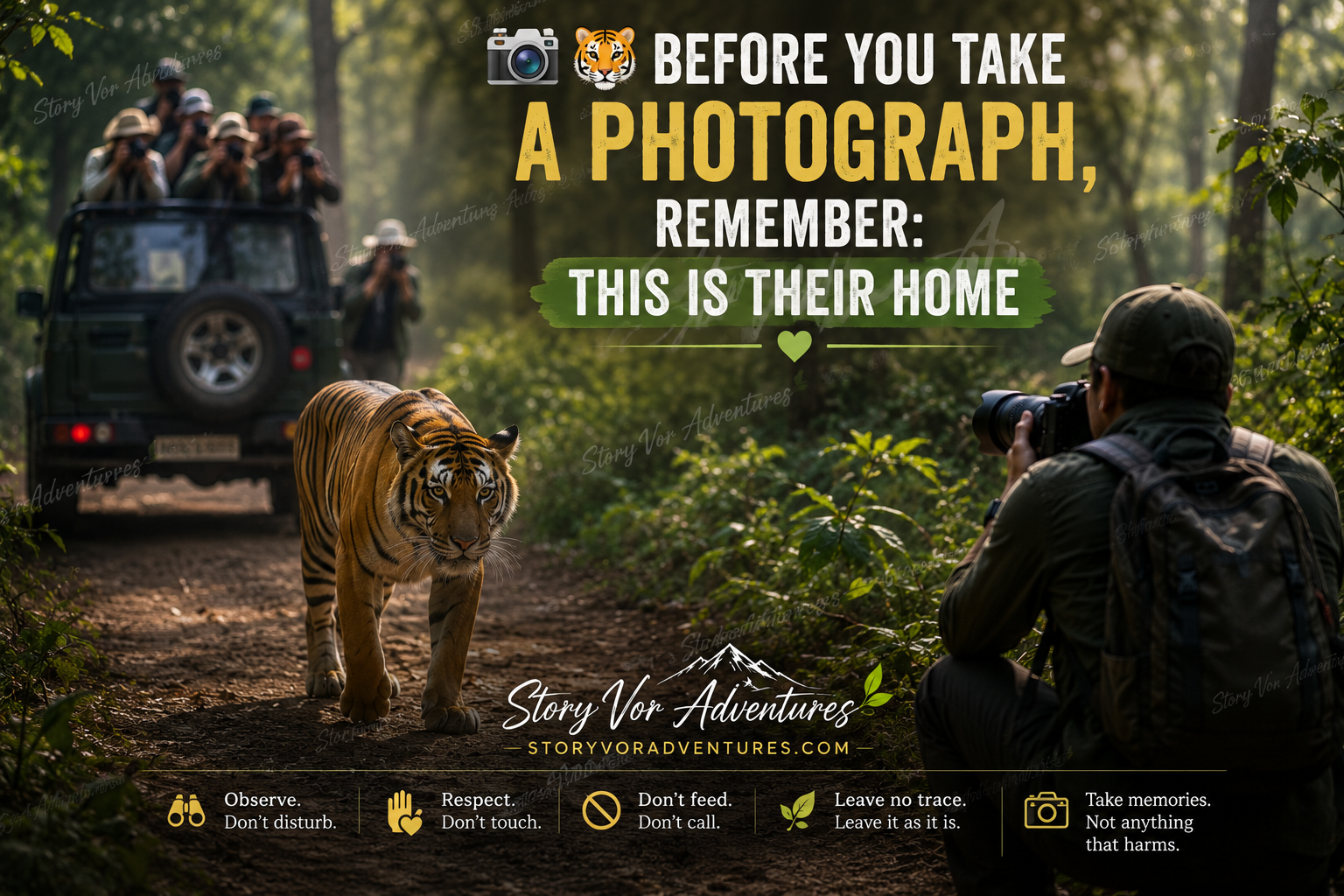
📸🐅 Before You Take a Photograph, Remember: This Is Their Home
Discover why responsible wildlife photography matters. Learn how travellers can protect animals, respect habitats and capture nature without disturbing it.
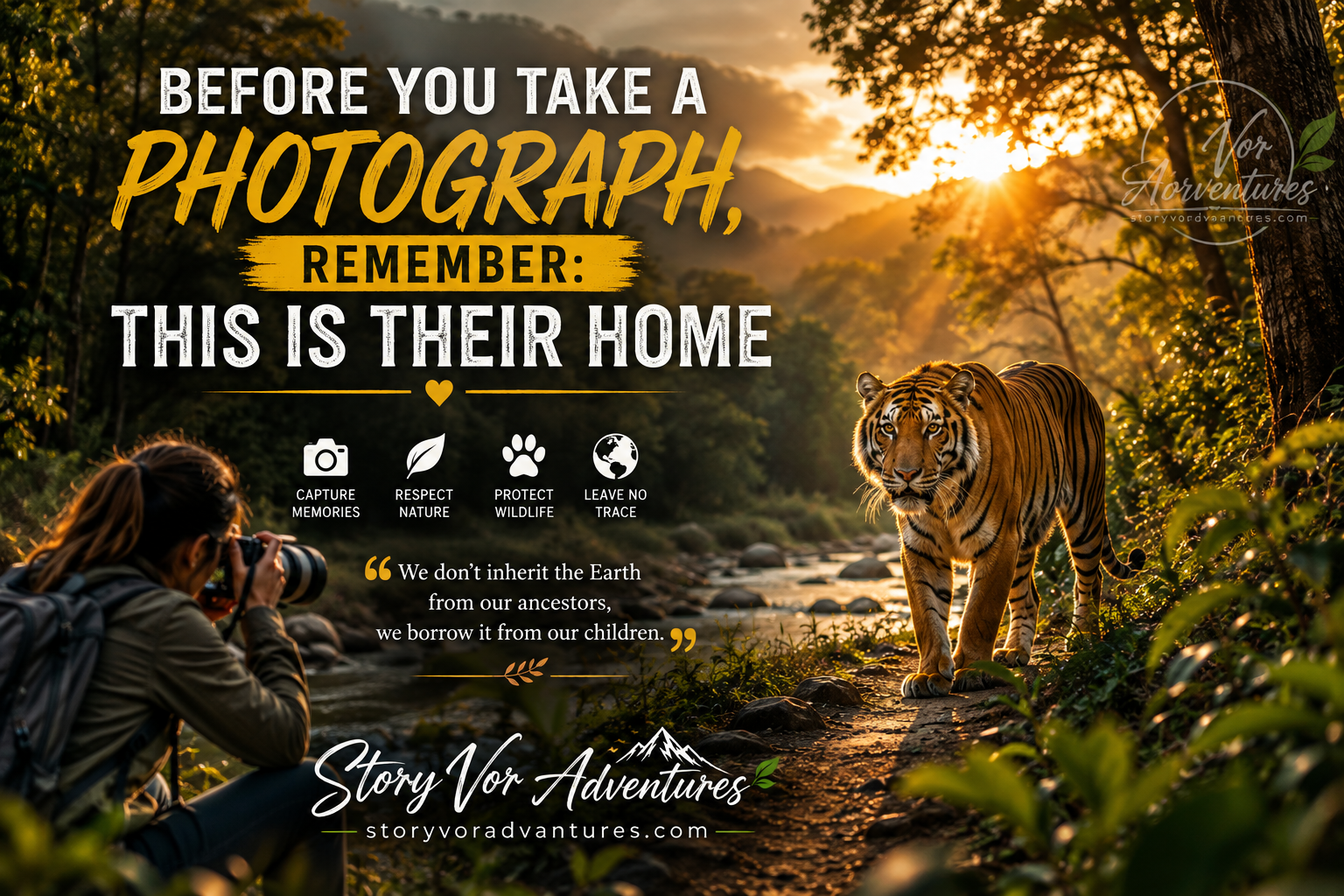
There is something magical about seeing a wild animal for the first time.
A tiger walking silently through tall grass.
An elephant standing beside her calf.
A deer appearing between the trees.
A bird feeding its chicks in a tiny nest.
A sea turtle slowly returning to the ocean.
For us, these moments may last only a few seconds.
We reach for our cameras.
We zoom in.
We try to capture the perfect photograph.
And when we return home, that photograph may become one of our favourite memories.
But there is something important we often forget.
For us, it is a photograph.
For them, it is their life.
The forest is not a photography studio.
The mountain is not a backdrop.
The river is not a tourist attraction.
The ocean is not an aquarium.
This is their home.
And when we enter it, we are visitors.
🌳 We Enter Their World — They Don’t Enter Ours
Imagine waking up one morning and discovering strangers standing outside your bedroom.
They are talking loudly.
Taking photographs.
Moving closer because they want a better angle.
Somebody switches on a bright light.
Another person tries to make you move because your position isn’t good enough for their photograph.
You would probably feel frightened, uncomfortable or angry.
Yet wild animals can experience disturbance too.
When we enter forests, oceans, mountains and other natural habitats, we are stepping into places where animals eat, sleep, hide, raise their young and survive.
That quiet patch of grass may be where a deer rests.
That tree may contain a nest.
That riverbank may be an animal’s regular drinking place.
That cave may be shelter.
That apparently empty stretch of forest may be somebody’s territory.
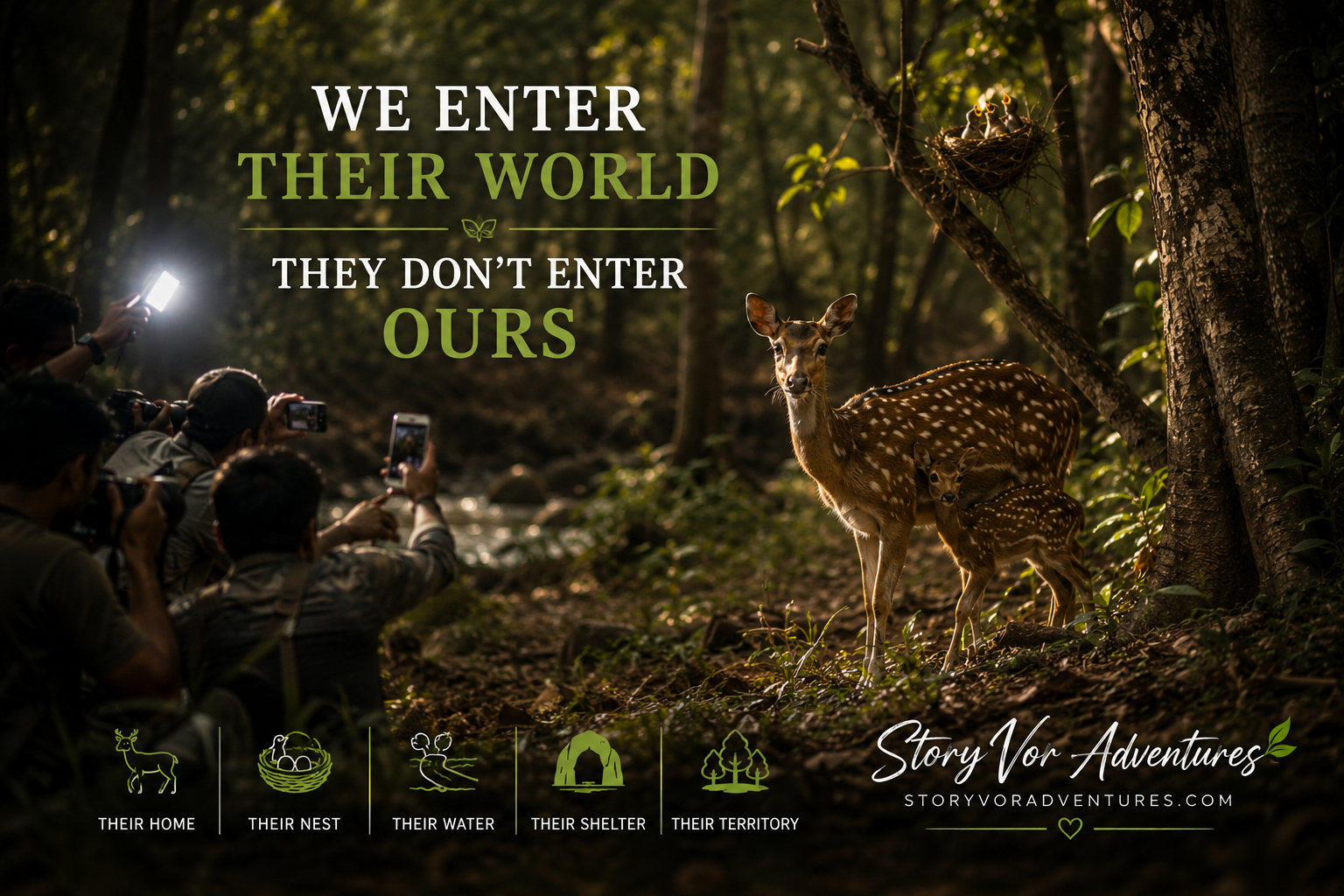
Nature may be our destination, but it is their address.
📸 The Perfect Photograph Is Never Worth an Animal’s Fear
Wildlife photography can be beautiful.
A single photograph can make millions of people appreciate an animal they may never see in person.
Images can inspire conservation.
They can tell stories.
They can remind us how extraordinary our planet really is.
But no photograph becomes more valuable because an animal suffered for it.
If getting the photograph requires chasing an animal, surrounding it, frightening it, blocking its path or moving dangerously close—
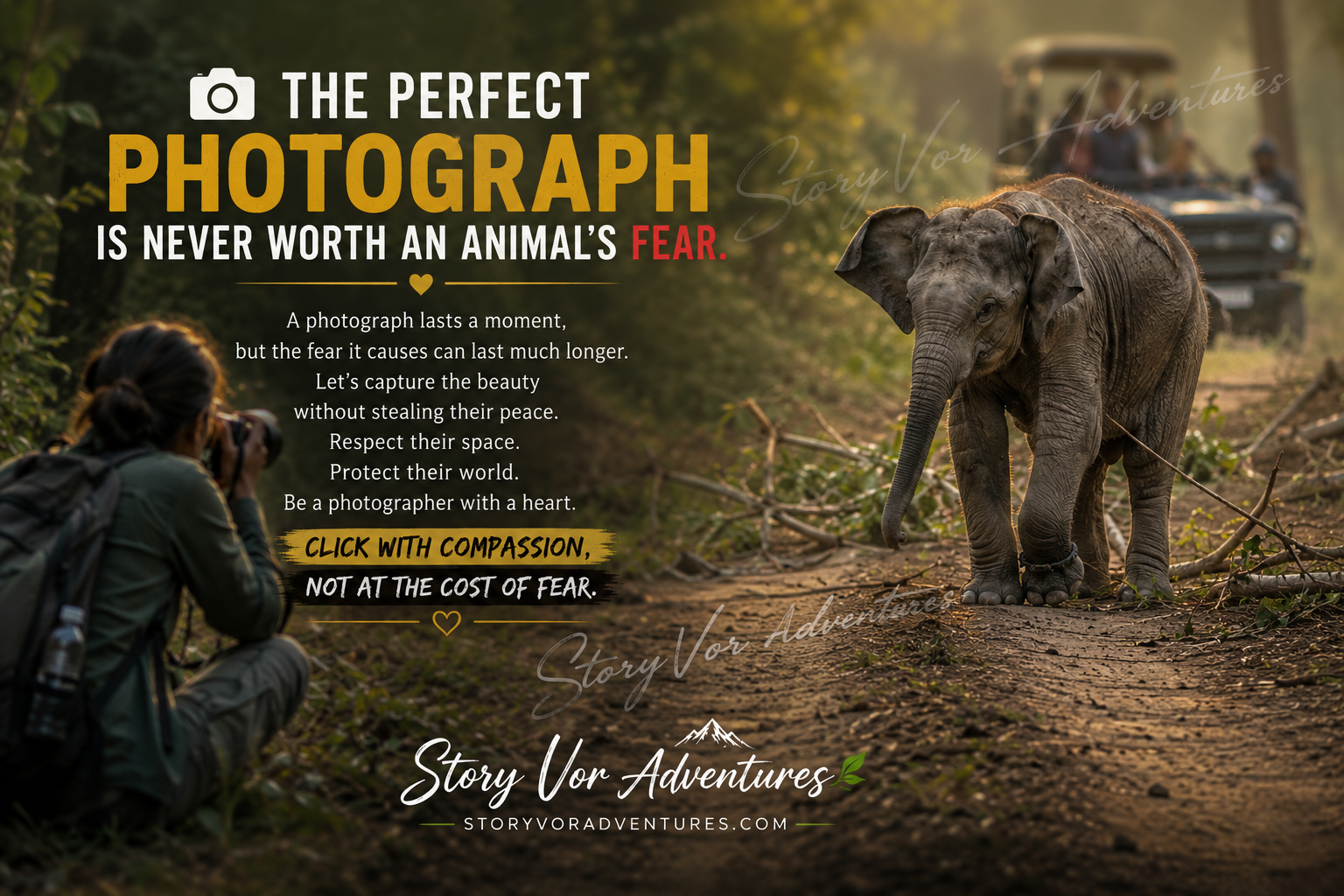
the photograph is already too expensive.
The price was paid by the animal.
A truly beautiful wildlife photograph should capture nature without forcing nature to perform.
Sometimes the most respectful thing a photographer can do is lower the camera and simply watch.
Because not every beautiful moment needs to belong to our photo gallery.
Some moments are allowed to remain with nature.
🐅 A Tiger Doesn’t Know You Only Want a Photograph
Imagine seeing a tiger in the wild.
Your heart starts beating faster.
You have dreamed about this moment.
Your camera comes out immediately.
But the tiger doesn’t know your intentions.
It doesn’t know that you travelled hundreds of kilometres just to see it.
It doesn’t understand social media.
It doesn’t know that you want only one beautiful photograph.
From its perspective, humans, vehicles, noises and sudden movements are simply things appearing inside its environment.
The same is true for countless wild animals.
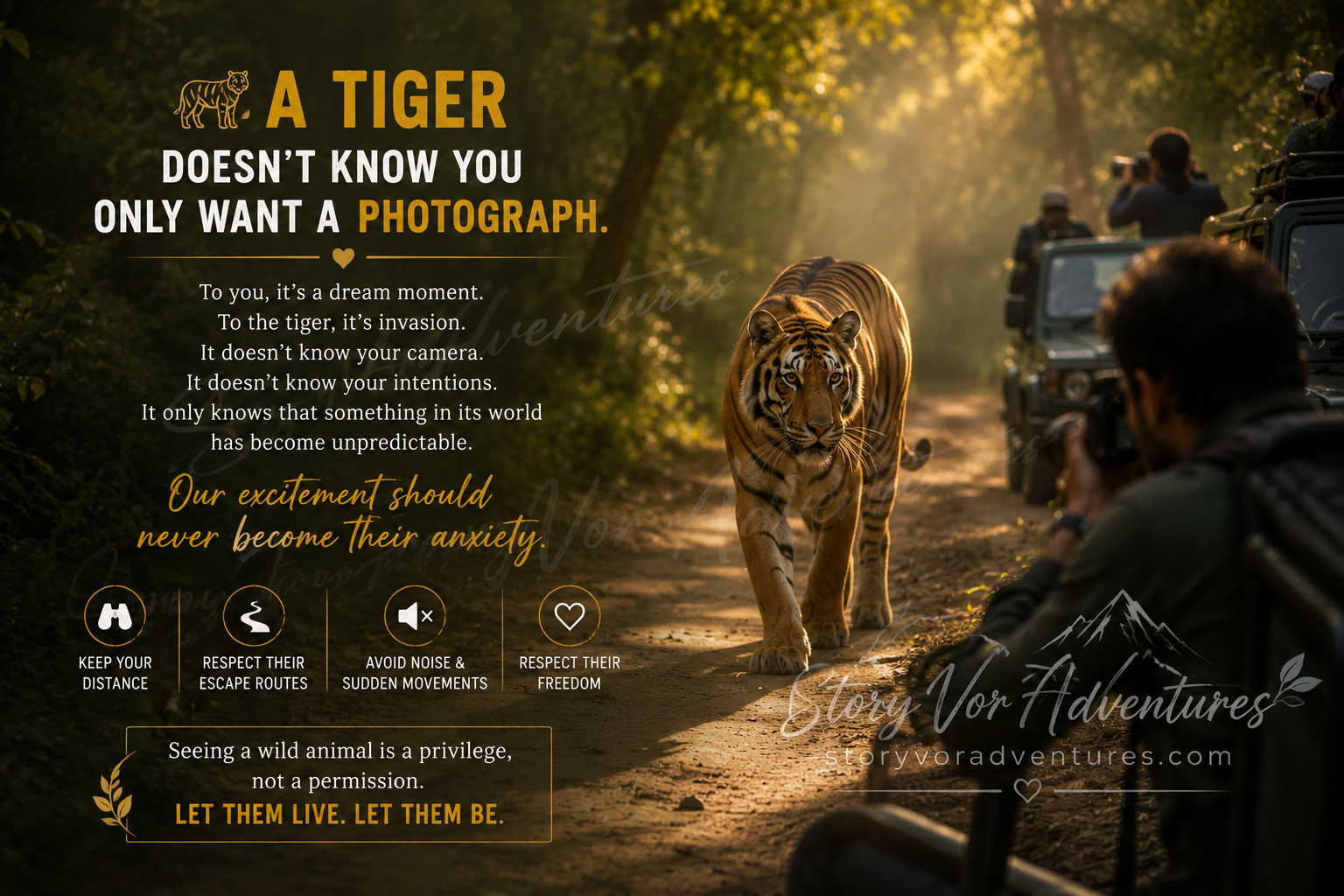
Our excitement should never become their anxiety.
Wildlife deserves distance.
It deserves escape routes.
It deserves the freedom to walk away from us.
Seeing a wild animal is a privilege.
It is never permission to interfere with its life.
🐘 A Mother Protecting Her Baby Isn’t Being Aggressive
Few things in nature are more beautiful than seeing a mother animal with her young.
An elephant walking beside her calf.
A monkey holding her baby.
A deer watching over a fawn.
A bird protecting a nest.
These scenes naturally attract our attention.
But this is also when animals may be especially vulnerable and protective.
A mother doesn’t understand that someone simply wants a cute photograph of her baby.
She understands something much more basic:
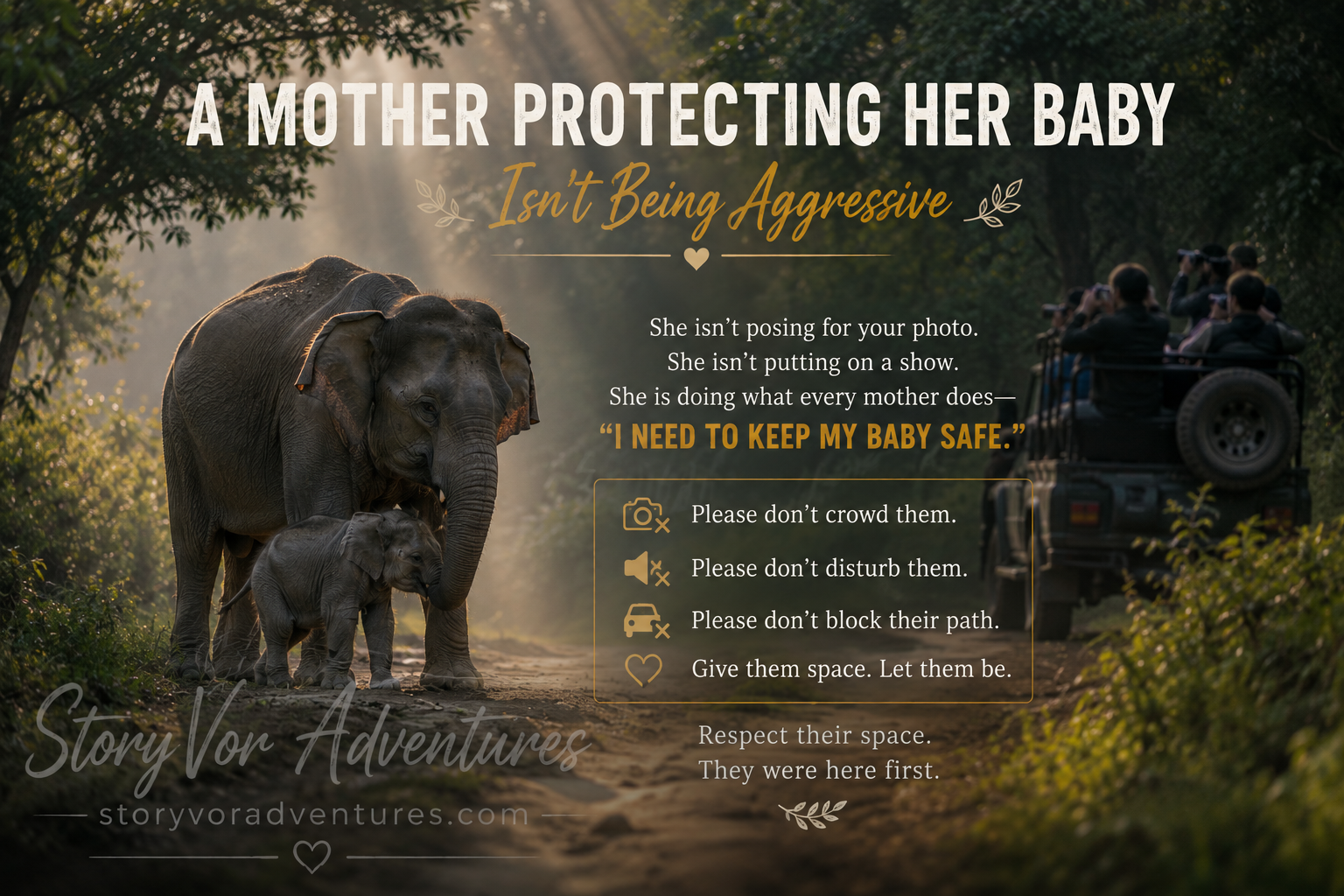
“I need to keep my baby safe.”
If she becomes defensive because people move too close, she is not ruining our wildlife experience.
We have entered hers.
Give mothers and young animals additional space.
A photograph taken from farther away can still be beautiful.
More importantly, the family can continue its day without being forced to respond to us.
🐦 That Tiny Nest Is Someone’s Entire World
A bird’s nest may look small to us.
A few twigs.
Some grass.
A handful of leaves.
Perhaps two tiny eggs inside.
But to the bird that built it, that little nest represents enormous effort.
It may contain the next generation of its family.
Moving branches for a clearer photograph, touching the nest or repeatedly approaching it can create unnecessary disturbance.
The same principle applies throughout nature.
A burrow is not just a hole.
A hollow tree isn’t just an interesting photograph.
A coral reef isn’t decoration.
A wetland isn’t wasted land.
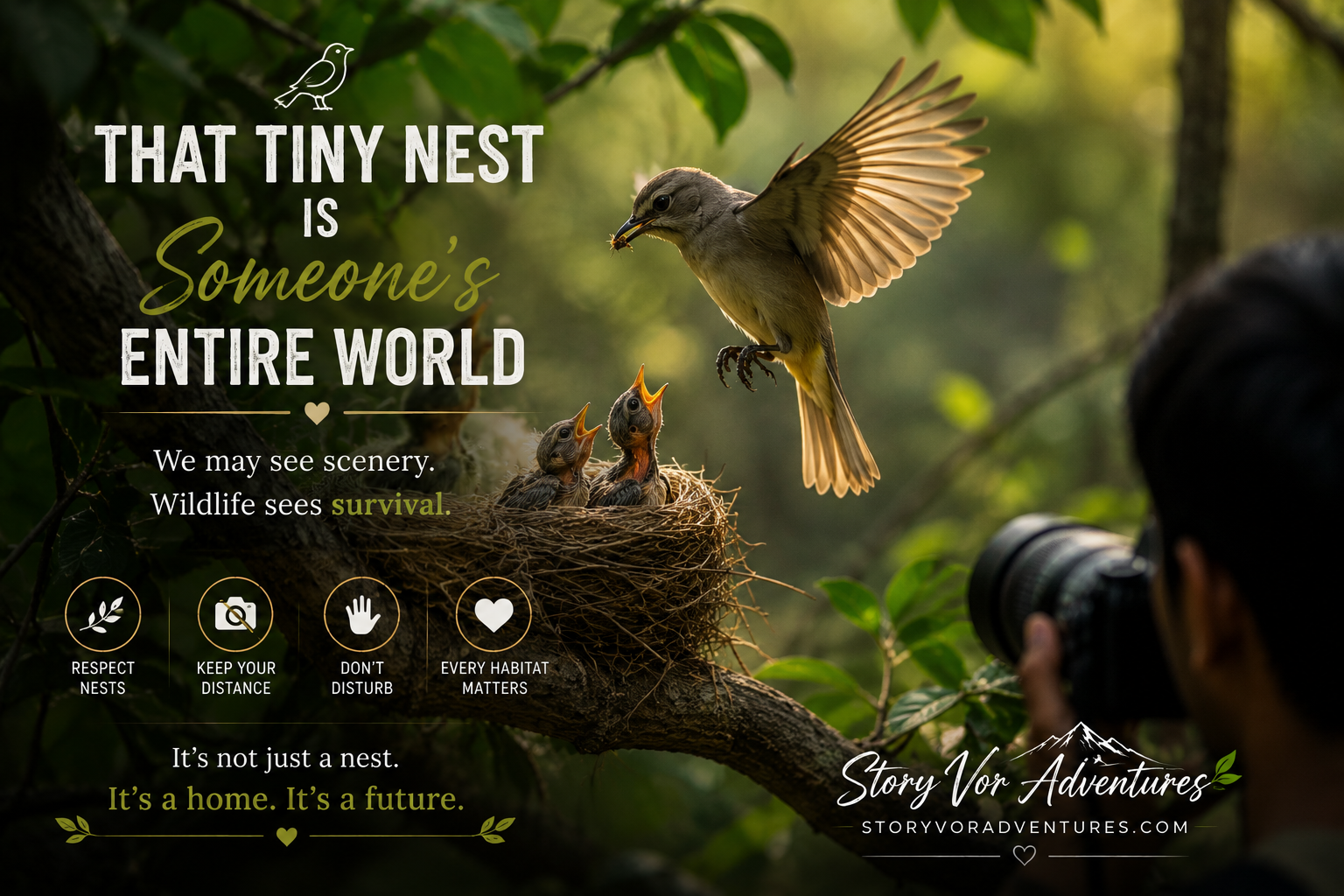
Every habitat means something to the creature that depends on it.
We may see scenery.
Wildlife sees survival.
🦌 Don’t Make Animals Perform for Social Media
Social media has changed the way we travel.
Beautiful wildlife photographs can inspire people to care about nature.
But the search for extraordinary content can also create unhealthy pressure.
Closer.
More dramatic.
More unusual.
Something nobody else has photographed.
Something that will make people stop scrolling.
But wildlife doesn’t exist to create content for us.
An animal shouldn’t have to become frightened so that a video becomes exciting.
It shouldn’t be touched simply because somebody wants a selfie.
It shouldn’t be fed so that it moves closer to the camera.
It shouldn’t be surrounded because several people want the same photograph.
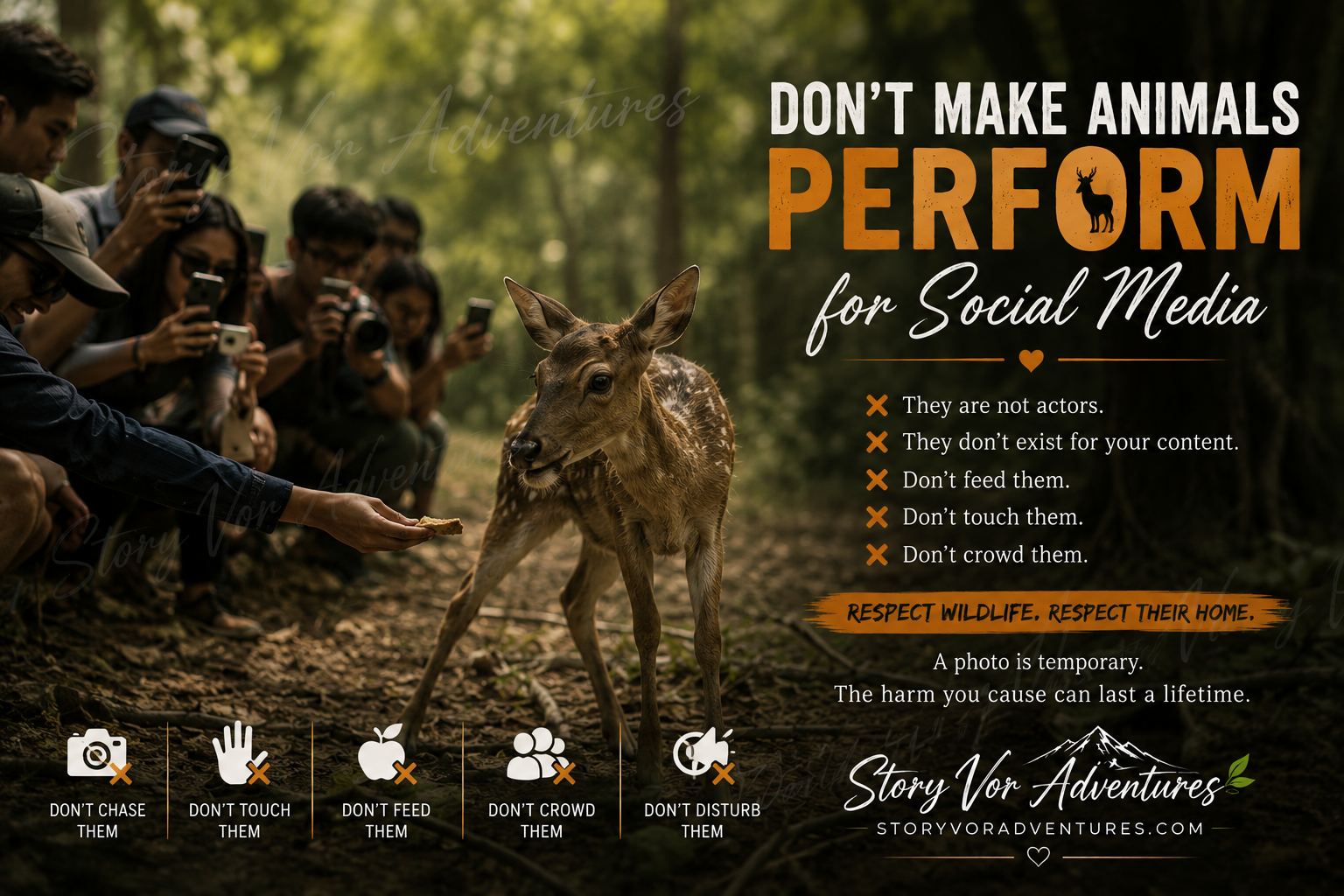
If a photograph needs an animal to lose its comfort, the photograph isn’t worth taking.
Likes disappear.
Trends disappear.
Posts disappear from people’s feeds within hours.
But the consequences of disturbing wildlife can last much longer.
🍎 Feeding Wildlife Is Not Always Kindness
Giving food to an animal can feel compassionate.
The animal looks hungry.
It approaches.
We have something available.
So feeding it feels like helping.
But good intentions do not always create good outcomes.
Wild animals need to remain wild.
When animals begin associating humans with food, their natural behaviour can change.
They may approach roads, vehicles, campsites or settlements more frequently.
They may become dependent on food that isn’t part of their natural diet.
They may lose their natural caution around people.
And eventually, the animal that once approached tourists innocently can find itself in dangerous situations.
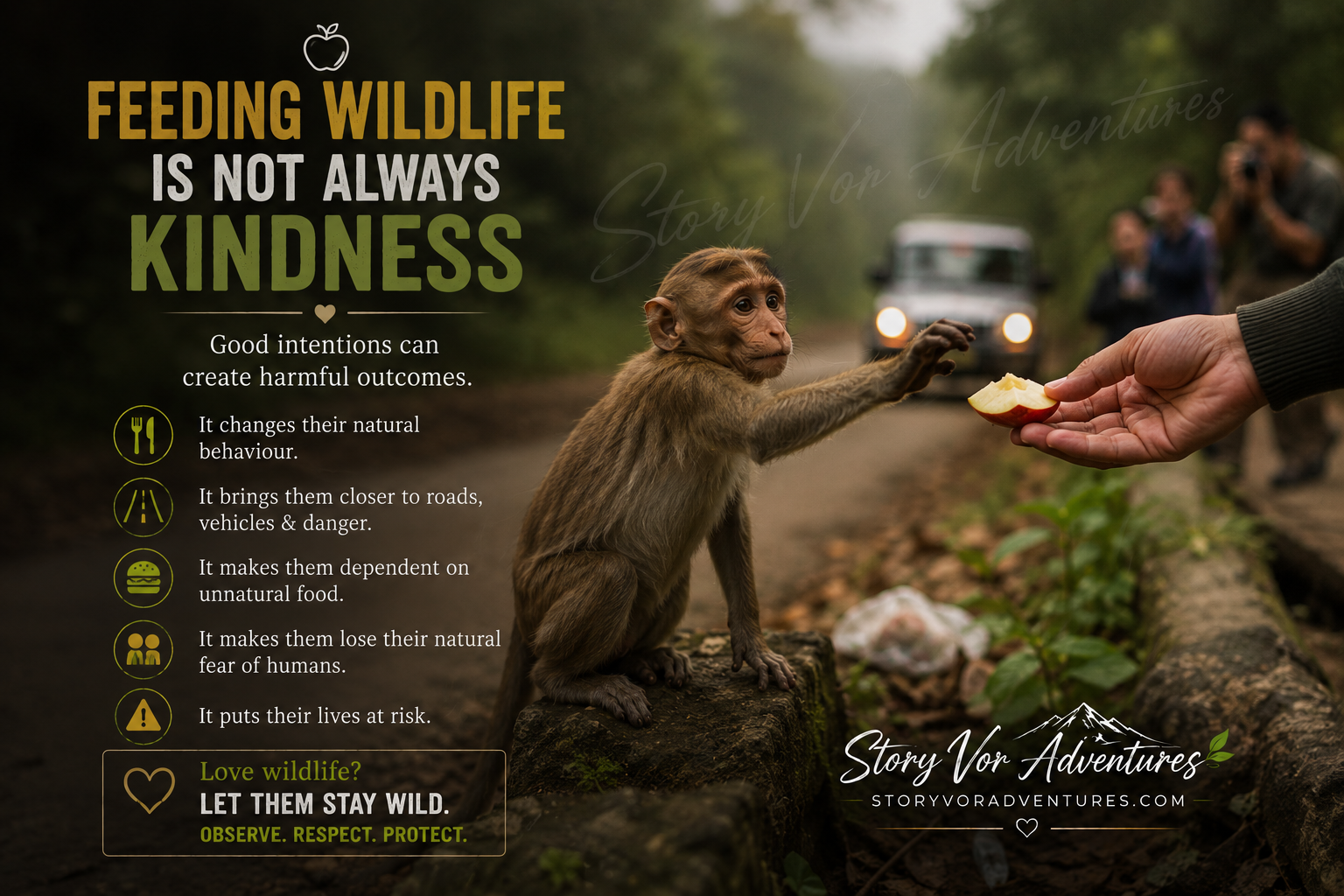
Sometimes loving wildlife means resisting the desire to interact with it.
Observe.
Appreciate.
Photograph responsibly.
Then allow the animal to continue living as nature intended.
🚙 A Wildlife Safari Is Not a Race
There is a special excitement when somebody says:
“Tiger!”
or
“Leopard!”
Suddenly cameras appear.
People become excited.
Vehicles may begin moving toward the sighting.
Everyone wants a clear view.
Everyone wants the photograph.
But imagine the scene from the animal’s perspective.
It may simply be trying to cross a path.
Reach water.
Return to its young.
Rest.
Or move through territory it has used long before tourism existed there.
A responsible wildlife experience should never become a race to surround an animal.
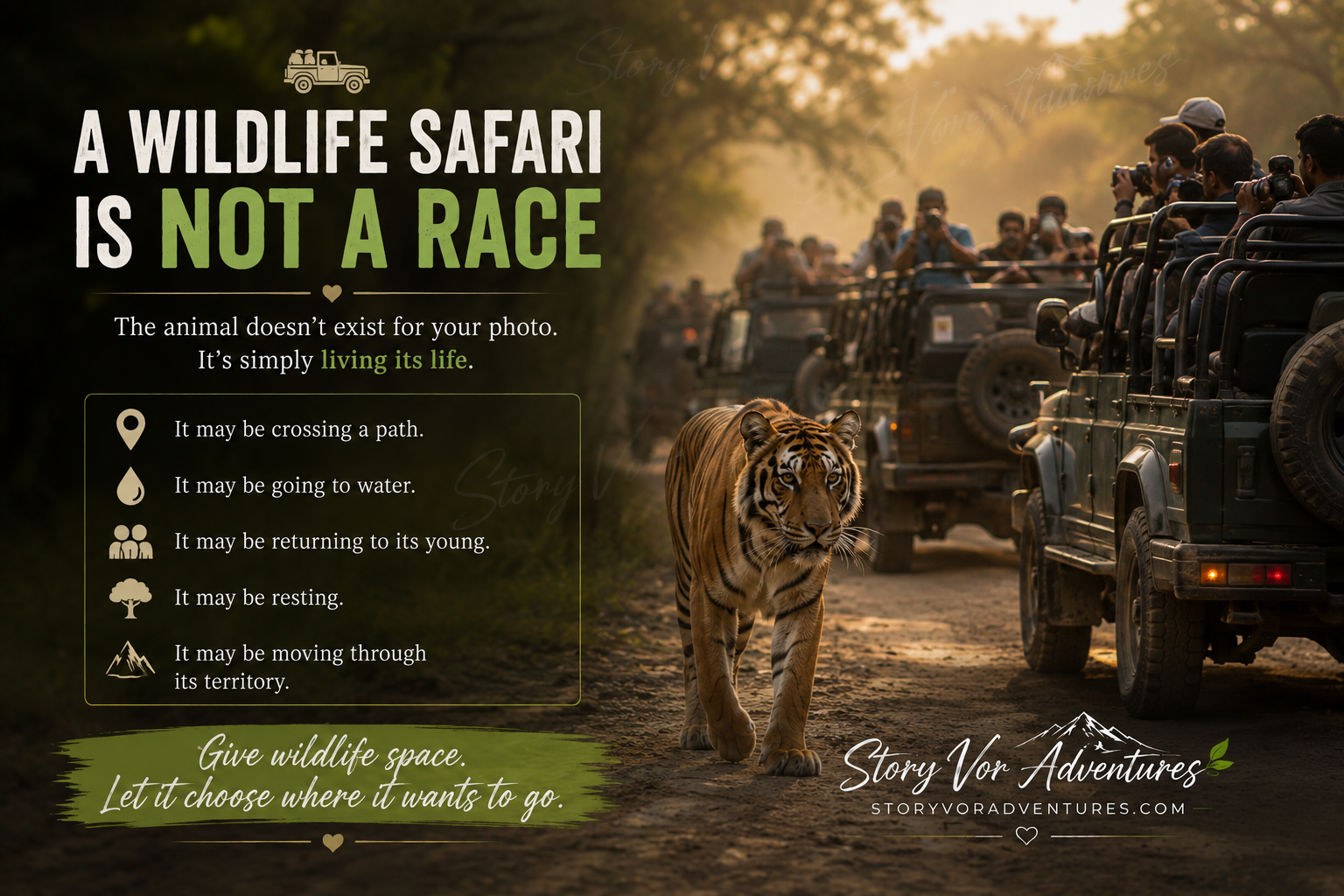
Give wildlife space to choose where it wants to go.
The best encounter isn’t necessarily the closest one.
It is the one where the animal was allowed to behave naturally.
🌊 The Same Respect Belongs Beneath the Water
Responsible wildlife tourism doesn’t end at the forest boundary.
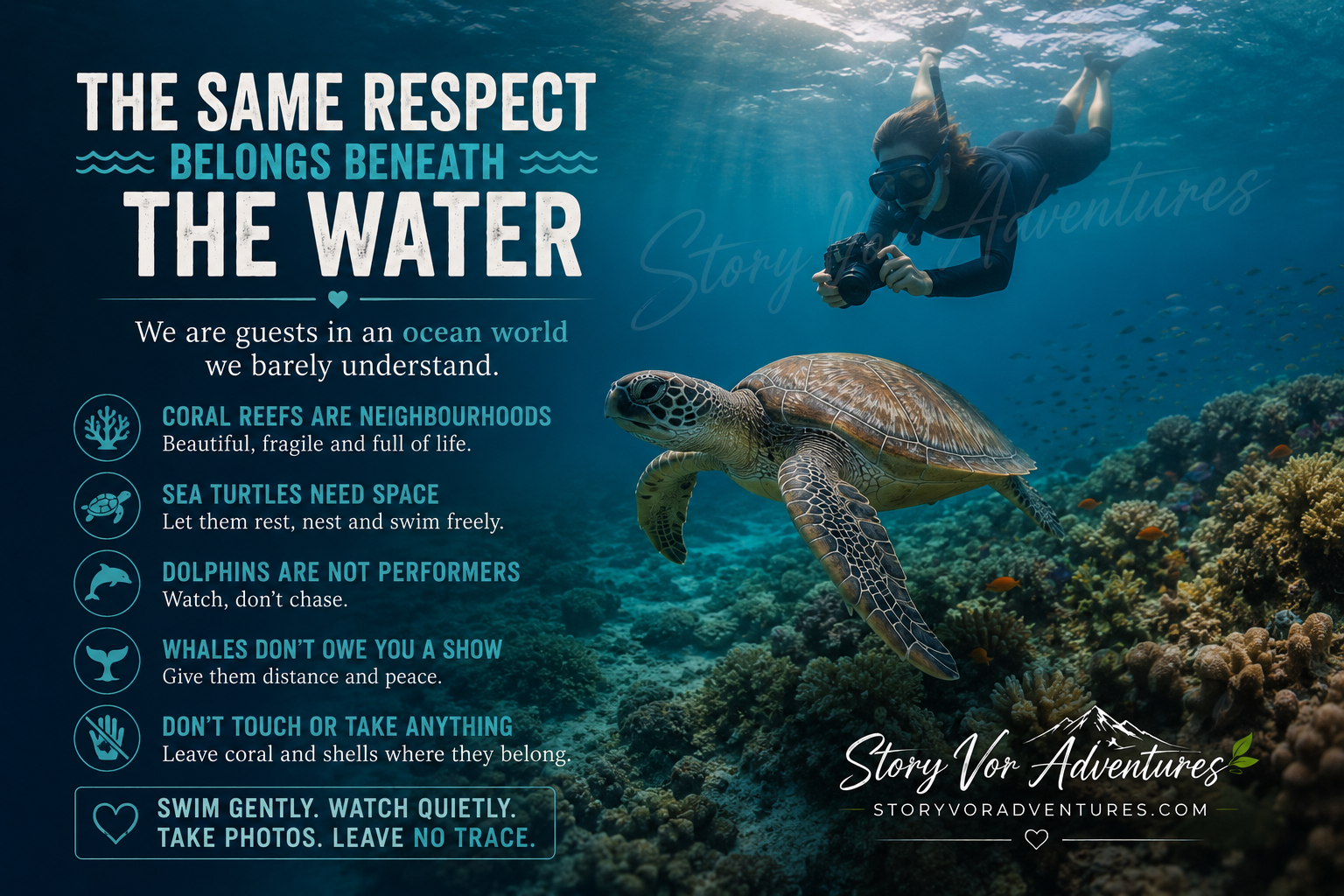
The ocean is home too.
Coral reefs are neighbourhoods filled with life.
Sea turtles need space.
Dolphins aren’t performers.
Whales don’t owe boats a close encounter.
Marine animals should not have to change direction repeatedly because tourists want photographs.
And beautiful coral should never be touched, broken or collected as a souvenir.
When entering the ocean, remember something simple:
We are guests in an enormous home we barely understand.
Swim gently.
Watch quietly.
Leave everything where it belongs.
Take the photograph.
Leave the ocean unchanged.
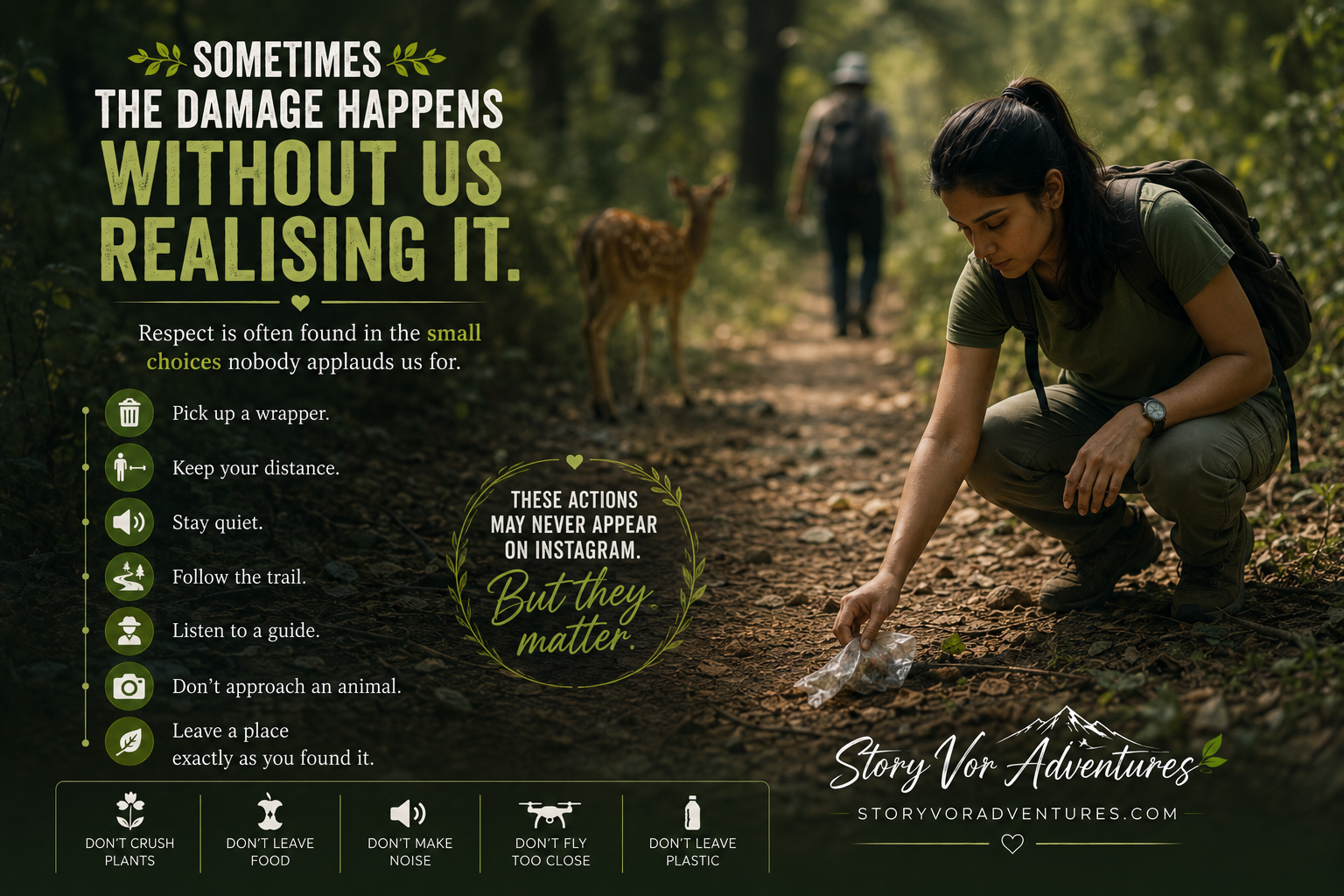
🌿 Sometimes the Damage Happens Without Us Realising It
Not every harmful action looks cruel.
Sometimes people genuinely don’t realise what they are doing.
Walking away from a trail for a better photograph may crush small plants.
Leaving food behind may attract wildlife.
Playing loud music may disturb animals that depend on sound to understand their surroundings.
Flying equipment too close may frighten birds.
Dropping a tiny piece of plastic may seem insignificant.
But nature experiences the combined effect of millions of tiny actions.
Respect is often found in the small choices nobody applauds us for.
Picking up a wrapper.
Keeping our distance.
Staying quiet.
Following the trail.
Listening to a guide.
Not approaching an animal.
Leaving a place exactly as we found it.
These actions may never appear on Instagram.
But they matter.
❤️ The Animal Doesn’t Know How Much You Love It
This may be one of the strangest truths about wildlife tourism.
You might absolutely love animals.
You may have travelled across the world because seeing one particular species has been your dream since childhood.
You may support conservation.
You may feel emotional the moment the animal appears.
But the animal doesn’t know any of that.
It only experiences your behaviour.
Love for wildlife isn’t measured by how close we can get.
It is measured by how much space we are willing to give.
It is measured by whether we respect boundaries even when nobody is watching.
It is measured by whether the animal’s wellbeing matters more to us than our photograph.
📷 A Beautiful Photograph Should Have a Beautiful Story Behind It
Imagine looking at a wildlife photograph ten years from now.
What story would you rather remember?
“I got incredibly close to this animal.”
Or:
“I watched this animal living freely in its natural home, and I was lucky enough to witness it.”
The second photograph carries something deeper.
Respect.
Patience.
Wonder.
Gratitude.
A wildlife photograph shouldn’t only be beautiful because of what appears inside the frame.
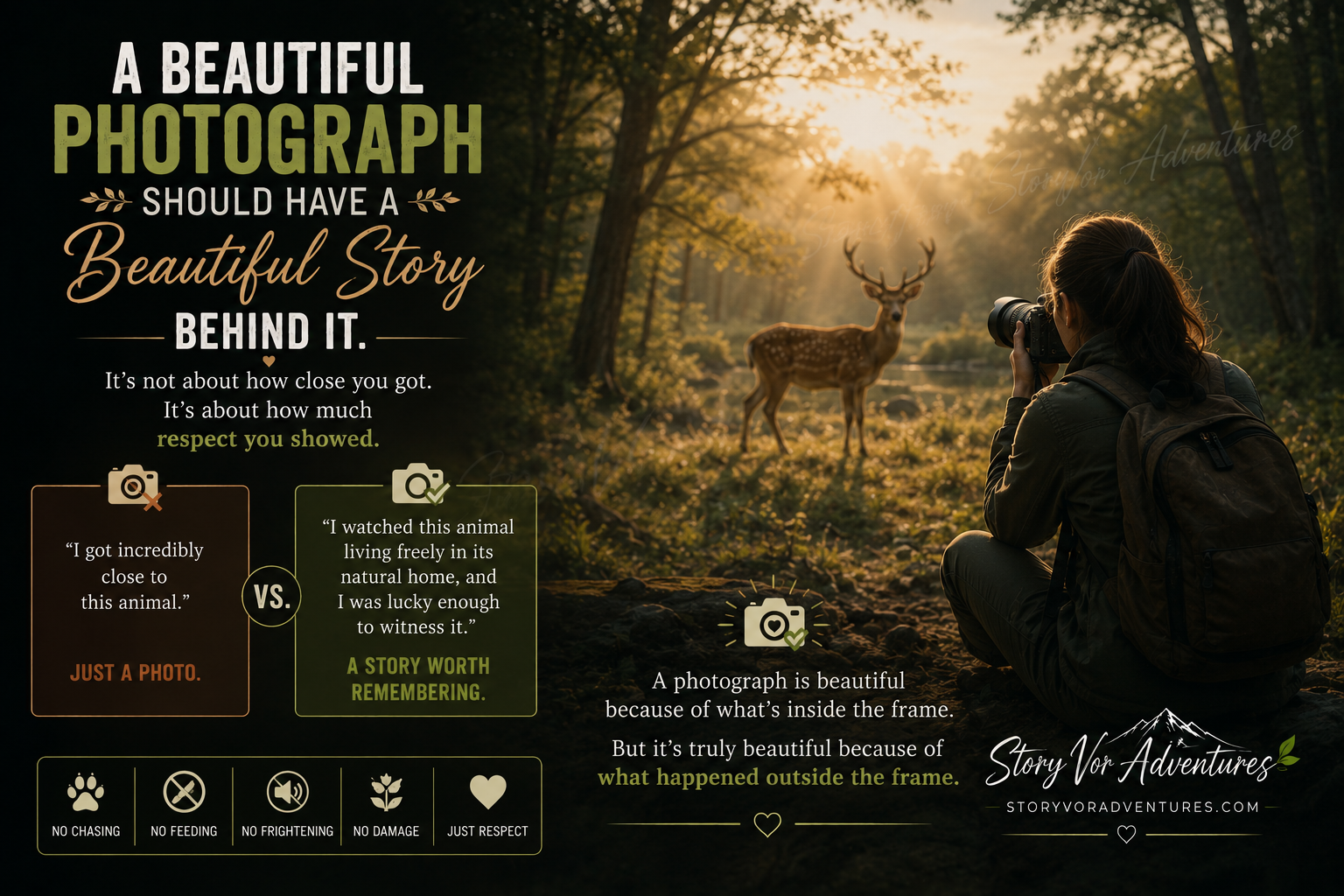
It should also be beautiful because of what happened outside the frame.
No chasing.
No frightening.
No feeding.
No damage.
Just a human being quietly witnessing another living creature.
🌍 We Are Visitors Here
Humans sometimes behave as though every beautiful place was created for us.
Mountains become viewpoints.
Forests become destinations.
Beaches become resorts.
Wildlife becomes attractions.
But these places had meaning long before tourists arrived.
Forests were homes.
Rivers were lifelines.
Mountains were ecosystems.
Oceans were entire worlds.
And animals were living their lives without needing an audience.
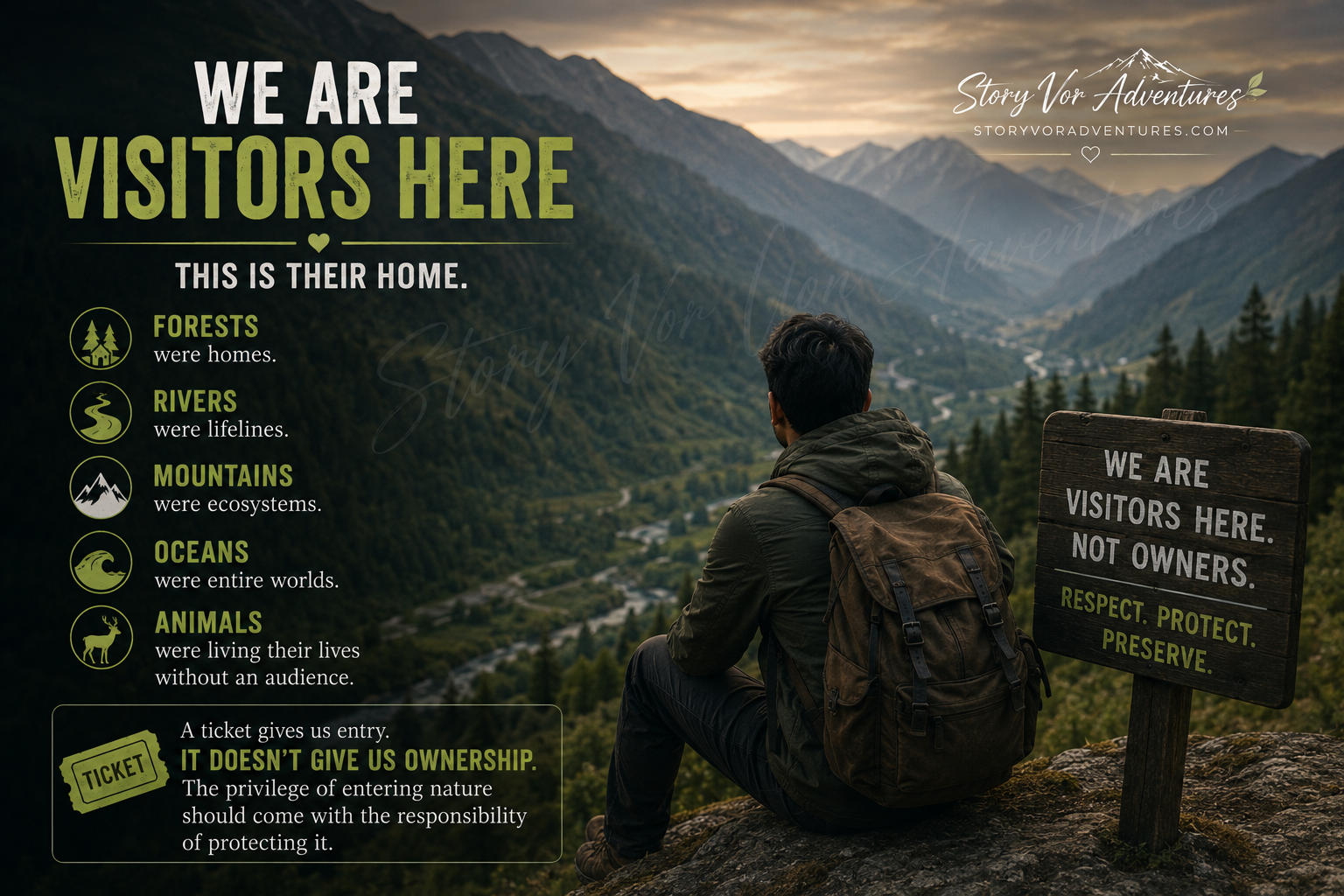
We don’t own a place simply because we paid to visit it.
A ticket gives us entry.
It doesn’t give us ownership.
The privilege of entering nature should come with the responsibility of protecting it.
👧 What Will Our Children Photograph?
Imagine taking your child to the same forest you once visited.
You tell them:
“I saw my first wild elephant here.”
Then suddenly, between the trees, an elephant appears.
Your child sees it with their own eyes.
Not on your phone.
Not in an old photograph.
Not inside a documentary.
Right there.
Alive.
Wild.
Free.
Imagine how much more valuable that moment would be than simply showing them an old photograph and saying:
“Animals used to live here.”
That difference depends partly on what our generation chooses to protect.
The goal shouldn’t be to leave our children beautiful wildlife photographs.
The goal should be to leave them wildlife to photograph.
🌱 Responsible Travellers Can Become Part of the Solution
Tourism doesn’t automatically have to harm nature.
When done responsibly, travel can help people understand why wildlife and wild places deserve protection.
As travellers, we can make better choices.
Keep a respectful distance from wildlife.
Never chase or corner an animal for a photograph.
Avoid feeding wild animals.
Stay on designated paths where required.
Follow responsible guides and local conservation rules.
Keep noise low.
Never leave plastic or rubbish behind.
Avoid damaging plants, nests, reefs or natural structures.
Respect local communities that live alongside wildlife.
Support conservation-focused experiences.
And sometimes—
put the camera down.
Look.
Listen.
Remember how extraordinary it is that this animal still has somewhere wild to call home.
💔 What If Your Photograph Becomes the Last One?
There is a painful thought hidden behind every photograph of threatened wildlife.
What if one day that photograph becomes historical evidence?
A photograph of an animal children can no longer find.
A forest that no longer exists.
A river that stopped flowing.
A coral reef that lost its life.
Nobody wants their travel memories to become records of what humanity failed to protect.
Our photographs should tell a different story.
A story where we saw something beautiful—
and decided it deserved to remain beautiful.
🌳 Before You Take the Photograph, Remember This
Before pressing the shutter, look beyond the frame.
That animal has a life you know almost nothing about.
It may have travelled kilometres looking for food.
It may be searching for water.
It may have babies nearby.
It may be tired.
It may be afraid.
It may simply want to pass.
Give it that freedom.
You can wait for another photograph.
You can change your angle.
You can use your zoom.
You can walk away without getting the picture you wanted.
The animal cannot choose another home simply because tourists entered this one.
❤️ Final Thoughts: Let Your Photograph Mean Something
Take photographs of nature.
Take thousands if you want.
Capture mountains glowing beneath sunrise.
Photograph elephants walking across grasslands.
Capture birds crossing the evening sky.
Remember the rivers, forests and oceans that made you feel small in the most beautiful way.
Share those photographs.
Let them inspire other people to love our planet.
But never forget what exists beyond the photograph.
A living world.
A world with families.
Homes.
Fear.
Instinct.
Birth.
Survival.
And lives that matter even when no camera is watching.
Someday, the photographs on our phones will become old.
Cameras will change.
Social-media platforms will change.
We will grow older.
But hopefully the forests will still stand.
The rivers will still flow.
Birds will still fill the mornings with sound.
And wild animals will still walk through places that belong to them.
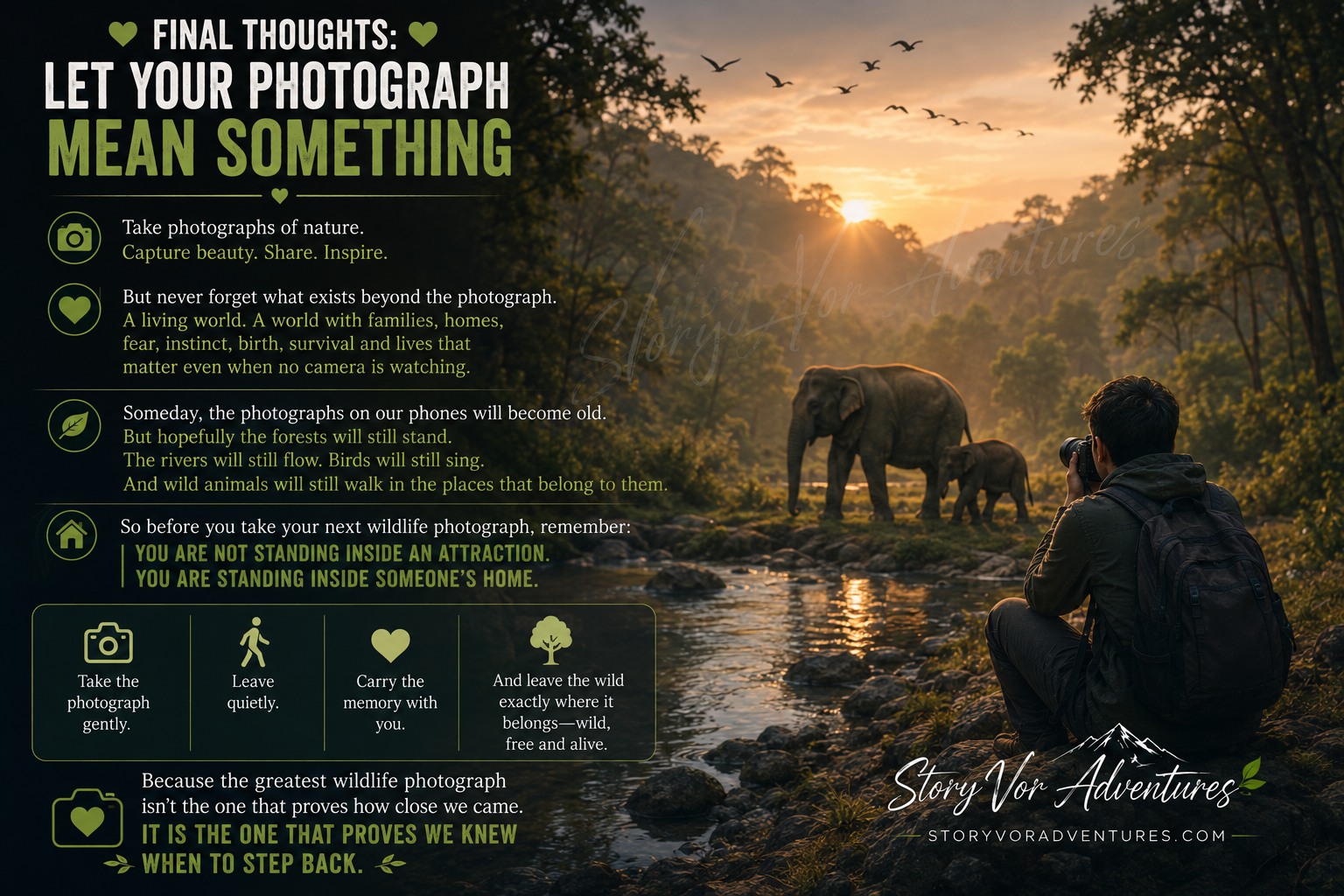
So before you take your next wildlife photograph, remember:
You are not standing inside an attraction.
You are standing inside someone’s home.
Take the photograph gently.
Leave quietly.
Carry the memory with you.
And leave the wild exactly where it belongs—
wild, free and alive. 🌍🐅❤️
Because the greatest wildlife photograph isn’t the one that proves how close we came.
It is the one that proves we knew when to step back.
© 2026 storyvoradvantures