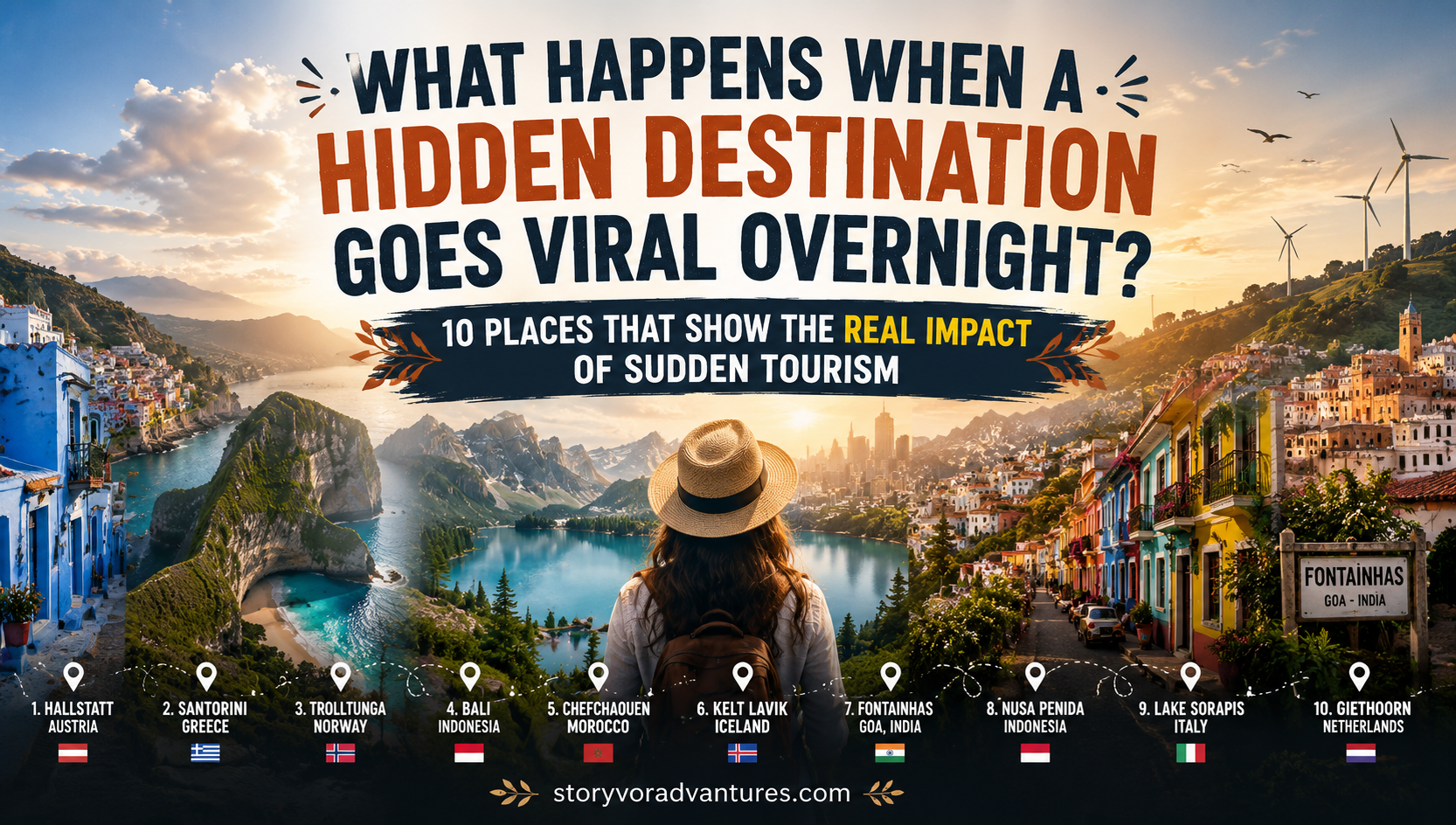
🌍 What Happens When a Hidden Destination Goes Viral Overnight? 10 Places That Show the Real Impact of Sudden Tourism
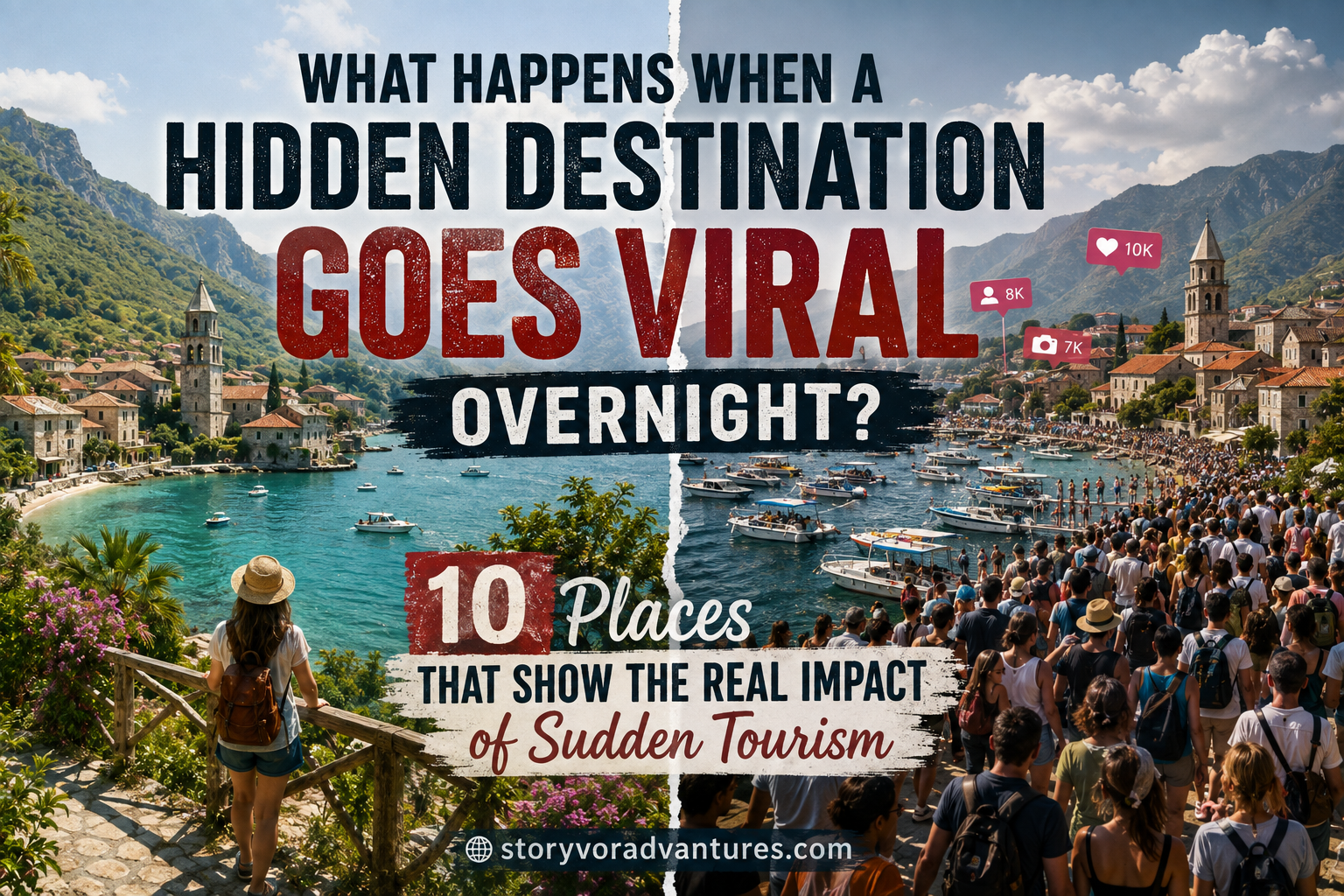
Discover 10 destinations transformed by sudden tourism and social media, and learn how travellers can explore beautiful places more responsibly.
Imagine a quiet place that barely appears on most travel itineraries.
A small village wakes up to the sound of birds. A narrow mountain road carries more local vehicles than tourist buses. A beach has enough empty space for footprints to disappear with the next tide.
Then someone posts a photograph.
Maybe it is a turquoise lake surrounded by mountains.
Maybe it is a tiny village that looks almost unreal.
Maybe it is a hidden canyon, an untouched beach or a colourful street.
The post gets shared.
Thousands of people save the location.
Travel creators arrive.
Videos appear with captions such as:
“You won’t believe this place exists.”
“Visit before everyone finds out.”
“The hidden gem nobody knows about.”
And sometimes, almost everyone finds out.
Tourism can bring jobs, customers and opportunities to communities that previously received very few visitors. But when popularity grows faster than roads, waste systems, accommodation and environmental protection, a beautiful destination can face an entirely new set of problems.
Here are 10 destinations that help us understand what can happen when a place becomes famous faster than it can adapt.
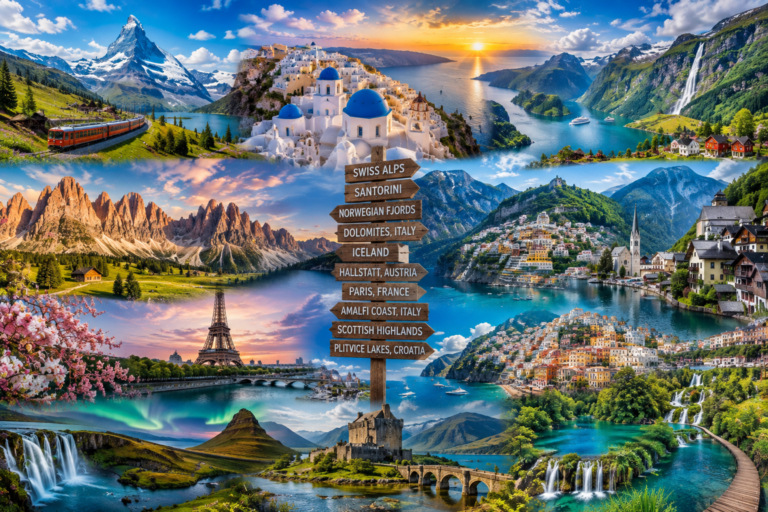
1. Hallstatt, Austria 🇦🇹
When a Small Village Becomes a Global Photograph
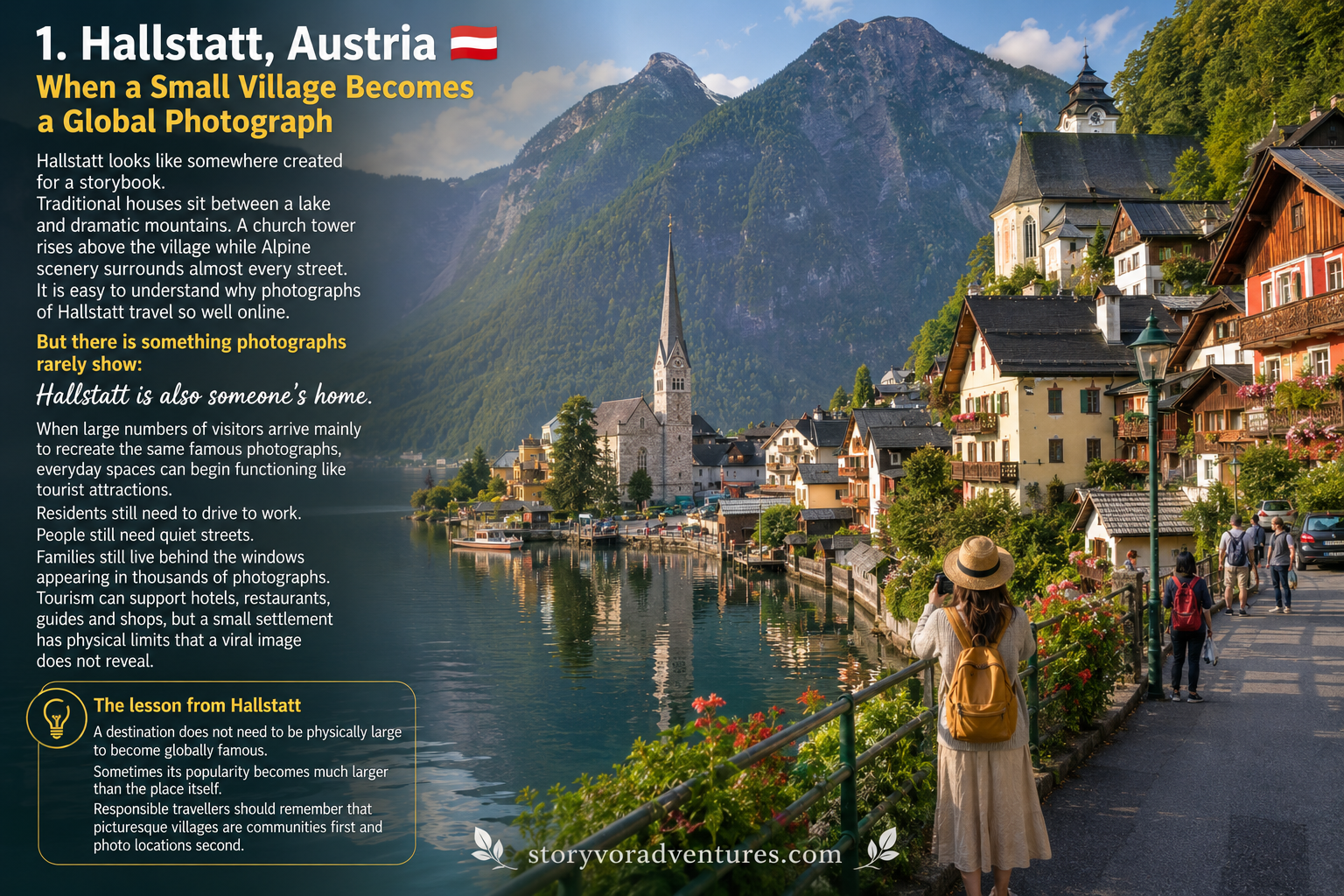
Hallstatt looks like somewhere created for a storybook.
Traditional houses sit between a lake and dramatic mountains. A church tower rises above the village while Alpine scenery surrounds almost every street.
It is easy to understand why photographs of Hallstatt travel so well online.
But there is something photographs rarely show:
Hallstatt is also someone’s home.
When large numbers of visitors arrive mainly to recreate the same famous photographs, everyday spaces can begin functioning like tourist attractions.
Residents still need to drive to work.
People still need quiet streets.
Families still live behind the windows appearing in thousands of photographs.
Tourism can support hotels, restaurants, guides and shops, but a small settlement has physical limits that a viral image does not reveal.
The lesson from Hallstatt
A destination does not need to be physically large to become globally famous.
Sometimes its popularity becomes much larger than the place itself.
Responsible travellers should remember that picturesque villages are communities first and photo locations second.
2. Maya Bay, Thailand 🇹🇭
When Paradise Becomes Too Popular
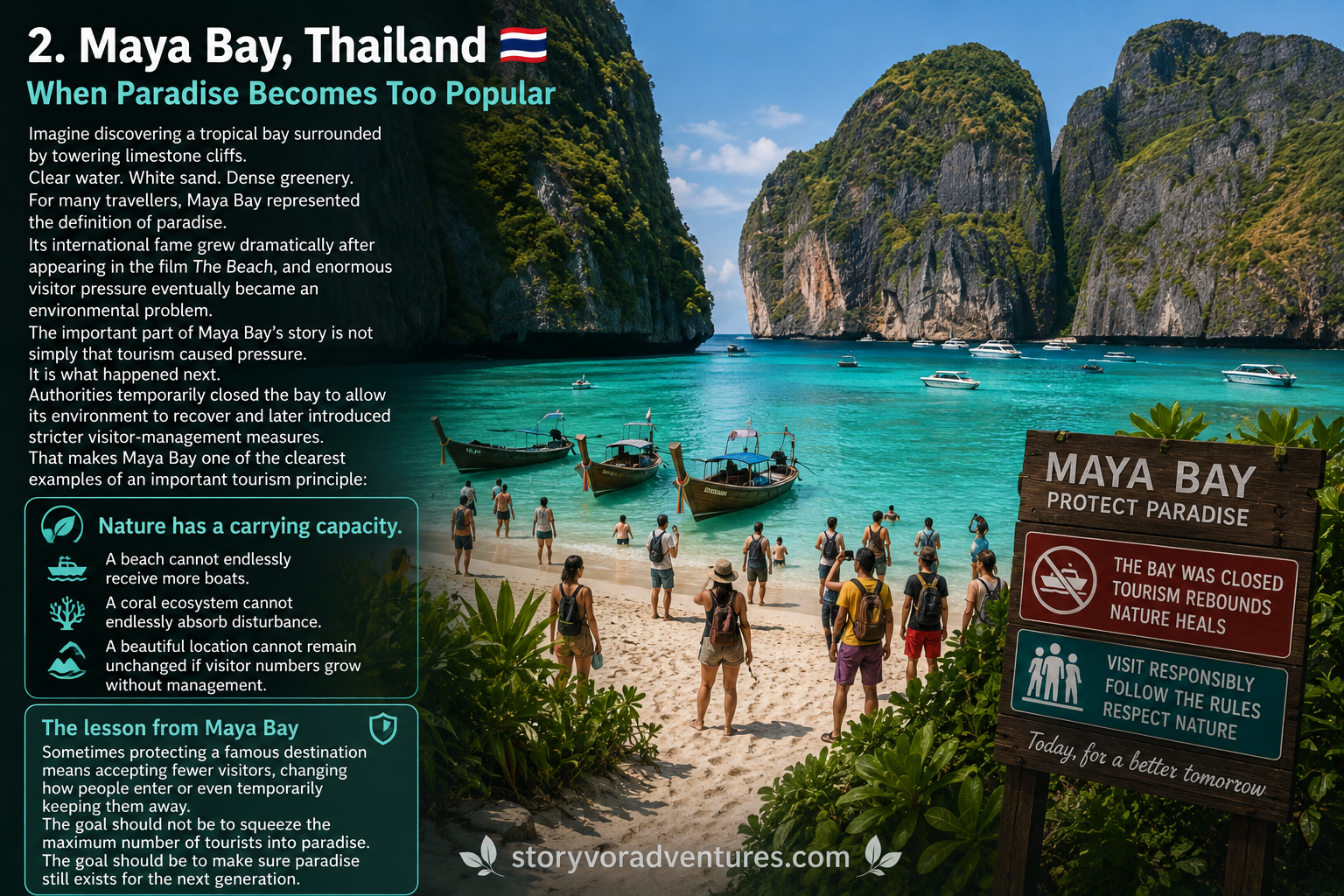
Imagine discovering a tropical bay surrounded by towering limestone cliffs.
Clear water.
White sand.
Dense greenery.
For many travellers, Maya Bay represented the definition of paradise.
Its international fame grew dramatically after appearing in the film The Beach, and enormous visitor pressure eventually became an environmental problem.
The important part of Maya Bay’s story is not simply that tourism caused pressure.
It is what happened next.
Authorities temporarily closed the bay to allow its environment to recover and later introduced stricter visitor-management measures.
That makes Maya Bay one of the clearest examples of an important tourism principle:
Nature has a carrying capacity.
A beach cannot endlessly receive more boats.
A coral ecosystem cannot endlessly absorb disturbance.
And a beautiful location cannot remain unchanged if visitor numbers grow without management.
The lesson from Maya Bay
Sometimes protecting a famous destination means accepting fewer visitors, changing how people enter or even temporarily keeping people away.
The goal should not be to squeeze the maximum number of tourists into paradise.
The goal should be to make sure paradise still exists for the next generation.
3. Fjaðrárgljúfur Canyon, Iceland 🇮🇸
When One Video Changes a Landscape
Some destinations become famous slowly.
Others receive an enormous publicity boost almost instantly.
Iceland’s Fjaðrárgljúfur Canyon became widely recognised online after appearing in popular visual media and social posts.
The landscape seems designed for a camera.
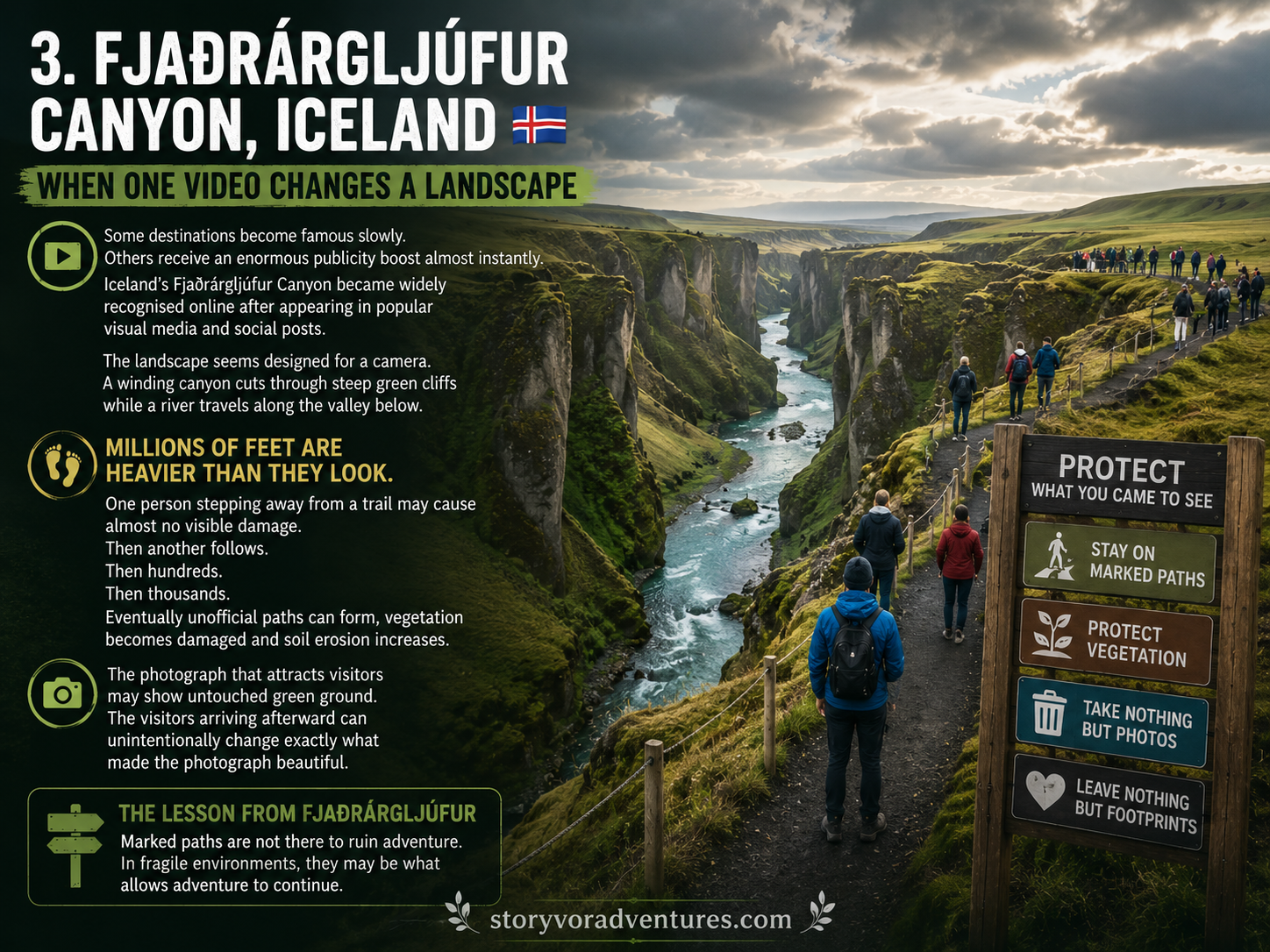
A winding canyon cuts through steep green cliffs while a river travels along the valley below.
But fragile landscapes have one major weakness:
Millions of feet are heavier than they look.
One person stepping away from a trail may cause almost no visible damage.
Then another follows.
Then hundreds.
Then thousands.
Eventually unofficial paths can form, vegetation becomes damaged and soil erosion increases.
The photograph that attracts visitors may show untouched green ground.
The visitors arriving afterward can unintentionally change exactly what made the photograph beautiful.
The lesson from Fjaðrárgljúfur
Marked paths are not there to ruin adventure.
In fragile environments, they may be what allows adventure to continue.
4. Seceda, Dolomites, Italy 🇮🇹
When Mountains Become a Social-Media Stage
The Dolomites contain some of Europe’s most dramatic mountain scenery.
Seceda is particularly photogenic.
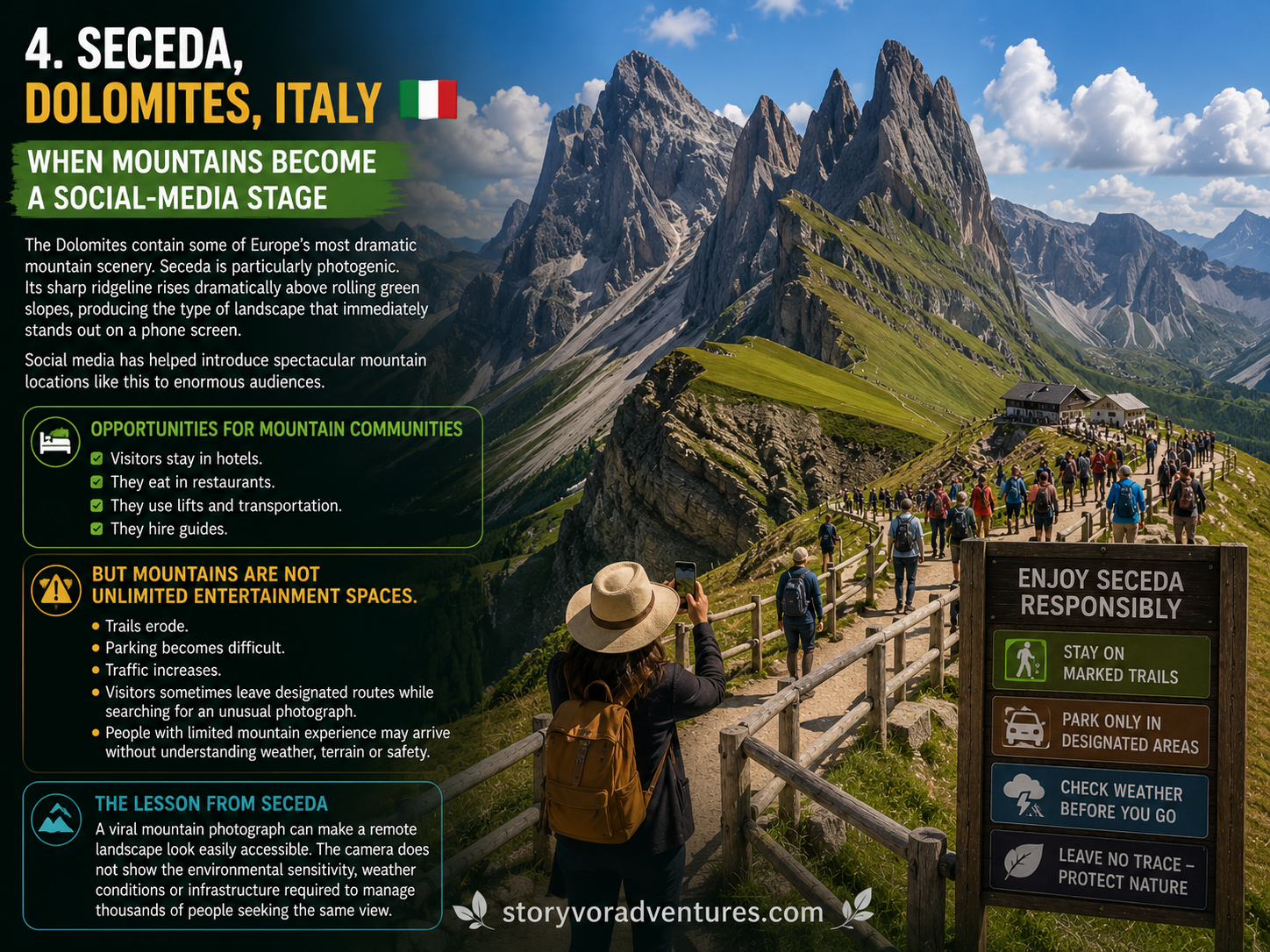
Its sharp ridgeline rises dramatically above rolling green slopes, producing the type of landscape that immediately stands out on a phone screen.
Social media has helped introduce spectacular mountain locations like this to enormous audiences.
That creates opportunity for mountain communities.
Visitors stay in hotels.
They eat in restaurants.
They use lifts and transportation.
They hire guides.
But mountain environments are not unlimited entertainment spaces.
Trails erode.
Parking becomes difficult.
Traffic increases.
Visitors sometimes leave designated routes while searching for an unusual photograph.
And people with limited mountain experience may arrive without understanding weather, terrain or safety.
The lesson from Seceda
A viral mountain photograph can make a remote landscape look easily accessible.
The camera does not show the environmental sensitivity, weather conditions or infrastructure required to manage thousands of people seeking the same view.
5. Santorini, Greece 🇬🇷
When Everyone Wants the Same Sunset
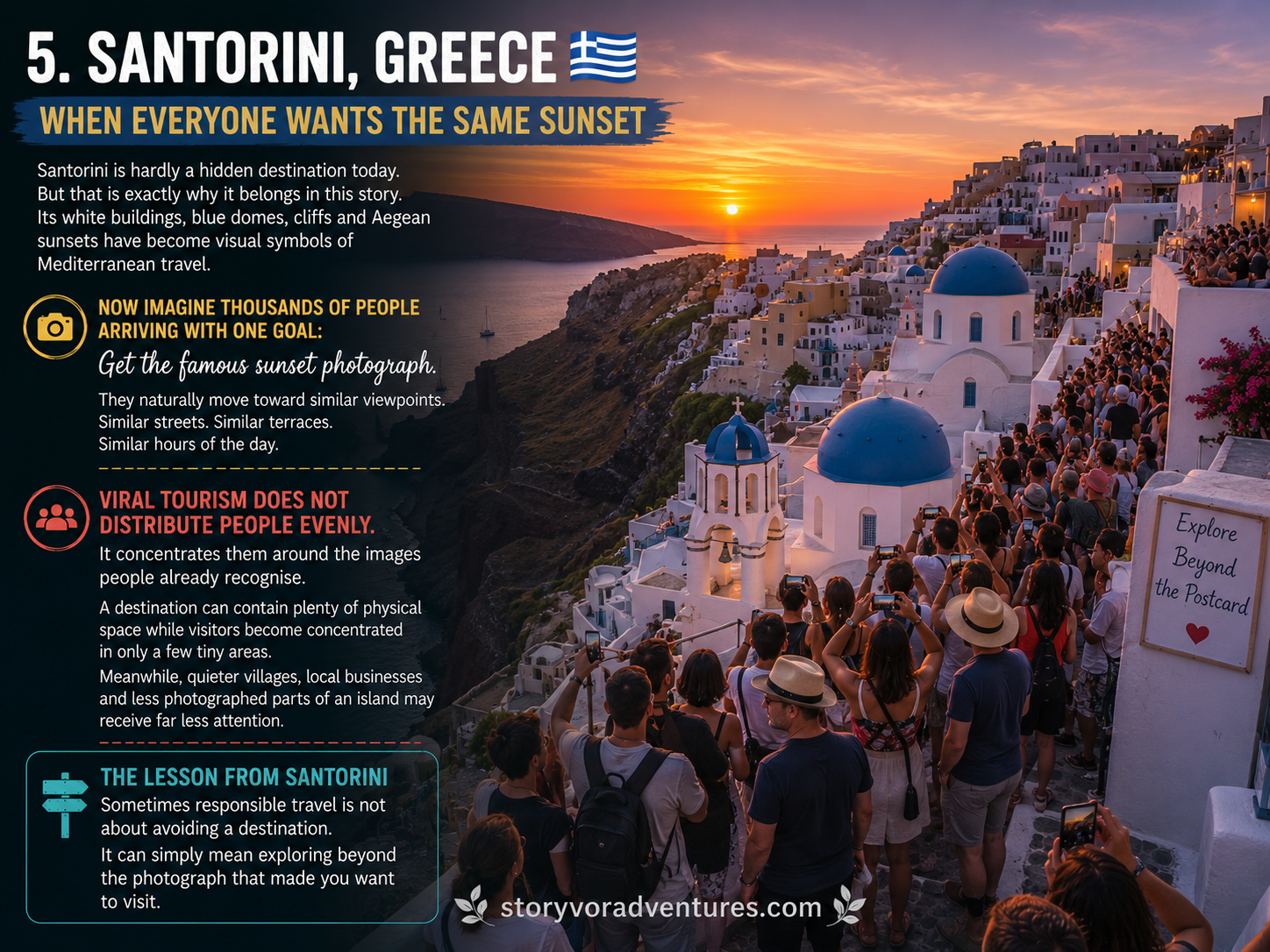
Santorini is hardly a hidden destination today.
But that is exactly why it belongs in this story.
Its white buildings, blue domes, cliffs and Aegean sunsets have become visual symbols of Mediterranean travel.
Now imagine thousands of people arriving with one goal:
Get the famous sunset photograph.
They naturally move toward similar viewpoints.
Similar streets.
Similar terraces.
Similar hours of the day.
This creates an unusual tourism problem.
A destination can contain plenty of physical space while visitors become concentrated in only a few tiny areas.
Viral tourism does not distribute people evenly.
It concentrates them around the images people already recognise.
Meanwhile, quieter villages, local businesses and less photographed parts of an island may receive far less attention.
The lesson from Santorini
Sometimes responsible travel is not about avoiding a destination.
It can simply mean exploring beyond the photograph that made you want to visit.
6. Trolltunga, Norway 🇳🇴
The Photograph at the End of the Hike
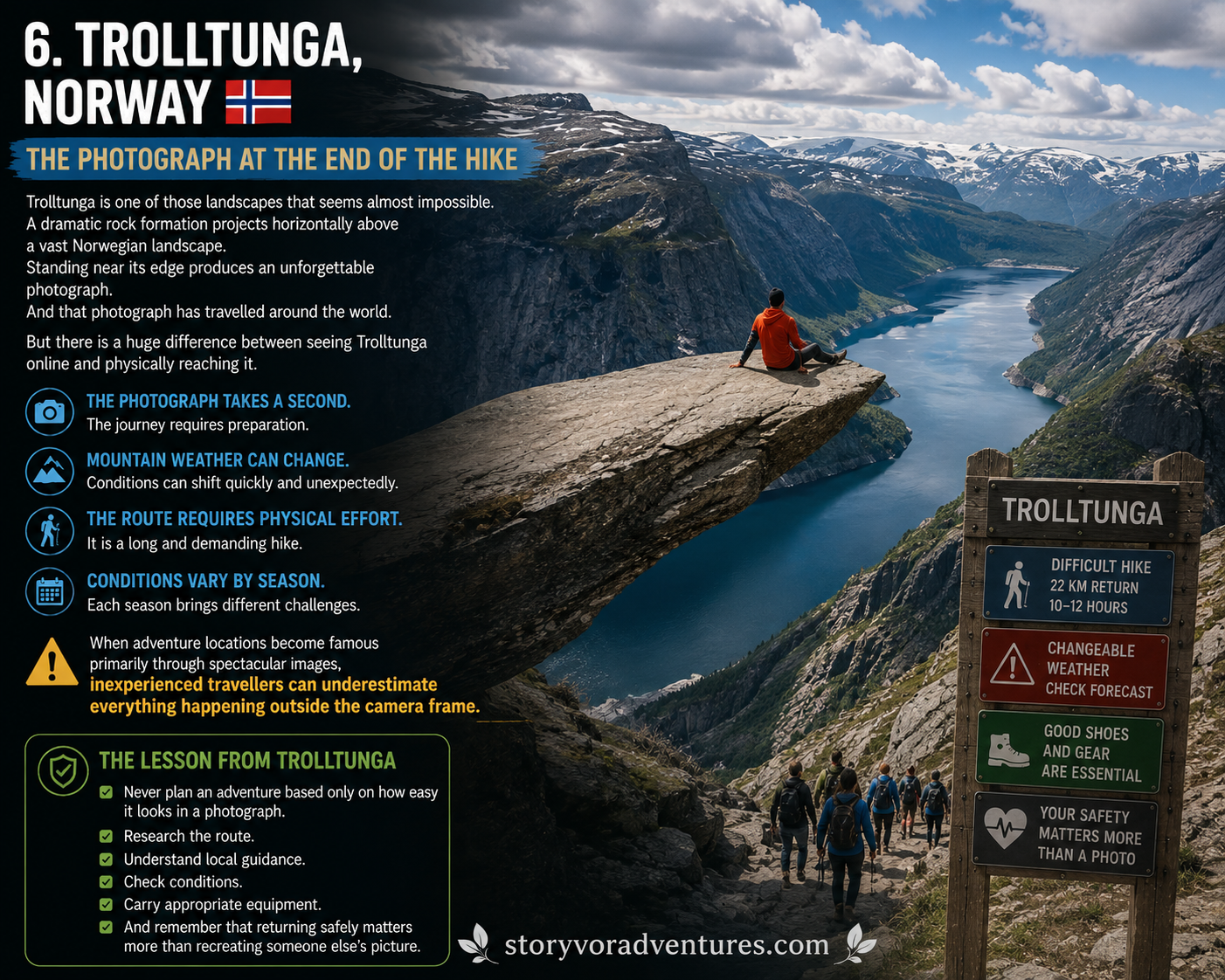
Trolltunga is one of those landscapes that seems almost impossible.
A dramatic rock formation projects horizontally above a vast Norwegian landscape.
Standing near its edge produces an unforgettable photograph.
And that photograph has travelled around the world.
But there is a huge difference between seeing Trolltunga online and physically reaching it.
The photograph takes a second.
The journey requires preparation.
Mountain weather can change.
The route requires physical effort.
Conditions vary by season.
When adventure locations become famous primarily through spectacular images, inexperienced travellers can underestimate everything happening outside the camera frame.
The lesson from Trolltunga
Never plan an adventure based only on how easy it looks in a photograph.
Research the route.
Understand local guidance.
Check conditions.
Carry appropriate equipment.
And remember that returning safely matters more than recreating someone else’s picture.
7. Chefchaouen, Morocco 🇲🇦
When a City’s Colour Becomes Its Global Identity
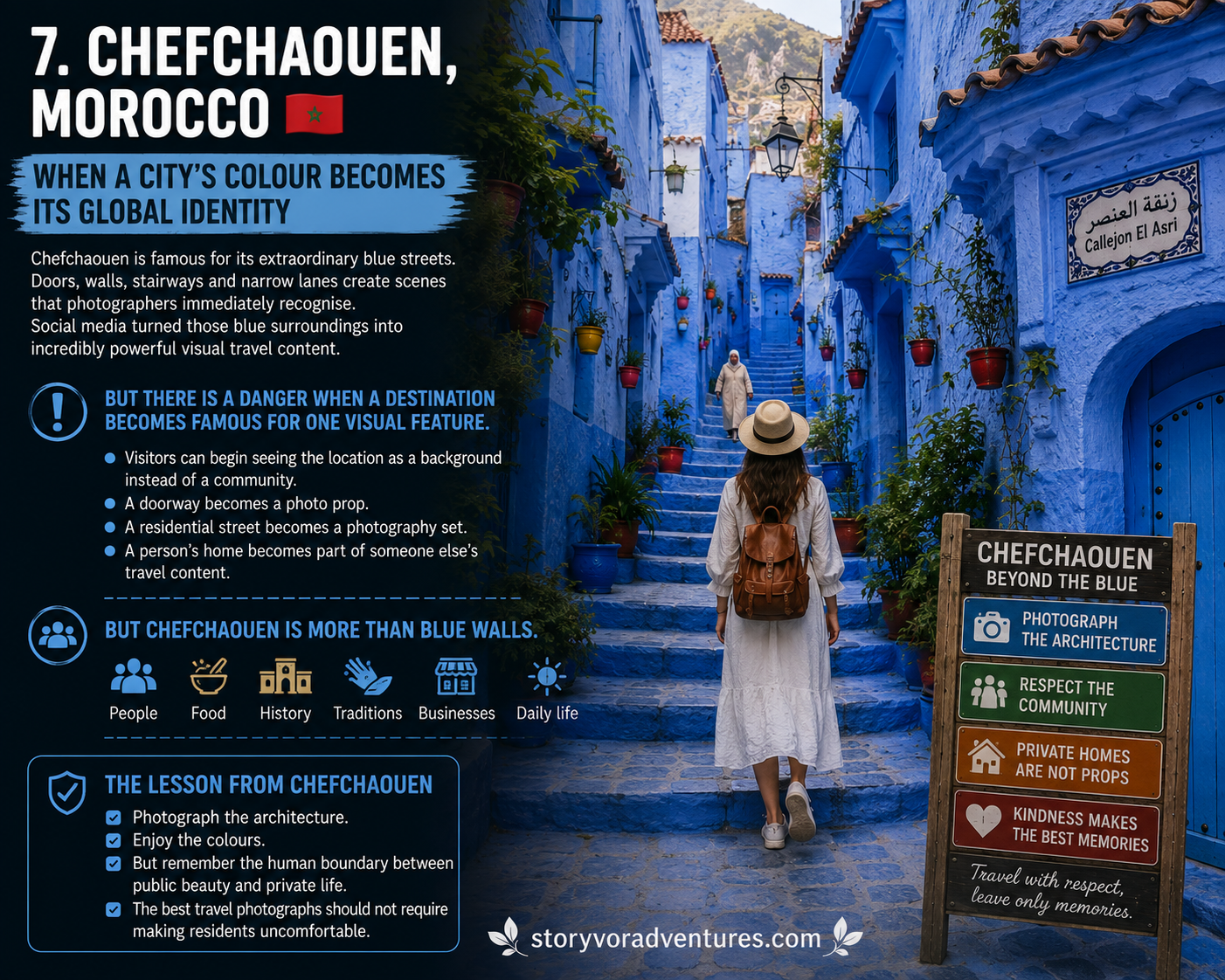
Chefchaouen is famous for its extraordinary blue streets.
Doors, walls, stairways and narrow lanes create scenes that photographers immediately recognise.
Social media turned those blue surroundings into incredibly powerful visual travel content.
But there is a danger when a destination becomes famous for one visual feature.
Visitors can begin seeing the location as a background instead of a community.
A doorway becomes a photo prop.
A residential street becomes a photography set.
A person’s home becomes part of someone else’s travel content.
But Chefchaouen is more than blue walls.
It has people, food, history, traditions, businesses and ordinary daily life.
The lesson from Chefchaouen
Photograph the architecture.
Enjoy the colours.
But remember the human boundary between public beauty and private life.
The best travel photographs should not require making residents uncomfortable.
8. Nusa Penida, Indonesia 🇮🇩
When One Viewpoint Becomes More Famous Than the Island
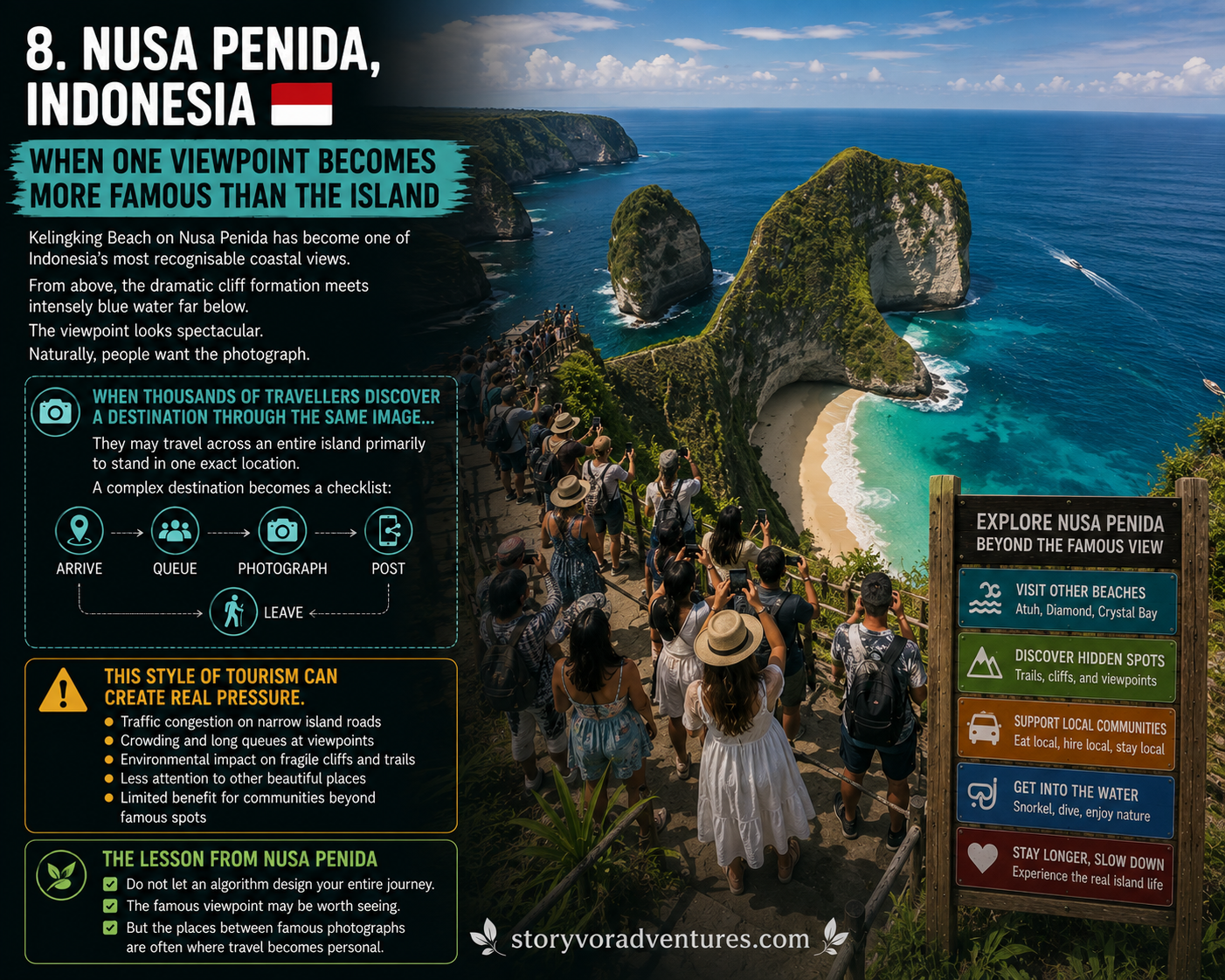
Kelingking Beach on Nusa Penida has become one of Indonesia’s most recognisable coastal views.
From above, the dramatic cliff formation meets intensely blue water far below.
The viewpoint looks spectacular.
Naturally, people want the photograph.
But when thousands of travellers discover a destination through the same image, something interesting happens.
They may travel across an entire island primarily to stand in one exact location.
A complex destination becomes a checklist:
Arrive.
Queue.
Photograph.
Post.
Leave.
This style of tourism can concentrate traffic and pressure around particular roads and viewpoints while giving visitors very little understanding of the wider destination.
The lesson from Nusa Penida
Do not let an algorithm design your entire journey.
The famous viewpoint may be worth seeing.
But the places between famous photographs are often where travel becomes personal.
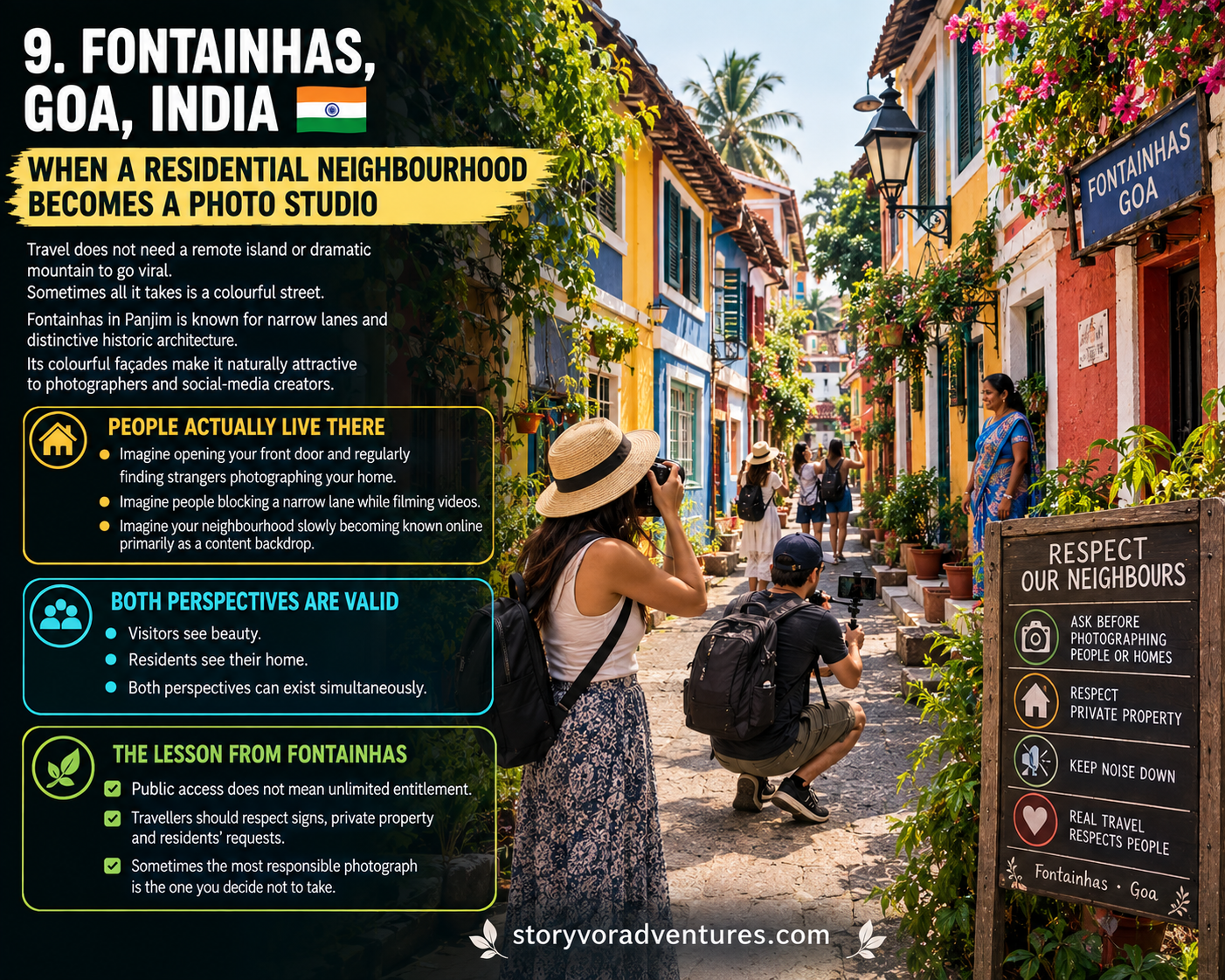
9. Fontainhas, Goa, India 🇮🇳
When a Residential Neighbourhood Becomes a Photo Studio
Travel does not need a remote island or dramatic mountain to go viral.
Sometimes all it takes is a colourful street.
Fontainhas in Panjim is known for narrow lanes and distinctive historic architecture.
Its colourful façades make it naturally attractive to photographers and social-media creators.
But there is an important detail:
People actually live there.
Imagine opening your front door and regularly finding strangers photographing your home.
Imagine people blocking a narrow lane while filming videos.
Imagine your neighbourhood slowly becoming known online primarily as a content backdrop.
The conflict is understandable.
Visitors see beauty.
Residents see their home.
Both perspectives can exist simultaneously.
The lesson from Fontainhas
Public access does not mean unlimited entitlement.
Travellers should respect signs, private property and residents’ requests.
Sometimes the most responsible photograph is the one you decide not to take.
10. Lake Sorapis, Italy 🇮🇹
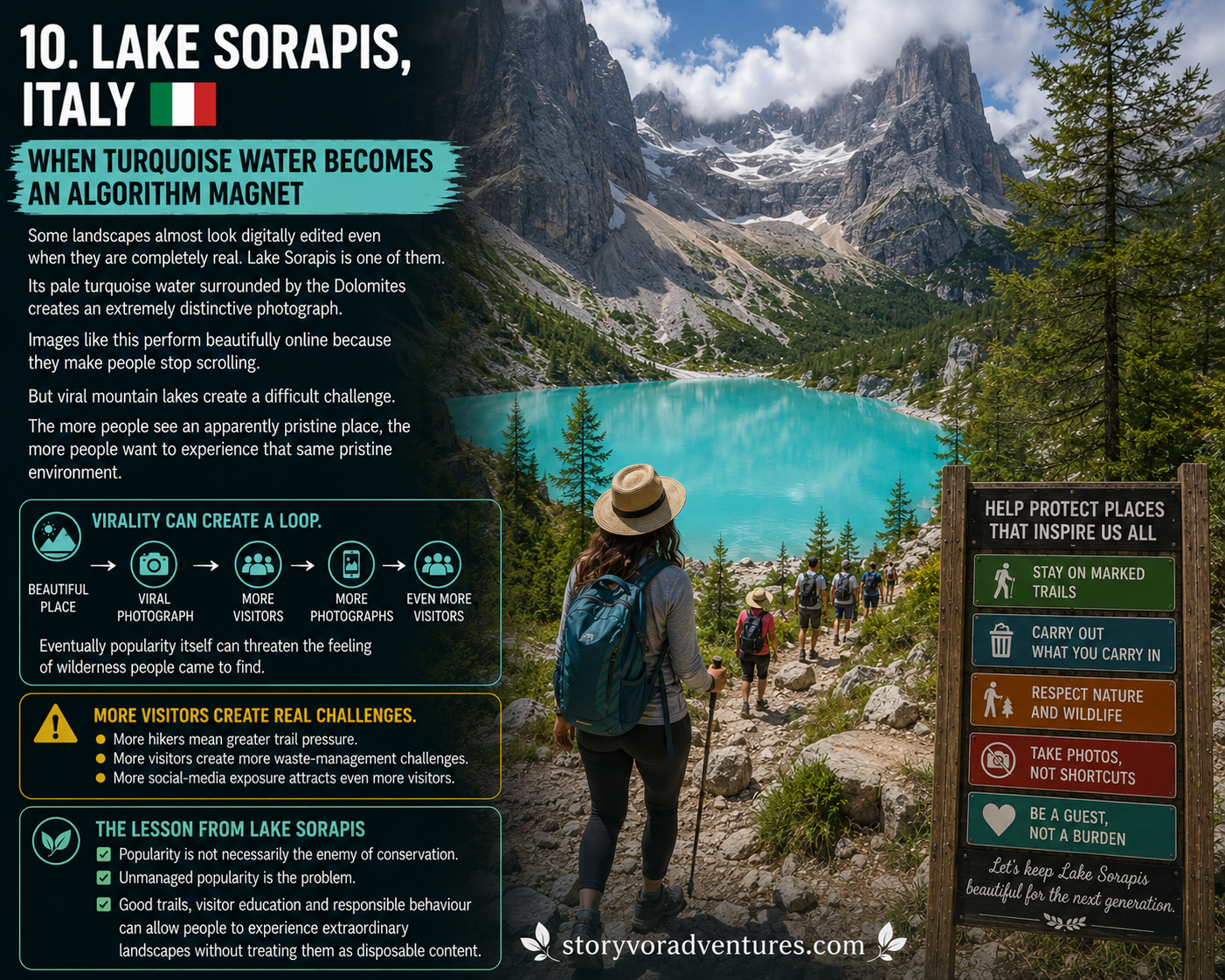
When Turquoise Water Becomes an Algorithm Magnet
Some landscapes almost look digitally edited even when they are completely real.
Lake Sorapis is one of them.
Its pale turquoise water surrounded by the Dolomites creates an extremely distinctive photograph.
Images like this perform beautifully online because they make people stop scrolling.
But viral mountain lakes create a difficult challenge.
The more people see an apparently pristine place, the more people want to experience that same pristine environment.
Eventually popularity itself can threaten the feeling of wilderness people came to find.
More hikers mean greater trail pressure.
More visitors create more waste-management challenges.
More social-media exposure attracts even more visitors.
It can become a loop:
Beautiful place → viral photograph → more visitors → more photographs → even more visitors.
The lesson from Lake Sorapis
Popularity is not necessarily the enemy of conservation.
Unmanaged popularity is the problem.
Good trails, visitor education and responsible behaviour can allow people to experience extraordinary landscapes without treating them as disposable content.
📱 Why Does Social Media Change Travel So Quickly?
Travel recommendations once moved relatively slowly.
Someone visited a place.
They told friends.
A guidebook mentioned it.
A newspaper published an article.
Tourism gradually increased.
Today, one video can potentially reach millions of screens in an extremely short period.
That changes the speed of tourism.
A destination may suddenly need:
- More parking
- Better public transport
- More toilets
- Waste collection
- Trail management
- Emergency services
- Accommodation
- Environmental protection
- Visitor education
But infrastructure cannot go viral.
A road cannot suddenly become five times wider because a video received millions of views.
A village cannot instantly create a new sewage system.
A mountain trail cannot automatically repair itself.
That gap between digital popularity and physical capacity is one of the biggest challenges of modern tourism.
💰 Going Viral Is Not Always Bad
It would be unfair to describe tourism only as a problem.
For many communities, visitors create genuine opportunity.
A family can open a homestay.
A local guide can build a career.
Restaurants gain customers.
Drivers find work.
Traditional crafts reach new buyers.
Young residents may find employment without leaving their hometown.
Tourism can even create financial reasons to protect natural and cultural heritage.
The real question is therefore not:
“Should tourists come?”
A better question is:
“How can tourism grow without destroying what visitors came to experience?”
That is a much harder question.
But it is also much more useful.
📸 Should We Stop Sharing Hidden Places Online?
Probably not completely.
Keeping every beautiful destination secret is neither realistic nor necessarily fair to communities that benefit from tourism.
But travellers and creators can share places more responsibly.
Before publishing a location, consider:
Is the ecosystem fragile?
Can the community handle a sudden increase in visitors?
Am I encouraging people to leave marked trails?
Am I showing behaviour that others might copy?
Does my photograph invade someone’s private property?
Am I presenting a dangerous location as effortless?
A creator with a large audience has influence.
Influence carries responsibility.
🧭 10 Rules for Visiting a Place You Discovered Online
Discovering a destination through social media is not automatically irresponsible.
What matters is what happens after discovery.
1. Research before travelling
Do not rely only on a 15-second video.
2. Respect marked trails
Especially in mountains, forests and fragile landscapes.
3. Never enter private property for a photograph
A beautiful doorway may still be someone’s home.
4. Carry your waste out
Remote places often have limited waste-management systems.
5. Visit outside peak hours when practical
This can reduce pressure and often creates a better experience.
6. Spend money locally
Eat at local restaurants, hire local guides and consider locally operated accommodation.
7. Follow visitor limits
Restrictions usually exist for a reason.
8. Do not copy dangerous photographs
A viral picture is never worth a serious injury.
9. Respect wildlife
Never chase, feed or disturb animals for content.
10. Leave the destination photographically richer — but physically unchanged
Take memories.
Take photographs.
Leave the landscape where it belongs.
🌍 The Hidden Cost of the Phrase “Hidden Gem”
There is something strange about modern travel.
Millions of people search online for:
“Places nobody knows about.”
The moment millions of people find the answer, the place is no longer hidden.
Maybe we need to stop treating secrecy as the definition of a great destination.
A place does not need to be unknown to be meaningful.
Travel can still feel extraordinary when we slow down enough to notice details that algorithms cannot rank.
A conversation with a shopkeeper.
Breakfast at a family-run café.
An empty street before sunrise.
A train journey between destinations.
A local festival.
A quiet hiking trail away from the famous viewpoint.
These experiences rarely become the photograph everyone copies.
That may be exactly why we remember them.
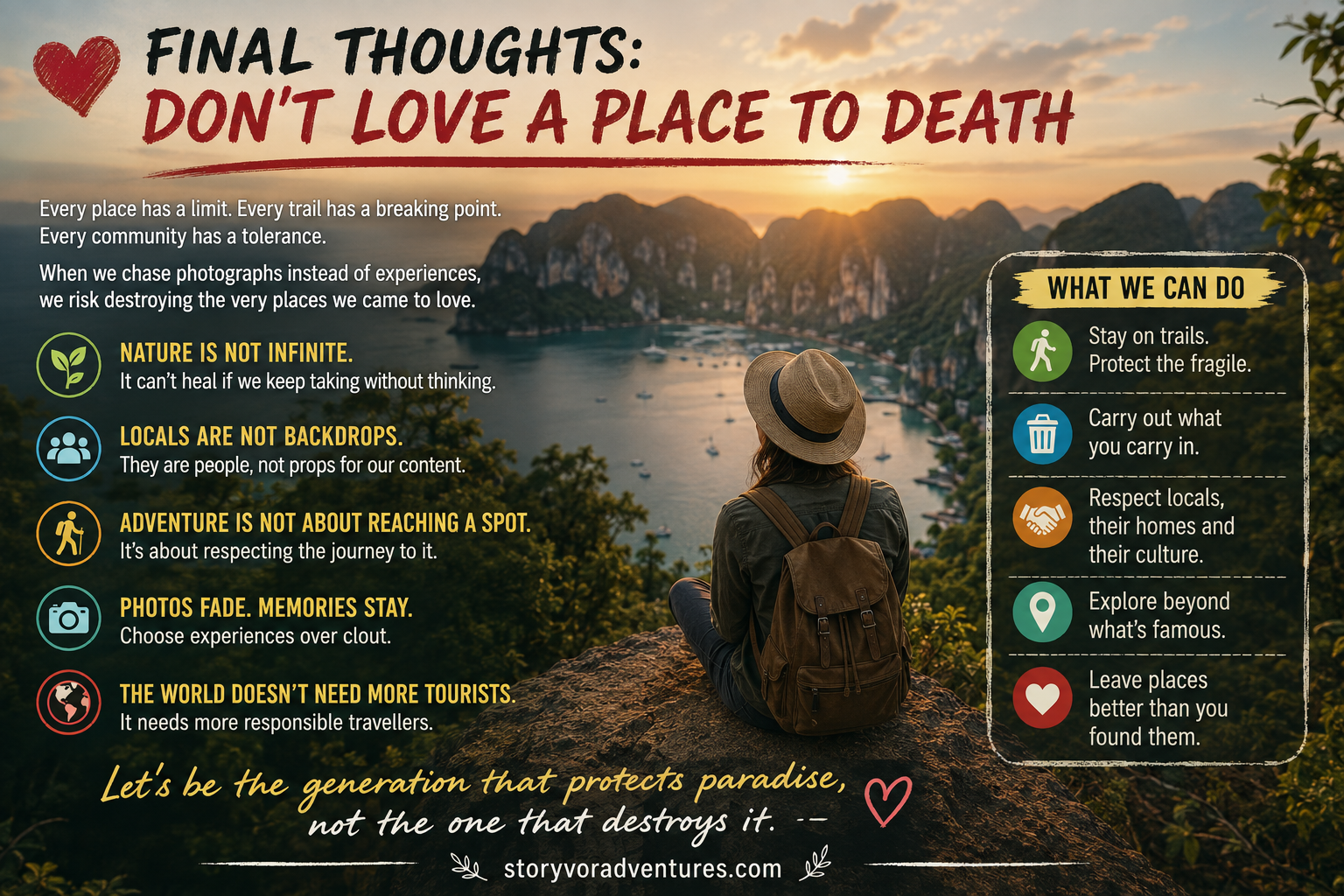
❤️ Final Thoughts: Don’t Love a Place to Death
Social media did not create our desire to explore.
Humans have always wanted to see what lies beyond the horizon.
Technology simply made discovery incredibly fast.
And that gives modern travellers a new responsibility.
When a beautiful destination appears on our screen, our first thought might be:
“I need to go there.”
Perhaps the second thought should be:
“How should I go there?”
Travel should create memories without erasing the character of the place that created them.
Visit the village.
Walk through the mountains.
Watch the sunset.
Photograph the blue streets.
Support the café.
Hire the local guide.
Listen to the people who call the destination home.
And when you leave, try to make sure the next traveller can still discover the beauty that brought you there.
Because the greatest hidden gem is not a place nobody has discovered.
It is a place people discovered — and still chose to protect.
Frequently Asked Questions
What is overtourism?
Overtourism generally describes a situation where visitor pressure becomes difficult for a destination, its residents, infrastructure or environment to manage sustainably.
Does social media cause overtourism?
Social media is only one factor, but viral photographs and videos can dramatically increase awareness of particular destinations and concentrate visitors around specific viewpoints or neighbourhoods.
Should travellers avoid popular destinations?
Not necessarily. Travelling outside peak periods, respecting local rules, staying longer and supporting local businesses can sometimes be more helpful than simply replacing one popular destination with another supposedly “hidden” one.
Is geotagging a hidden location bad?
It depends on the location. Sharing an established attraction is very different from exposing a fragile ecosystem or sensitive location that lacks visitor infrastructure.
How can tourists support local communities?
Choose locally operated accommodation and guides where practical, eat at local businesses, buy authentic local products and respect community rules rather than treating neighbourhoods purely as photo locations.
Important: This article is for educational and informational purposes. Travel conditions, access rules, environmental restrictions and visitor regulations can change. Travellers should check current official local guidance before visiting any destination.
© 2026 storyvoradvantures