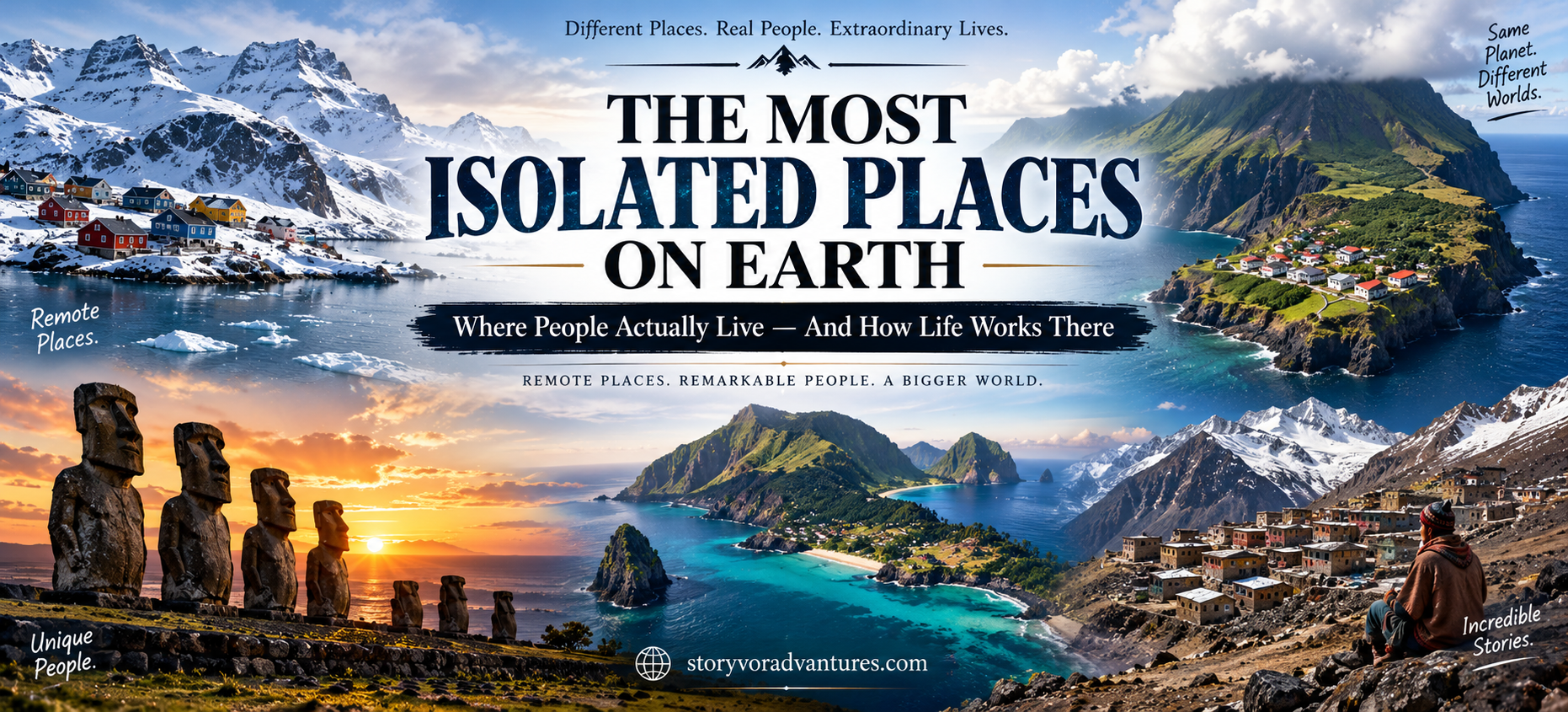
🌍 The Most Isolated Places on Earth Where People Actually Live — And How Life Works There
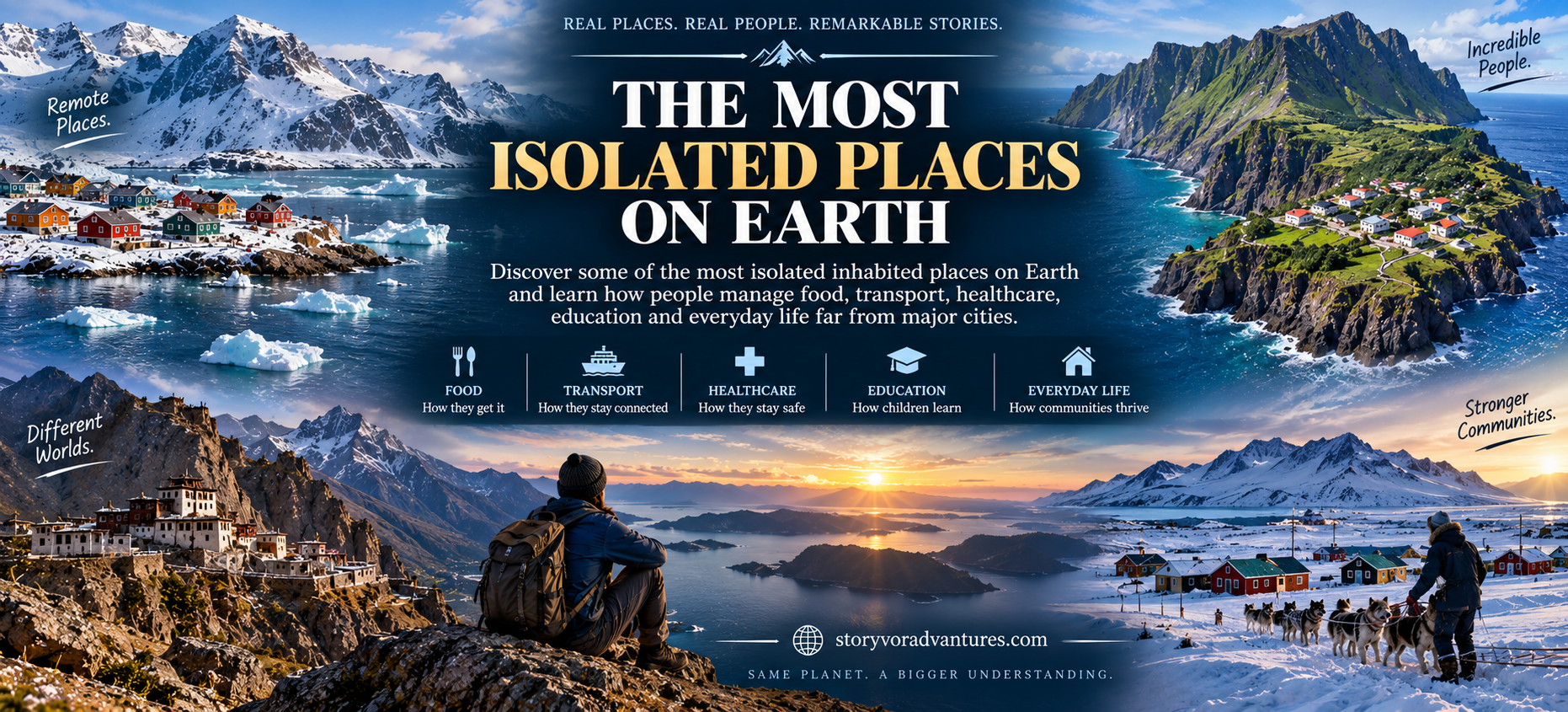
Discover some of the most isolated inhabited places on Earth and learn how people manage food, transport, healthcare, education and everyday life far from major cities.
- Most of us rarely think about how much infrastructure is working quietly behind everyday life. Food reaches supermarkets every morning. Hospitals are usually within driving distance. A broken appliance can be replaced. Flights connect cities in hours, packages arrive at the door, and a phone can connect us with somebody thousands of kilometres away almost instantly.
- But there are communities where distance changes almost everything.
- Across remote oceans, Arctic landscapes, high mountains and isolated islands, people live in settlements where the nearest major city may be hundreds or even thousands of kilometres away. A delayed ship can matter far more than a delayed delivery. Weather can determine whether transport operates at all. Medical treatment may require a journey that would seem extraordinary to someone living in a large city.
- Yet these places are not simply stories about hardship. They are homes.
- Children grow up there. People work, celebrate birthdays, attend school, repair buildings, cook meals, maintain traditions and build communities. Some residents leave; others choose to stay. And many have developed ways of living that make isolation manageable.
- So instead of asking only “How remote is this place?”, there is a much more interesting question:
How does ordinary life continue when the rest of the world is so far away?
Let’s travel to some of Earth’s most isolated inhabited communities and find out.
🌊 1. Tristan da Cunha — A Community Surrounded by an Enormous Ocean
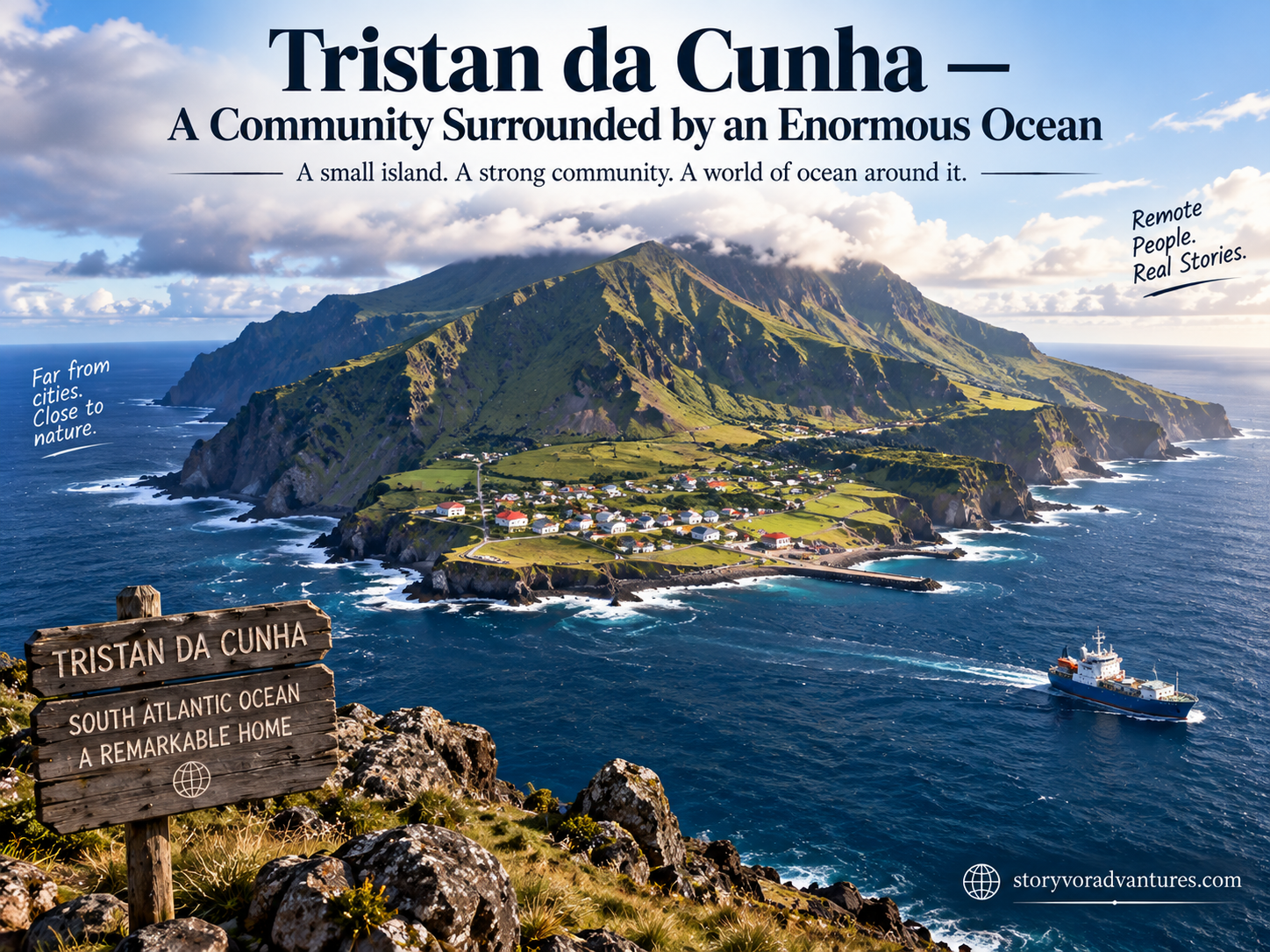
- In the South Atlantic lies a volcanic island so remote that its isolation almost sounds fictional. Tristan da Cunha is often described as the world’s most remote inhabited island community. Its settlement, Edinburgh of the Seven Seas, sits thousands of kilometres from major continental population centres, surrounded by an extraordinary amount of open ocean.
- The scale of the community makes the isolation even more remarkable. An official Tristan da Cunha population update dated August 28, 2026 listed 222 Tristan islanders, with 235 people physically present when expatriate workers, families and visitors were included. In other words, the permanent community is smaller than the number of people living in many apartment buildings.
- Living there changes the meaning of transport. Tristan does not function like an island with a busy international airport connecting residents to cities every day. Ocean travel and carefully planned logistics remain central to maintaining links with the outside world. When your community is separated from major supply centres by a vast stretch of sea, planning becomes part of everyday resilience.
- But thinking of Tristan only as “isolated” misses something important. For the people who live there, this is not an empty point on a map. It is a functioning community with families, work, local institutions and generations of shared history. Distance from the rest of the world may create limitations, but close community relationships can become especially important when the population is so small.
- The surprising lesson from Tristan da Cunha is that a community does not need millions of people to function. It needs people willing to keep the community functioning.
🏝️ 2. Pitcairn Island — What Happens When Almost Everyone Knows Everyone?
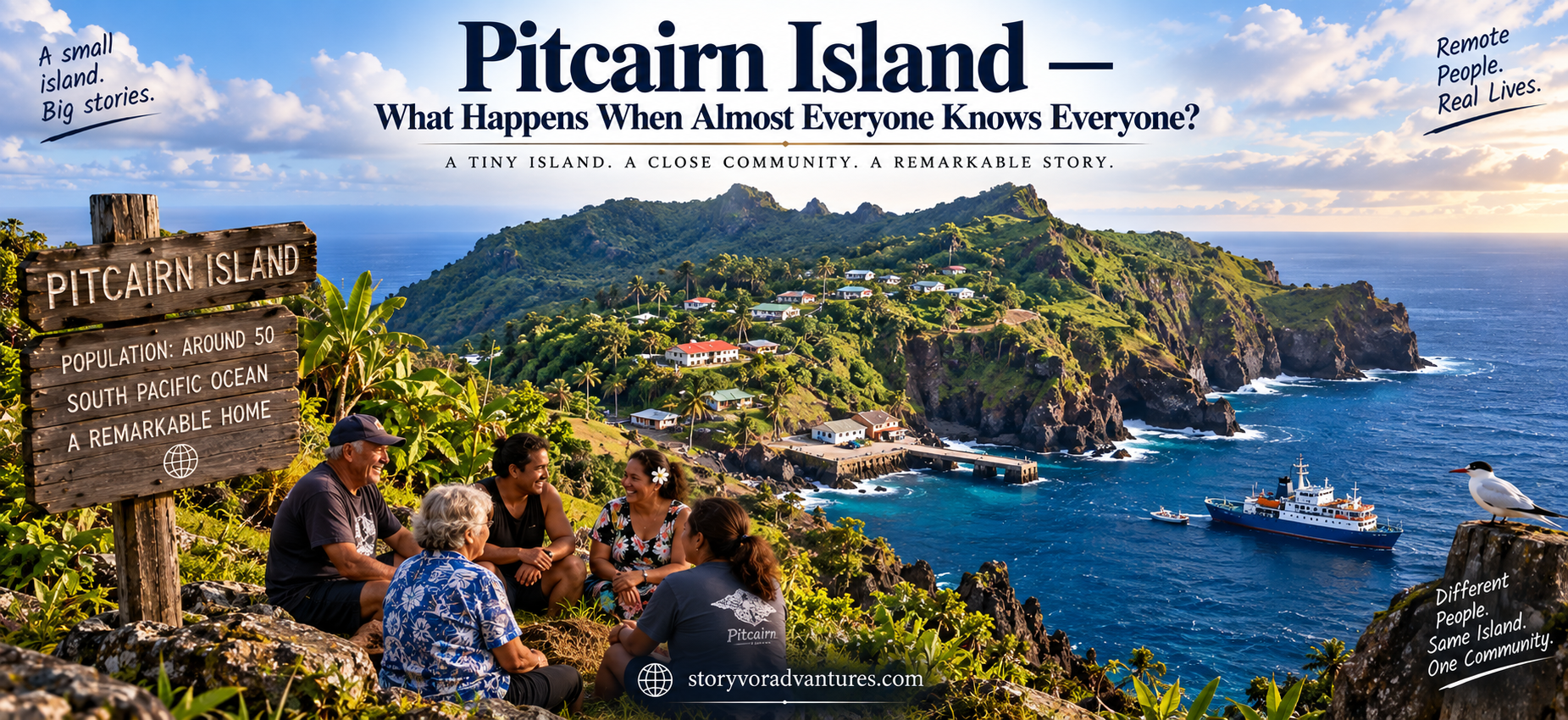
- Travel into the South Pacific and the scale becomes even smaller.
- The Pitcairn Islands form a British Overseas Territory consisting of Pitcairn, Henderson, Ducie and Oeno, but only Pitcairn itself is inhabited. The Pitcairn government describes the island as a small volcanic outcrop roughly 2,170 kilometres east-southeast of Tahiti, with a population of only around fifty people. Its administrative headquarters are not even on the island—they are in Auckland, New Zealand, more than 5,000 kilometres away.
- Imagine living in a community that small. In a major city, you can pass thousands of strangers in a single day. On Pitcairn, anonymity works differently. Community members may encounter the same people repeatedly across work, government, social life and practical island responsibilities. Maintaining infrastructure or responding to problems cannot always be somebody else’s job when the entire available population is tiny.
- Isolation does not mean the island has remained disconnected from modern technology. The government-operated marine science base, opened in 2024, includes facilities such as a laboratory and conference room and has access to high-speed internet. That detail captures something fascinating about modern remoteness: a location can be physically extremely isolated while still being digitally connected to researchers and institutions around the world.
- Pitcairn therefore challenges our traditional definition of isolation. Geography says you are far away. The internet says a conversation can cross the world almost instantly. A ship may still need a long time to physically bring something to you, while information can arrive in seconds.
- Remote life in the twenty-first century exists between those two realities.
🗿 3. Rapa Nui — An Isolated Island Connected to the World by Culture
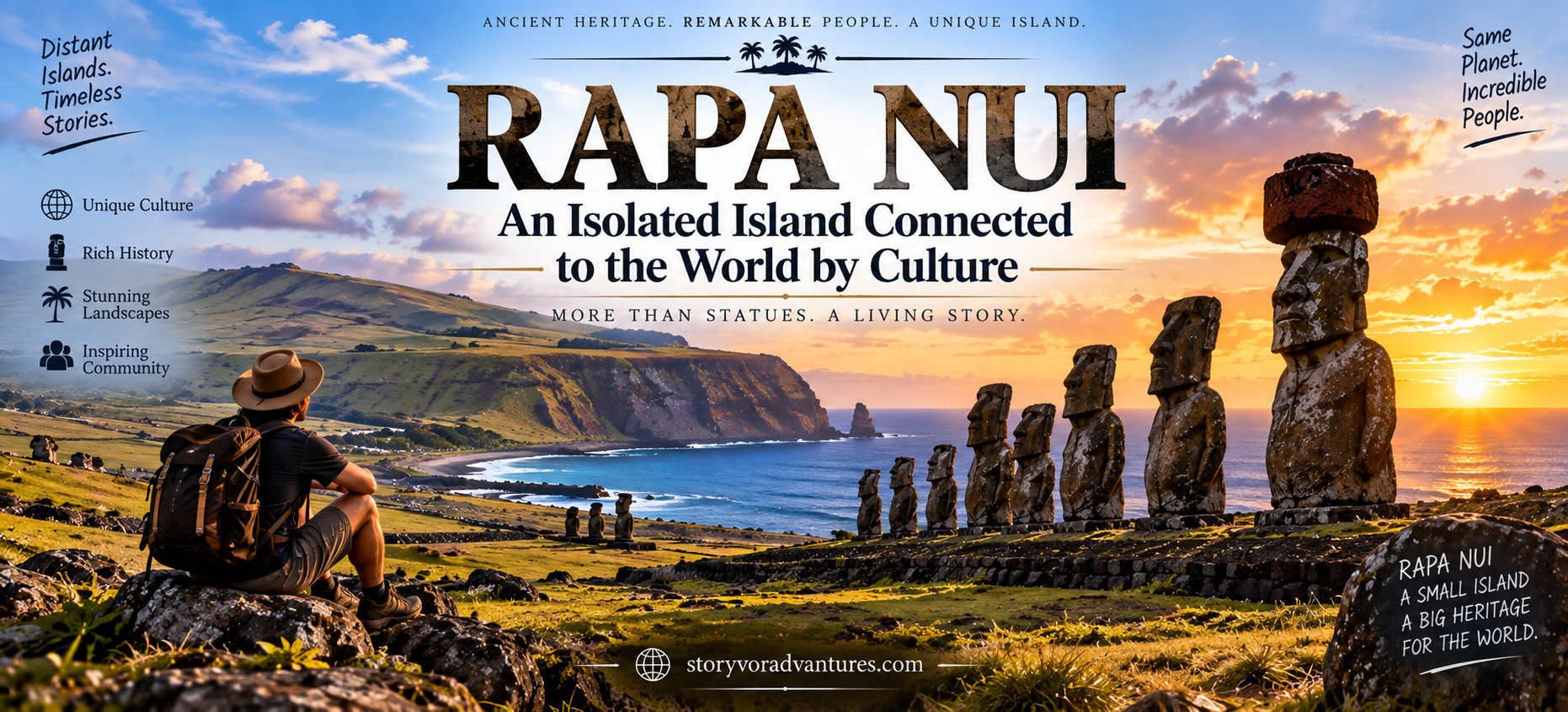
- Few remote islands are as instantly recognizable as Rapa Nui, also widely known as Easter Island. Its monumental moai have made the island famous around the world, yet the geographical reality behind those images is extraordinary. Chile’s official tourism site describes Rapa Nui as the world’s most isolated inhabited island, situated deep in the Pacific.
- Unlike some extremely remote communities, Rapa Nui has an airport and a significant tourism economy. But even air connectivity illustrates its isolation. Chile Travel’s current visitor guidance says access by air is through Mataveri International Airport, with direct flights departing from Santiago. Its itinerary guidance puts the direct flight at approximately 5½ hours.
- This makes Rapa Nui particularly interesting because remoteness and tourism exist together. People from around the world arrive to see moai, volcanic landscapes and archaeological sites, while local residents live ordinary lives in a place visitors may experience only briefly. The island must therefore balance connectivity and economic activity with protection of a cultural landscape that cannot simply be replaced if it is damaged.
- Current visitor rules demonstrate that responsibility. Chile requires specific entry documentation for Rapa Nui, and access to certain archaeological sites requires an accredited guide. Visitors are also instructed not to touch or climb on moai and ceremonial platforms.
- Rapa Nui shows us that isolation does not necessarily mean being unknown.
- A place can be geographically distant and globally famous at exactly the same time.
❄️ 4. Oymyakon — Where Extreme Cold Changes Ordinary Tasks
- Remoteness is not always created by an ocean.
- Sometimes climate creates its own kind of isolation.
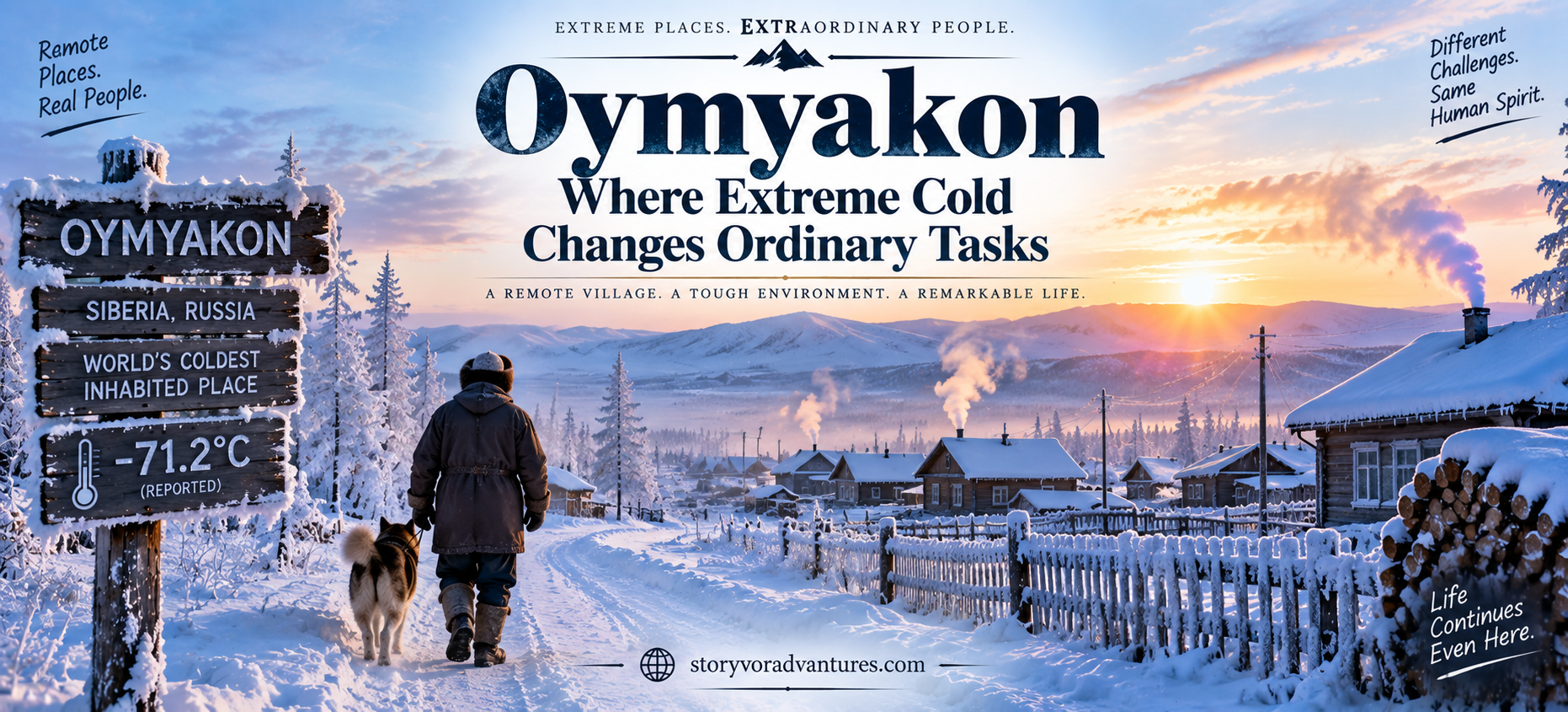
- In northeastern Siberia lies Oymyakon, widely known for extraordinary winter cold. National Geographic has described it as the coldest permanently inhabited place on Earth and reported a historic temperature of approximately −71.2°C. The settlement lies hundreds of kilometres east of Yakutsk in a region where winter is not simply a season—it is a major force shaping daily life.
- At temperatures that extreme, activities that seem completely ordinary elsewhere require more thought. Vehicles, heating systems, clothing, food storage and outdoor work all have to function in conditions where exposure can quickly become dangerous. The environment is not something residents can ignore while going about their day; it influences how the day itself is organized.
- This is what makes Oymyakon more interesting than simply calling it “one of the coldest places.” A temperature record is just a number until you imagine people waking up, preparing food, travelling, working and maintaining homes within that environment. The real story is not that the thermometer can fall extraordinarily low.
- The story is that ordinary human life continues anyway.
- Humans have occupied environments ranging from tropical islands to frozen continental interiors because adaptation is not limited to biology. We adapt through knowledge, architecture, clothing, technology, habits and community experience.
- Oymyakon makes that visible in one of Earth’s most extreme climates.
🏜️ 5. Supai — A Village Hidden Inside the Grand Canyon

- The United States contains some of the world’s largest cities and transport networks, yet deep inside the Grand Canyon region exists a community whose geography creates an entirely different experience.
- Supai, home of the Havasupai people, is located in a remote canyon landscape in Arizona. Its location demonstrates that a settlement does not have to be on an island to feel separated from surrounding infrastructure. Deep canyon walls, difficult terrain and limited conventional road access can create isolation just as effectively as kilometres of ocean.
- This is one of the reasons remote communities should not all be placed into a single category. The challenges facing an Arctic settlement are different from those facing an ocean island, and both are different from those of a community surrounded by steep canyon terrain. Geography determines which solutions are practical.
- For visitors, a remote landscape may feel like an adventure. For residents, however, the same landscape is part of everyday logistics. Food, medical needs, construction materials, communication and transport are not abstract travel questions—they are requirements of a functioning community.
- That distinction is important throughout this article.
- A remote destination for a traveller can be an ordinary hometown for somebody else.
🏔️ 6. La Rinconada — When Altitude Creates Isolation
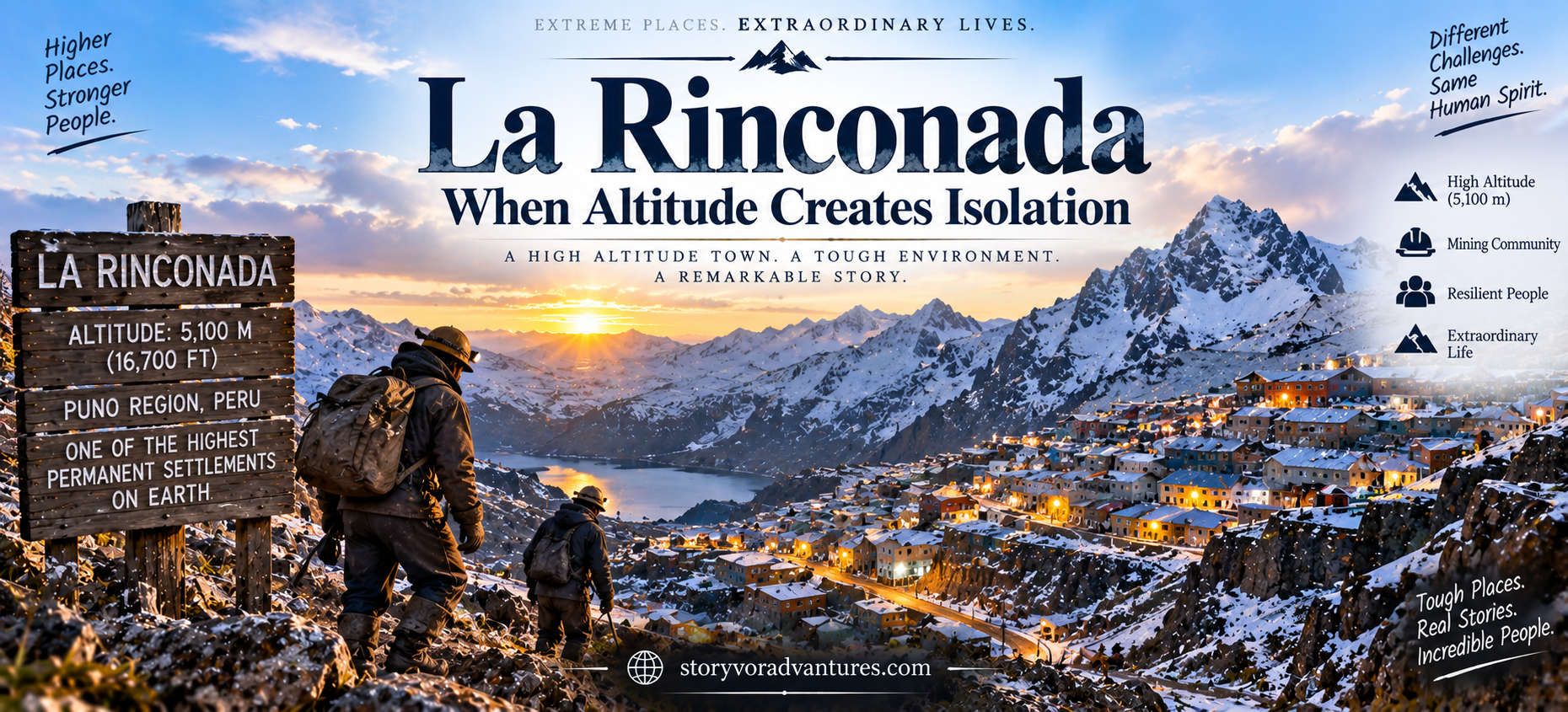
- High in the Peruvian Andes lies another kind of extreme settlement: La Rinconada.
- Its isolation is not primarily caused by an ocean or Arctic cold. It comes from altitude, mountain terrain and the difficult conditions associated with living several kilometres above sea level. La Rinconada is frequently described as one of the world’s highest permanent settlements, and its economy has long been closely connected with gold mining.
- At extreme altitude, the atmosphere contains substantially less available oxygen per breath than at sea level. For people arriving from lower elevations, acclimatization can become important, and physical exertion may feel dramatically harder. For long-term high-altitude populations, however, generations of experience and physiological adaptation help shape life in environments that outsiders may find extremely challenging.
- But remoteness should never be romanticized automatically. A dramatic mountain photograph can make an isolated settlement look peaceful or adventurous while hiding problems involving infrastructure, sanitation, working conditions or access to services. A location can be visually extraordinary while everyday life there remains complicated.
- La Rinconada therefore gives us an important reminder: surviving in an extreme environment and having a high quality of life are not necessarily the same thing.
- Understanding remote communities means looking beyond spectacular scenery.
🌊 7. Palmerston Island — When the Ocean Becomes the Main Road
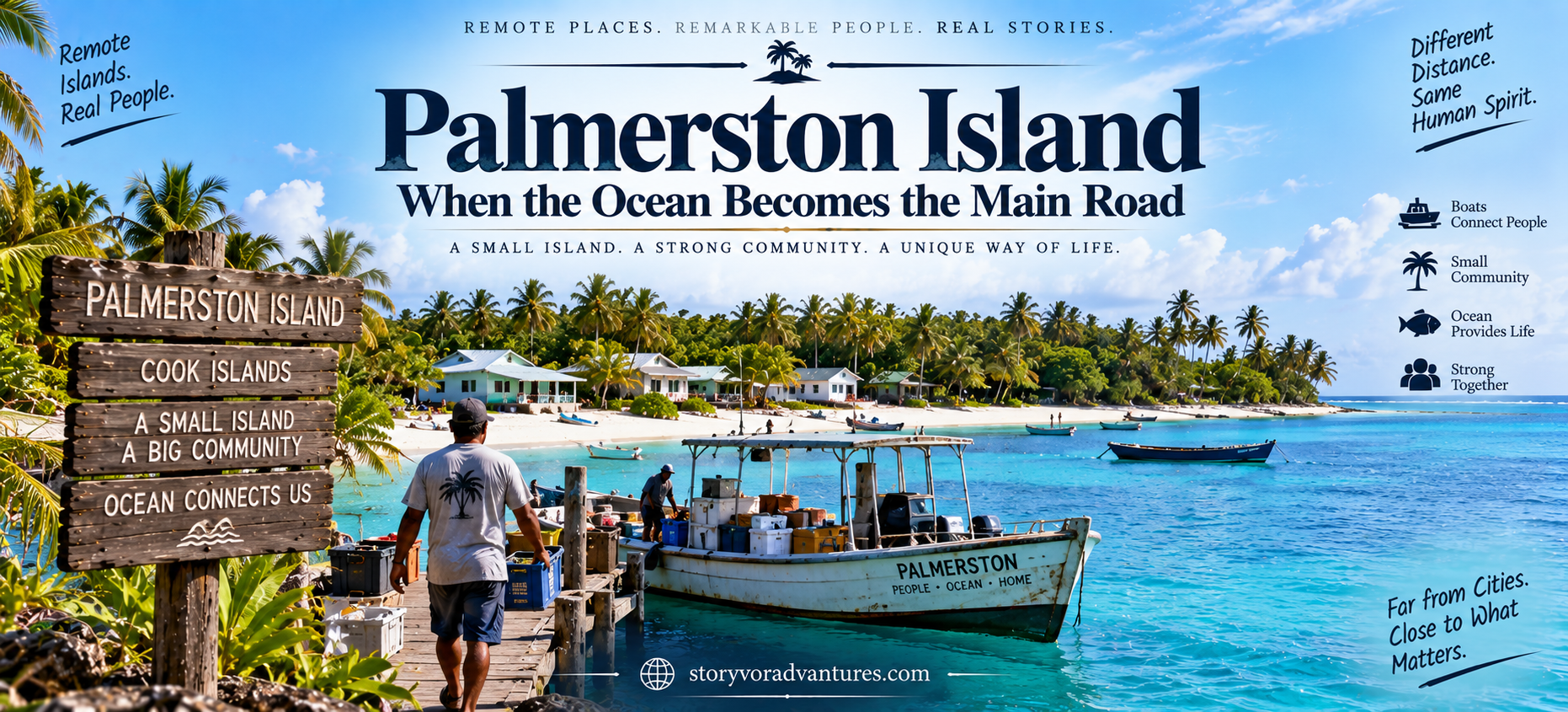
- On a map of the Pacific, small islands can appear like dots surrounded by blue.
- On the ground, that blue represents enormous distances.
- Palmerston Island, part of the Cook Islands, is one of those places where the ocean shapes practically every connection with the outside world. Communities on small Pacific islands have historically depended heavily on boats, local resources and careful planning because conventional road networks cannot connect them to another country or distant island.
- This changes how people think about supplies. In a city, running out of something might mean travelling to another supermarket. On a remote island, replacement goods may need to cross hundreds or thousands of kilometres of ocean. Weather and shipping schedules can therefore influence decisions that urban residents rarely need to consider.
- Yet isolation can also encourage a different relationship with resources. Repairing something may make more sense than immediately replacing it. Food production, fishing, storage and community cooperation can become especially valuable when imported goods have long supply chains.
- Modern communication has reduced some aspects of this isolation, but it cannot eliminate physical geography. A video call can carry a face across the Pacific almost instantly.
- It cannot carry a refrigerator, medicine or building material.
- That still requires transportation.
8. Remote Greenland — Where Weather Can Control the Schedule
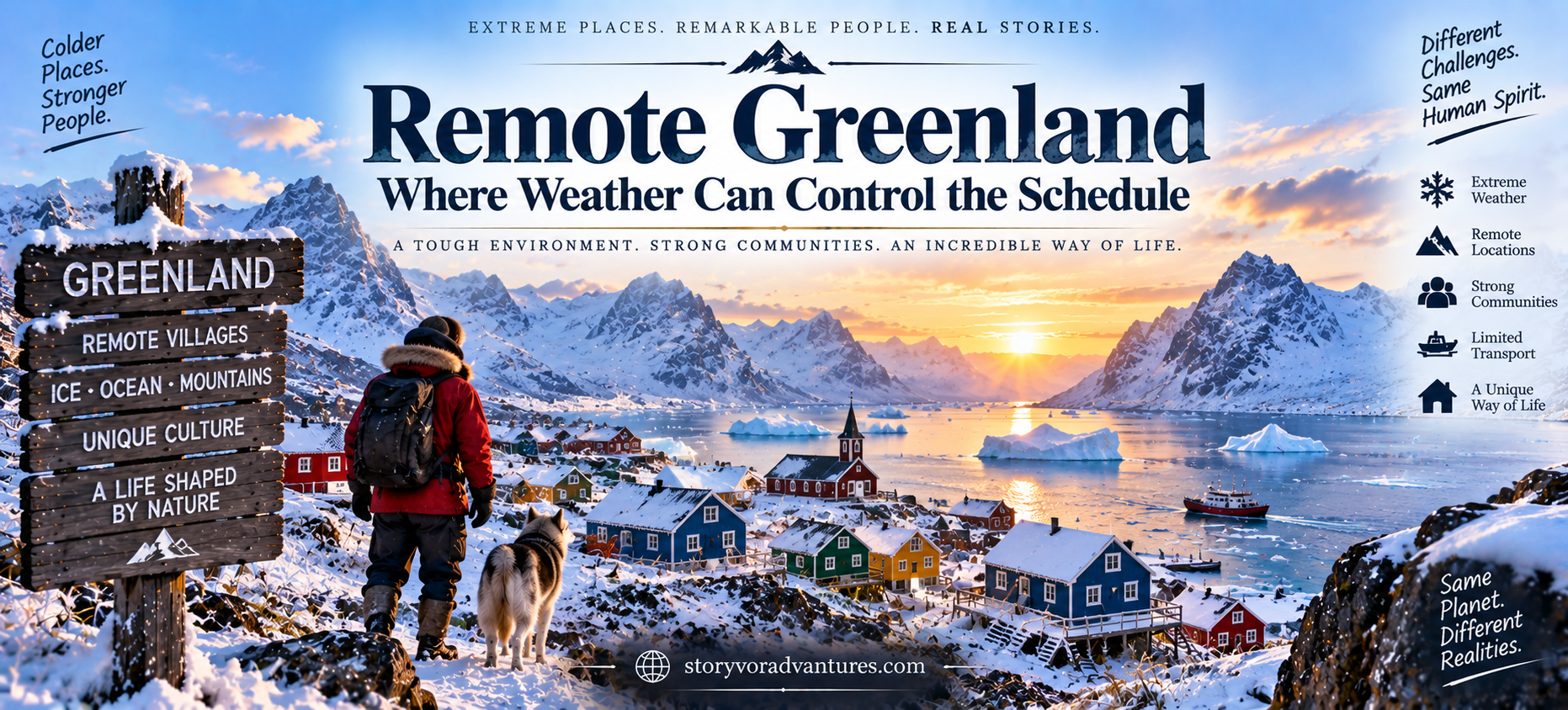
- Along Greenland’s enormous coastline are settlements separated not only by distance but also by ice, mountains, ocean and severe weather.
- Places such as Ittoqqortoormiit in eastern Greenland demonstrate how different transport becomes when conventional road connections between towns are not the foundation of the system. In much of Greenland, movement between communities relies heavily on combinations of boats, aircraft and helicopters, with seasonal conditions affecting what is practical.
- That creates a lifestyle in which weather can have more authority over the schedule than the clock. A journey that appears straightforward on a map may depend on visibility, sea conditions, ice and transport availability. Residents learn to plan around environmental uncertainty because the landscape cannot simply be engineered into behaving like a major metropolitan area.
- Greenland also reminds us that remote communities are not museum exhibits frozen in the past. Smartphones, internet access, modern healthcare systems, education and global culture can coexist with hunting traditions, local knowledge and landscapes that have shaped life for generations.
- Modernity does not always erase remoteness.
- Sometimes the two exist side by side.
🏝️ 9. Remote Islands Teach Us How Fragile Supply Chains Can Be
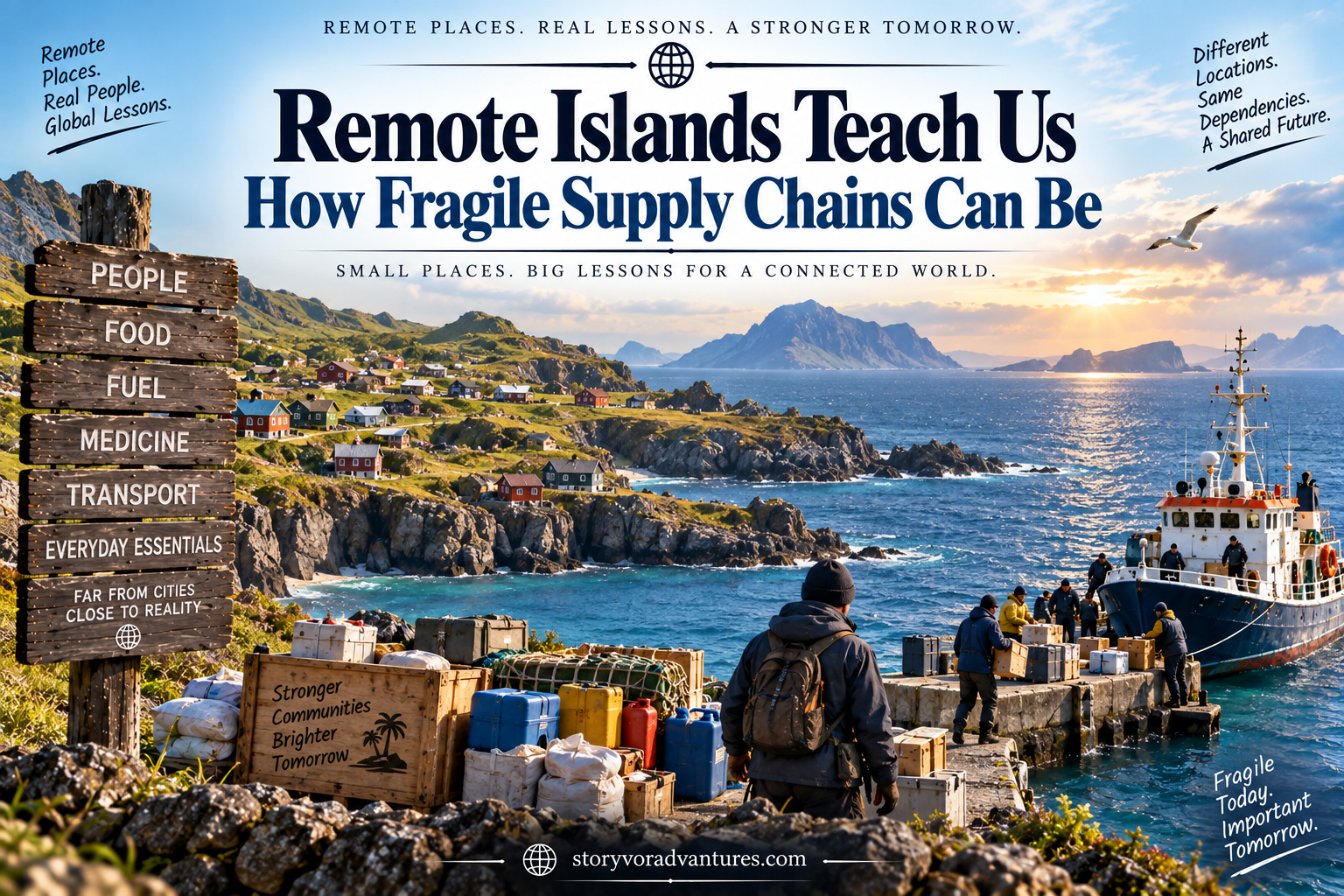
- One pattern appears repeatedly when studying isolated communities: distance makes supply chains visible.
- In a large city, food seems to appear magically on supermarket shelves. Fuel arrives at stations. Medicines arrive at pharmacies. Construction materials appear at building sites. Most consumers never see the ships, warehouses, aircraft, trucks, ports and workers that make this possible.
- Remote islands cannot hide that system as easily.
- When supplies arrive less frequently or travel much farther, communities must think carefully about storage, availability and timing. A disruption caused by weather, mechanical problems or transport delays can have consequences that would be minor in a city with multiple alternative suppliers.
- This makes remote communities surprisingly relevant to the rest of us. They reveal something that modern urban convenience often hides:
- Almost no community is truly independent.
- The difference is that isolation makes dependence easier to see.
🏥 10. What Happens When the Nearest Major Hospital Is Far Away?
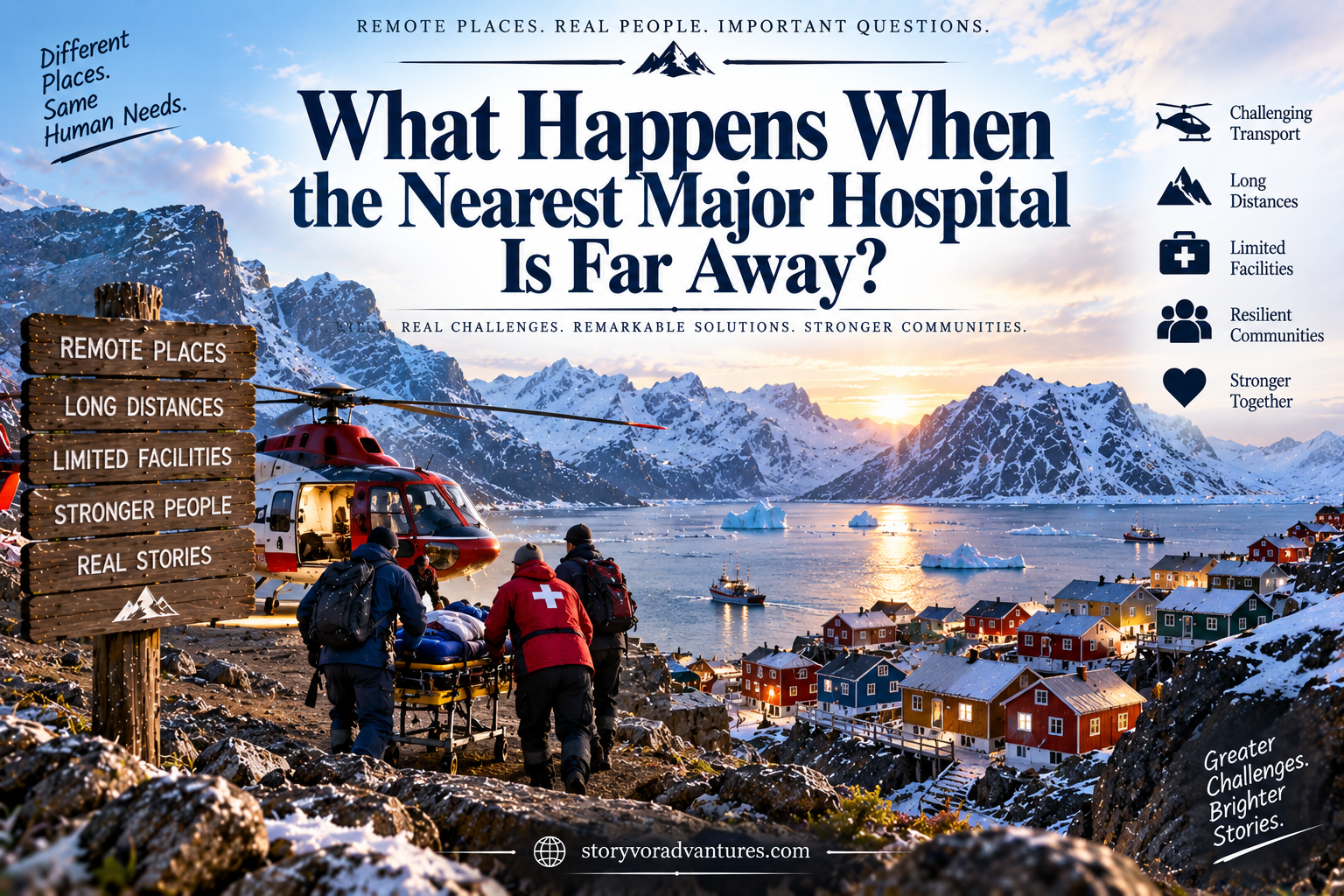
- One of the most serious consequences of geographic isolation involves healthcare.
- A headache, minor injury or routine illness may be manageable locally. But complicated surgery, advanced diagnostic equipment or specialist treatment can create an entirely different challenge when a settlement has only basic medical facilities and the nearest major hospital is far away.
- Remote communities therefore need systems for deciding what can be treated locally and when evacuation or travel becomes necessary. Distance, weather and transportation can become part of the medical equation in ways that people living near large hospitals rarely experience.
- This also explains why healthcare infrastructure matters enormously even when the population is tiny. A clinic serving a few hundred people may look insignificant compared with a giant city hospital, but for the community depending on it, that facility can be one of the most important buildings on the island or in the settlement.
- Isolation teaches a simple lesson about public services:
- Their importance is not measured only by how many people use them.
- Sometimes importance is measured by how few alternatives exist when they are needed.
📚 11. How Do Children Go to School in a Tiny Community?
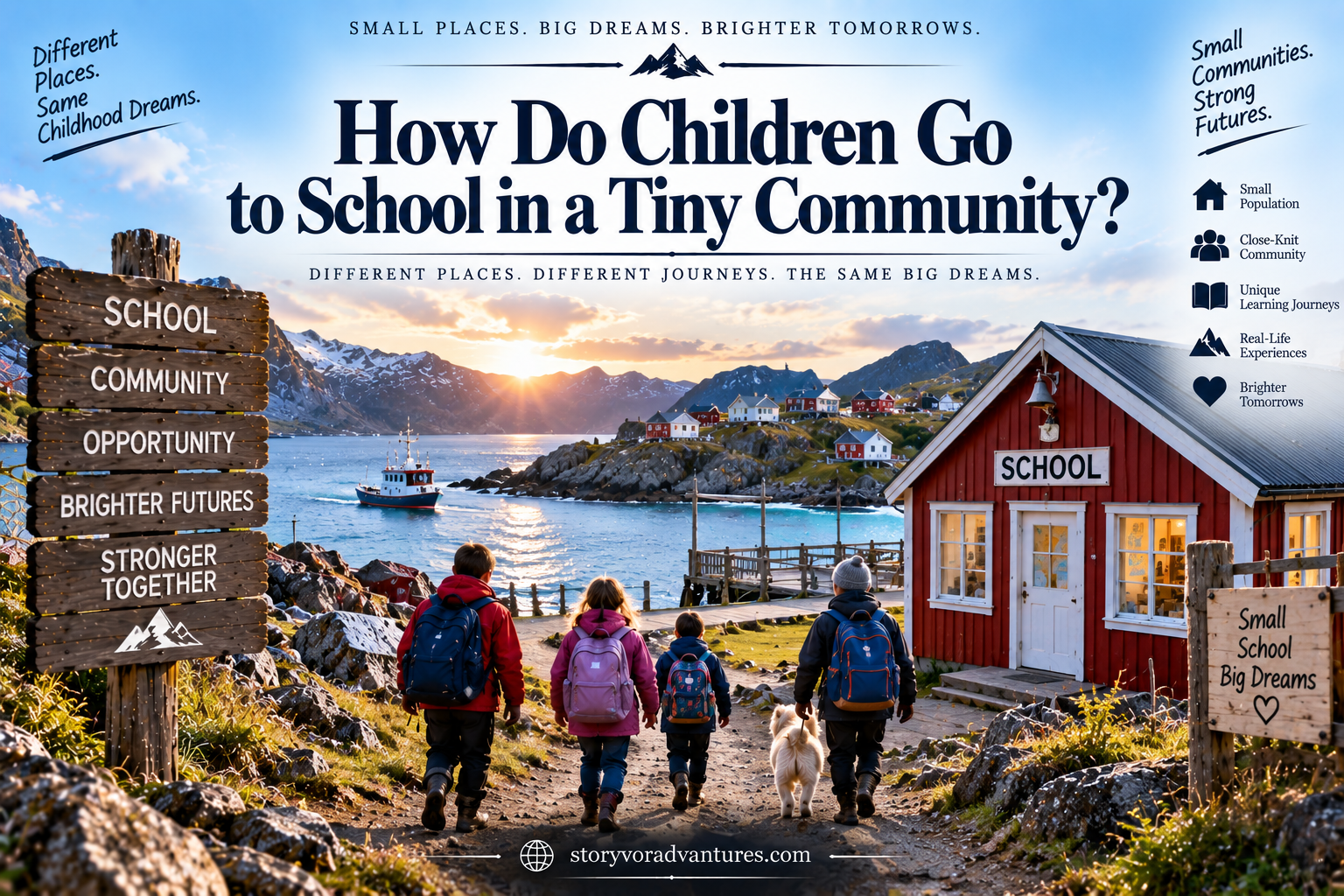
- Education presents another fascinating challenge.
- Imagine operating a school where the total number of children may be smaller than a single classroom in a large city. Age groups can be small, specialist teachers may be limited, and older students may eventually need opportunities that are unavailable locally.
- Remote communities solve these challenges differently depending on their location and political connections. Local schools, visiting teachers, online learning and education overseas can all become part of the picture.
- But education can create a difficult long-term question. When young people leave a tiny island or settlement for university, specialized training or employment, will they return?
- For a city of millions, losing a few residents changes almost nothing. For a community of only a few hundred—or a few dozen—every permanent departure can matter. A remote community therefore does not simply need people to survive today.
- It needs enough people to imagine a future there tomorrow.
📱 12. The Internet Has Changed What “Remote” Means
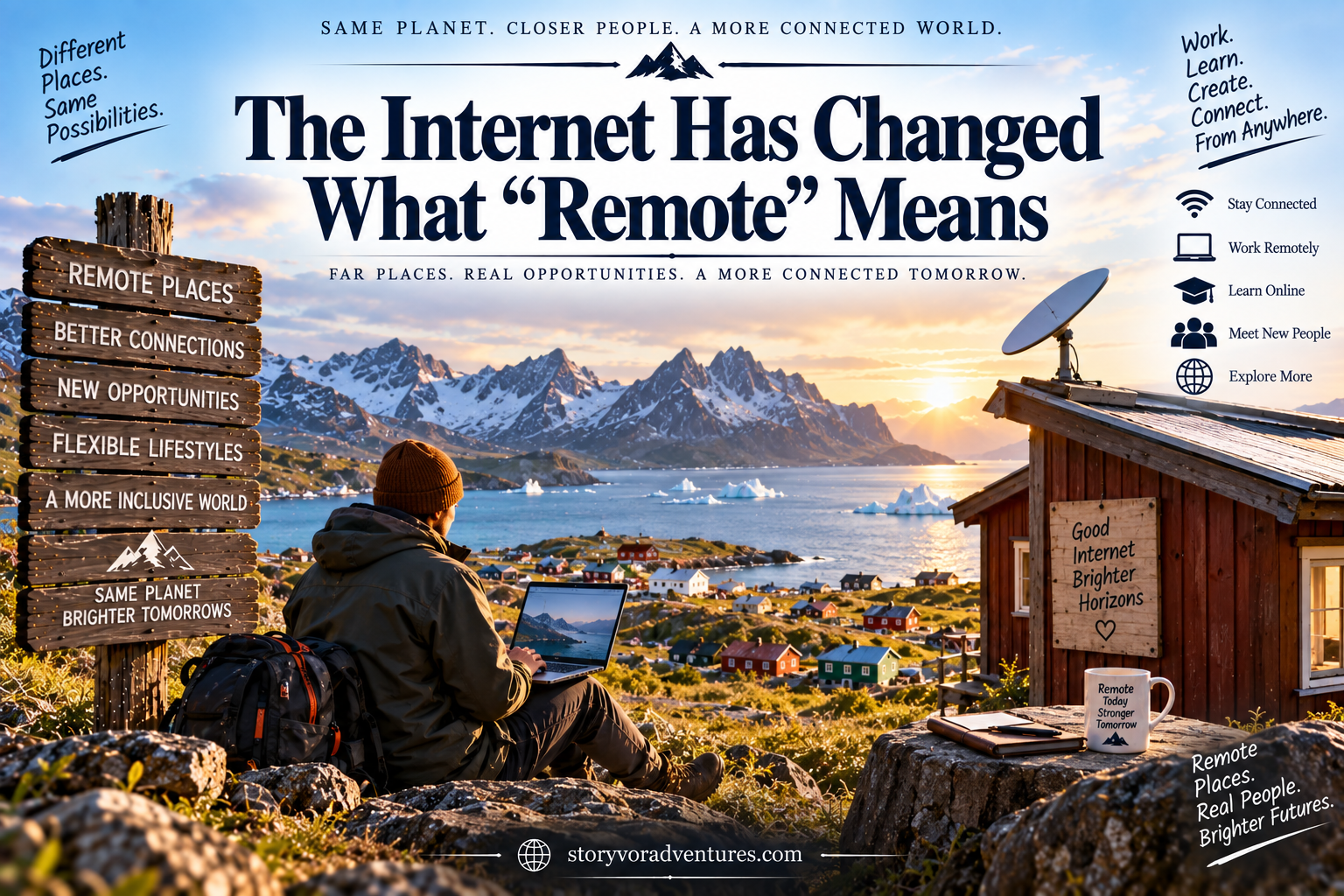
- For most of human history, physical distance also meant communication distance.
- A message from an isolated island might have travelled aboard a ship. News could arrive weeks or months after an event. Families separated by oceans had no instant way to see one another.
- The internet changed that relationship dramatically.
- Today, some physically remote communities can access global news, education, entertainment, businesses and personal communication without physically leaving home. Pitcairn’s government, for example, specifically notes high-speed internet access at its marine science facility despite the island’s extraordinary physical isolation.
- This creates a fascinating new definition of remoteness.
- A teenager on a distant island may watch the same online video at roughly the same time as somebody in London, Mumbai or New York. But if both teenagers order the same physical product, their experiences may be completely different.
- Information has escaped geography much faster than physical objects have.
- The internet can reduce social and informational isolation.
- It cannot shorten the ocean.
🤝 13. In a Tiny Community, Your Neighbour May Matter More Than You Realise
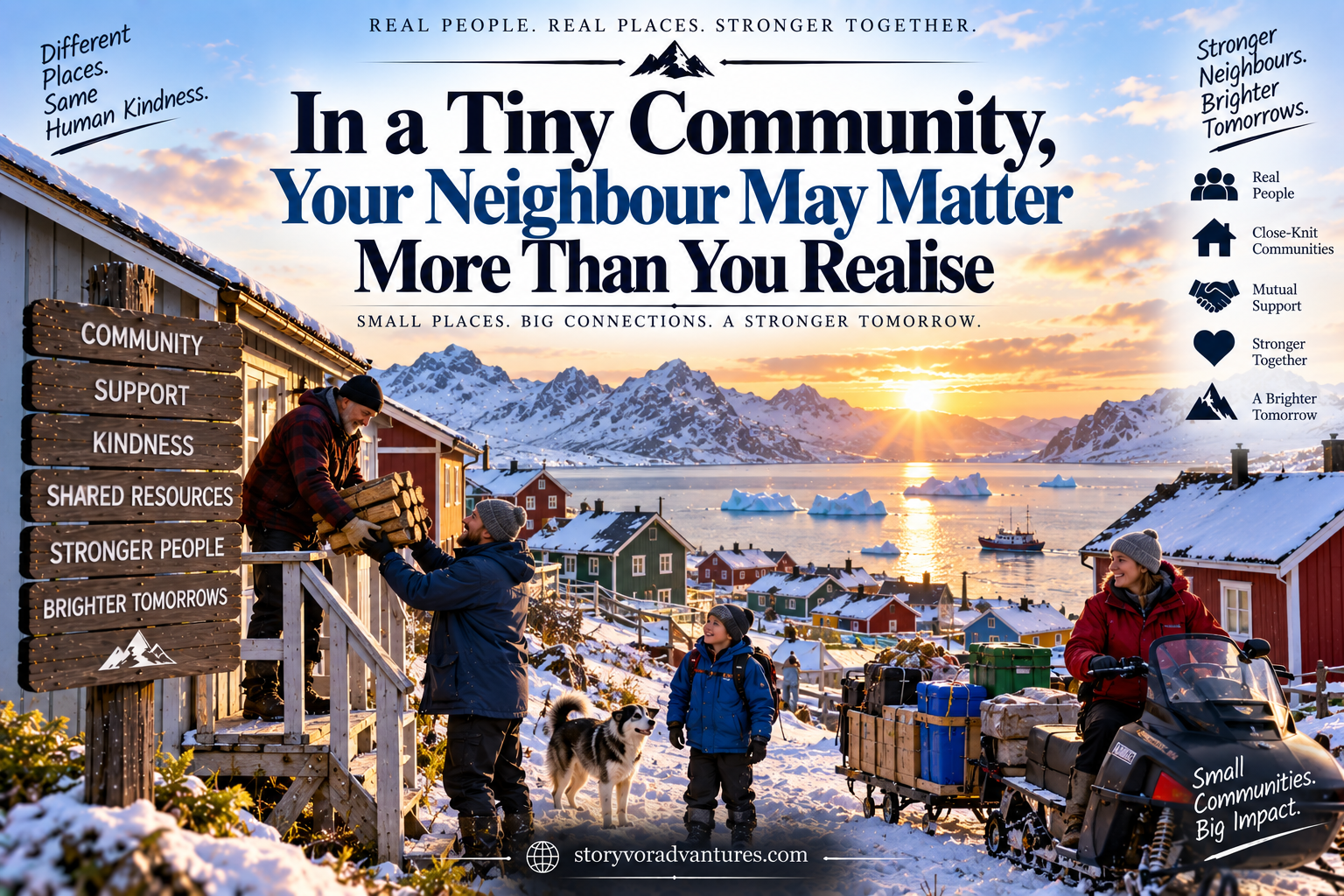
- Large cities allow people to specialize.
- One person repairs electricity. Another provides healthcare. Someone else manages food distribution. Thousands of other workers perform tasks most residents never need to understand.
- Small remote communities cannot always divide responsibility so widely.
- When only a few hundred people live together, individuals may perform multiple roles. The person you meet socially may also be involved in government, transport, maintenance, fishing, education or emergency response. Skills that would be outsourced in a city can become valuable community knowledge.
- This can make cooperation especially important. Relationships are not merely social; they can become part of the infrastructure that keeps the settlement functioning.
- Of course, small communities are not automatically perfect. Close relationships can bring their own pressures, disagreements and limitations. But extreme isolation makes one fact difficult to ignore:
- People need other people.
- The farther a community sits from outside assistance, the more visible that truth becomes.
✈️ 14. Why Would Anyone Choose to Stay?
- After reading about difficult transport, extreme weather, limited services and long supply chains, an obvious question appears:
- Why stay?
- But that question usually comes from the perspective of an outsider.
- Home is not simply the location offering the fastest internet, biggest supermarket or nearest airport. It can mean family, ancestry, language, landscape, identity, memory and belonging. A person raised on a remote island may see the surrounding ocean not as an obstacle but as part of home. Someone from an Arctic community may understand the landscape in ways that a visitor never could.
- Large cities offer opportunities that small communities cannot always provide. Remote places can offer things cities struggle to reproduce: familiarity, connection to landscape, cultural continuity and a strong sense of place.
- There is no universal answer.
- Some people leave.
- Some return.
- Some stay for their entire lives.
- And that is perhaps the point: the place that looks isolated to us may not feel incomplete to the person who calls it home.
🌍 15. What Remote Communities Can Teach the Rest of the World
- The most valuable lesson from remote communities is not that people can survive without modern civilization. Most isolated communities are connected to larger systems in important ways and may depend on imported supplies, healthcare, government support, transport or communications.
- The deeper lesson is about adaptation.
- When resources are harder to replace, planning matters. When outside help is distant, local knowledge matters. When populations are small, individual skills matter. When weather controls transport, patience matters. And when everybody repeatedly encounters everybody else, community relationships matter.
- People living in major cities benefit from enormous systems that make daily life feel effortless. Remote communities reveal those systems by showing us what happens when distance makes every connection more difficult.
- Perhaps isolation does not merely tell us how far a place is from somewhere else.
- It tells us how people build a functioning life despite that distance.
❤️ Final Thoughts — Remote Does Not Mean Empty
- Look at Tristan da Cunha on a world map and it appears almost lost in the Atlantic. Find Pitcairn and it seems like a tiny mark inside an enormous Pacific. Look toward Greenland, Siberia or a deep canyon and it becomes easy to describe these places using words such as distant, extreme and isolated.
- But maps can create a misleading perspective.
- A dot on a map can contain childhoods, friendships, arguments, weddings, school mornings, jobs, traditions, emergencies, celebrations and memories. What looks like “the middle of nowhere” from thousands of kilometres away can be the exact centre of somebody’s world.
- That may be the most important lesson these communities offer.
- Remoteness is measured from somewhere else. Home is measured from where you belong.
- The next time you see a tiny inhabited island or settlement far from a major city, don’t ask only:
- “How can anyone live there?”
- Ask something more interesting:
“How did people learn to make a life there?”
- Because sometimes the most isolated communities on Earth reveal something surprisingly universal about humanity:
Wherever people build a home, they find ways to keep life moving.
❓ Frequently Asked Questions
What is one of the most remote inhabited island communities in the world?
Tristan da Cunha is widely described as one of the world’s most remote inhabited island communities. Its official population update listed 222 resident islanders in August 2026.
Does anyone actually live on Pitcairn Island?
Yes. Pitcairn is the only inhabited island in the four-island Pitcairn group. Its government describes a population of around fifty people.
Is Rapa Nui still difficult to reach?
It is remote, but it has air service. Chile’s official tourism information currently lists direct access through Mataveri International Airport from Santiago, with the flight taking around 5½ hours.
Does living remotely mean living without the internet?
Not necessarily. Modern communications have changed remote life considerably. Physical supplies may still face long journeys even when digital information travels almost instantly.
What makes a place isolated?
There is no single definition. Distance from other settlements, transport access, terrain, weather, population size, healthcare access and supply routes can all contribute. An island can be isolated by ocean, while an inland settlement can be isolated by mountains, ice, desert or canyon terrain.
📌 Important Note
Geographic conditions, transport services, populations and local rules can change, so readers planning to visit any remote community should check current official information before travelling. Remote settlements are living communities rather than attractions alone; visitors should respect local residents, cultures, regulations and environments.