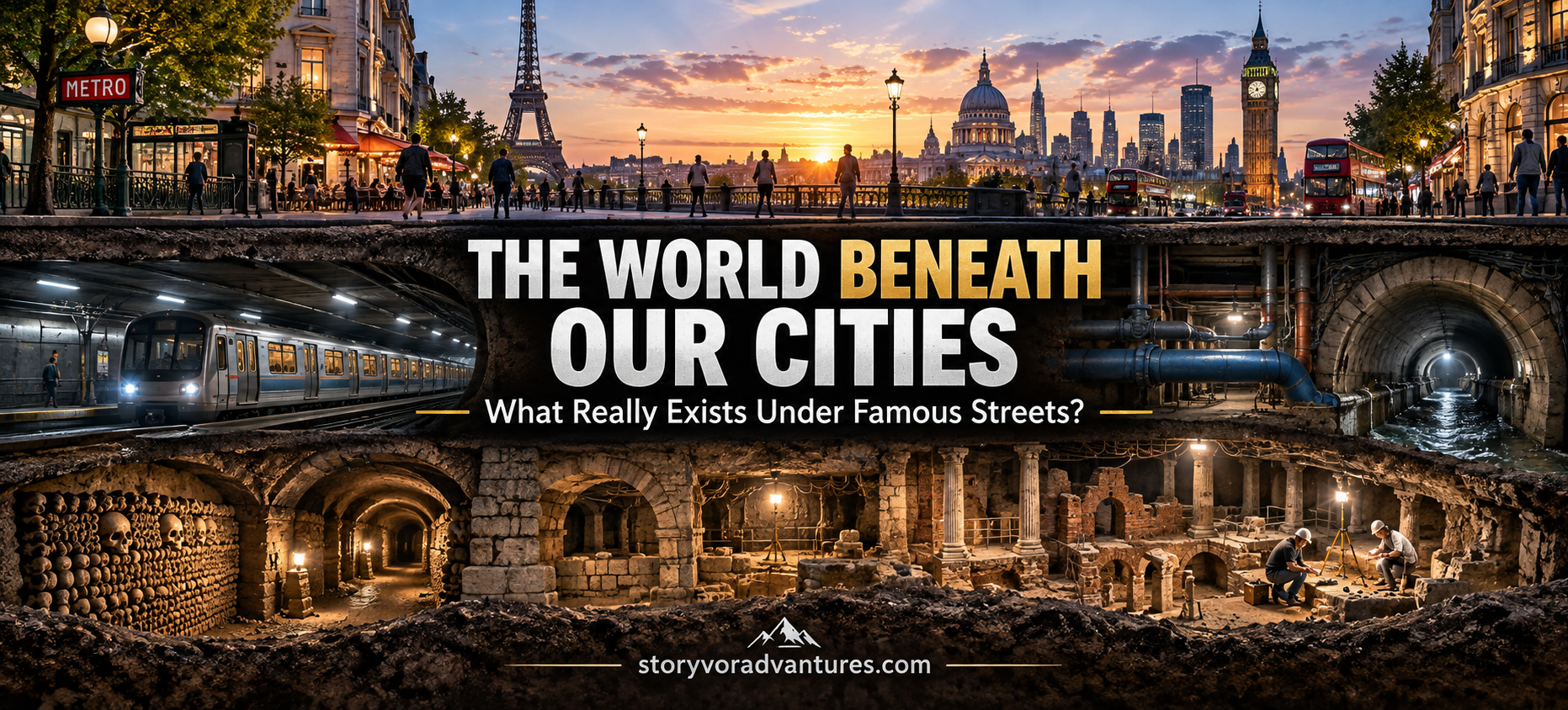
🏙️ The World Beneath Our Cities: What Really Exists Under Famous Streets?
From ancient ruins beneath Rome to Parisian quarries and enormous engineering systems under Tokyo, discover the hidden layers that keep the world’s cities alive.
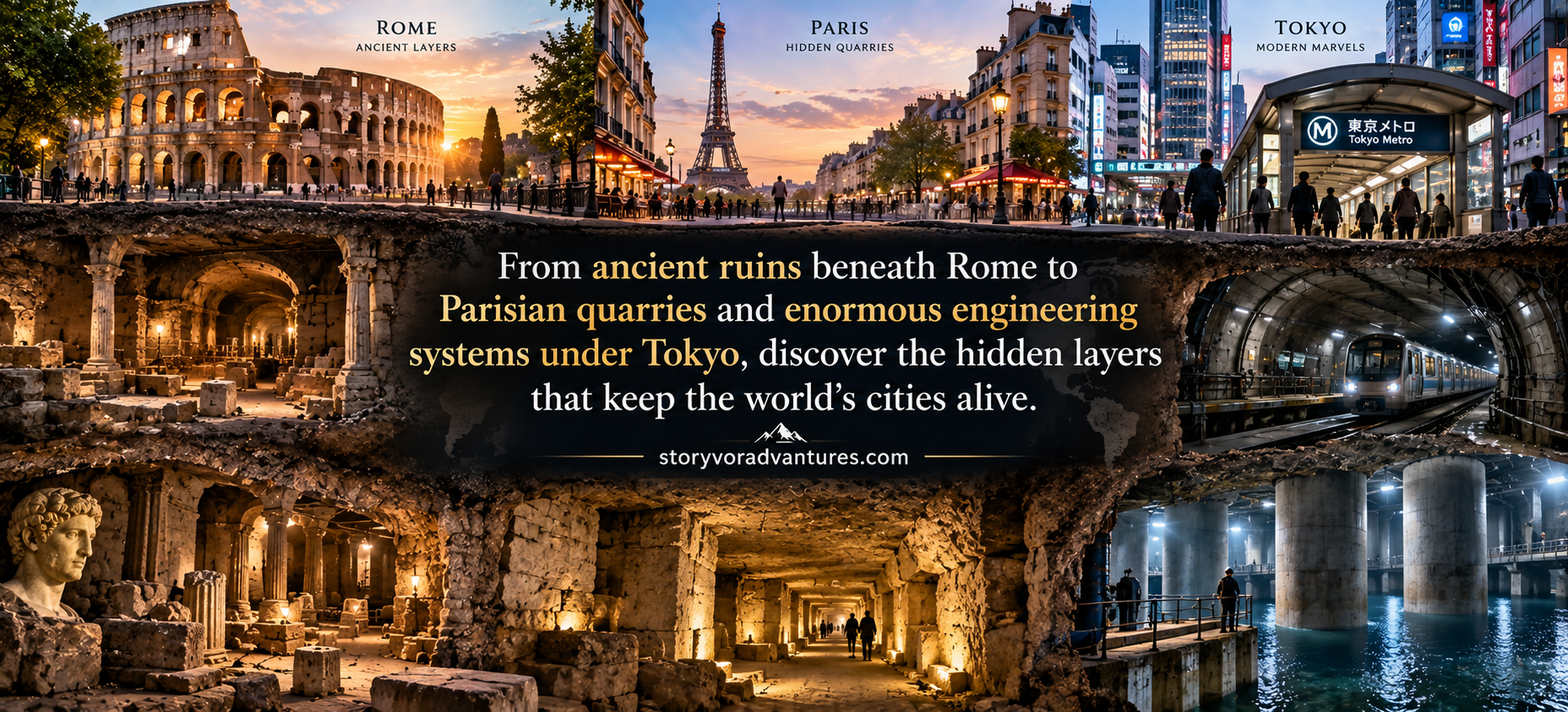
- Every morning, millions of people walk through cities without thinking about what may exist only a few metres beneath their feet.
- A crowded road might be sitting above a railway tunnel. A café could be built over the remains of an older city. Beneath an apartment building there may be forgotten foundations, water channels, wartime shelters or passages that were constructed hundreds of years before the modern neighbourhood existed.
- Cities rarely grow on completely empty land. They expand, rebuild, demolish and rebuild again. Roads rise, buildings disappear, rivers are redirected and transport systems are pushed underground. Over centuries, these changes can create something that almost resembles a second city beneath the visible one.
- In some places, the underground world is carefully mapped and used every day. In others, parts of the past remain sealed behind walls, beneath construction sites or inside spaces that ordinary visitors never see.
- So what actually exists beneath some of the world’s most famous streets?
- The answer is far more interesting than a few subway tunnels.
🇫🇷 1. Paris — A Modern Capital Standing Above Quarries and Catacombs
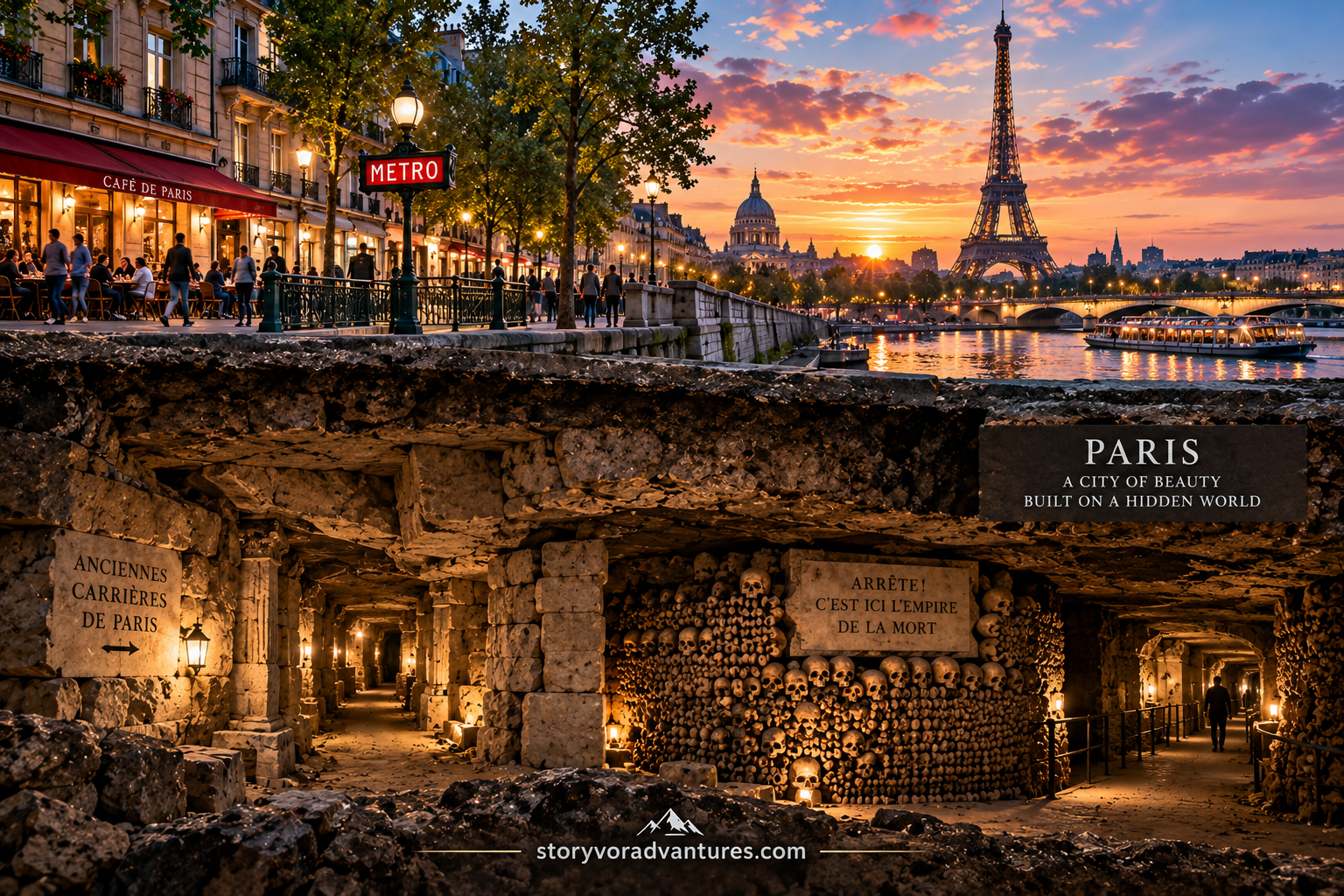
- Walk through Paris and the city above ground appears almost impossibly elegant. Boulevards, cafés, apartments and historic monuments create one of the world’s most recognizable urban landscapes. Yet beneath portions of that familiar city lies a very different environment.
- For centuries, stone was extracted from underground quarries around Paris. Limestone taken from these workings helped provide material for buildings above ground. As the city expanded over areas containing old quarry networks, the underground spaces became an engineering concern as well as a historical one.
- One particularly famous part of this underground story is the Paris Catacombs. Beginning in the late eighteenth century, remains from overcrowded and problematic cemeteries were transferred into sections of former quarry tunnels. Today, a limited portion of the Catacombs is accessible to visitors, while the wider underground quarry network extends far beyond the official visitor route.
- The contrast is extraordinary. Above ground, people may be shopping, eating or travelling through one of Europe’s busiest capitals. Far below parts of the same city, stone corridors preserve evidence of an entirely different chapter of Parisian history.
- It is a reminder that a city can have two landscapes at once: the one people see and the one that made the modern city possible.
🇮🇹 2. Rome — Today’s Streets Can Sit Above Yesterday’s City
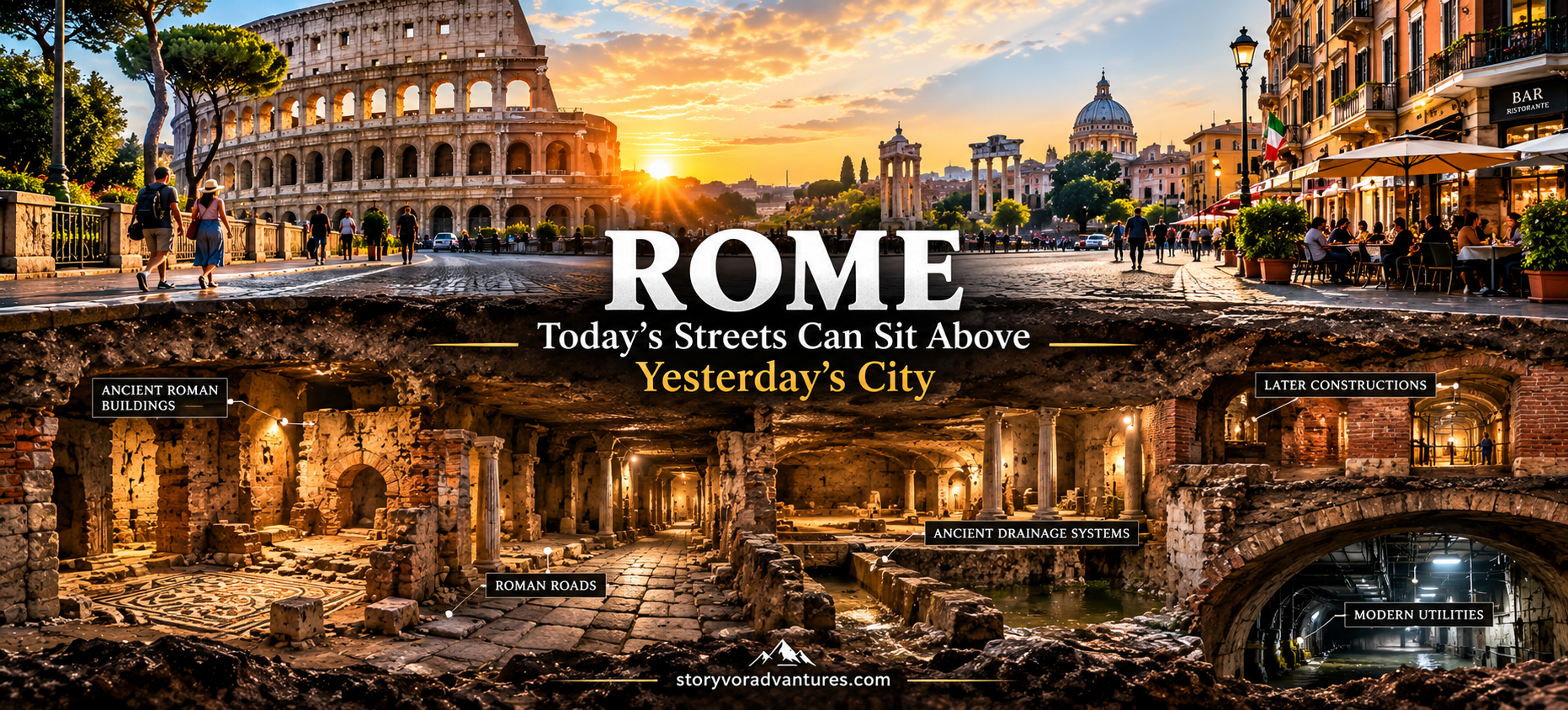
- Rome presents a different underground phenomenon. Instead of one enormous hidden system explaining everything beneath the city, Rome contains layers from different periods of its extraordinarily long history.
- Ancient structures were abandoned, damaged, reused or built over. Ground levels changed. New buildings appeared above older foundations. Churches sometimes incorporated or stood over structures belonging to earlier periods.
- This means travelling downward in Rome can sometimes feel surprisingly similar to travelling backward through time.
- Archaeological spaces beneath modern buildings can reveal ancient houses, roads, religious spaces, drainage systems and other remains. Some locations show how generations of Romans repeatedly adapted the same urban ground rather than simply clearing everything away and beginning again.
- That makes Rome’s underground world especially fascinating. What appears to be the “ground floor” of today’s city is not necessarily the ground level that existed there two thousand years ago.
- The city did not simply replace its past.
- In many places, it grew on top of it.
🇹🇷 3. Istanbul — Where Underground Engineering Once Stored a City’s Water
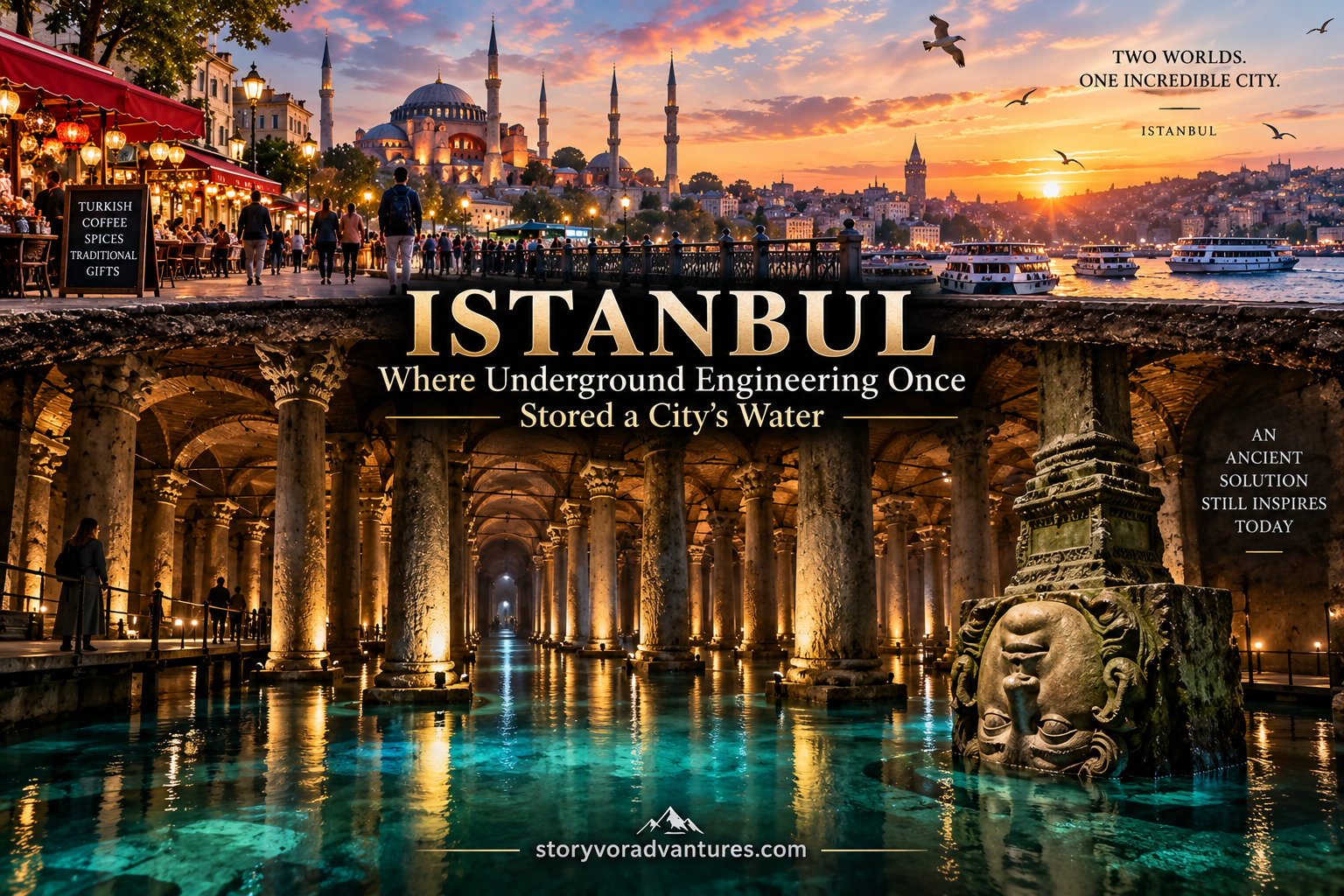
- Not every spectacular underground structure was designed for people to live or travel through.
- Some were built to keep the city itself functioning.
- Beneath Istanbul lies one of the most visually impressive examples: the Basilica Cistern. Constructed during the Byzantine era, this vast underground reservoir formed part of the infrastructure used to store water for the city.
- Its rows of columns make the space look almost like a submerged palace, which can distract from its original purpose. This was infrastructure—an engineered response to one of the oldest problems faced by large cities: securing and managing water.
- That idea remains relevant today. Modern residents expect water to appear when a tap is opened, electricity to travel invisibly through cables and waste to disappear through pipes. Much of the infrastructure making city life possible is intentionally hidden.
- Istanbul’s cistern makes that invisible relationship unusually beautiful.
- It shows that some of the greatest structures beneath cities were not monuments built to be admired. They were practical systems built because urban life depended on them.
🇬🇧 4. London — An Underground Network Far Bigger Than the Passenger Map
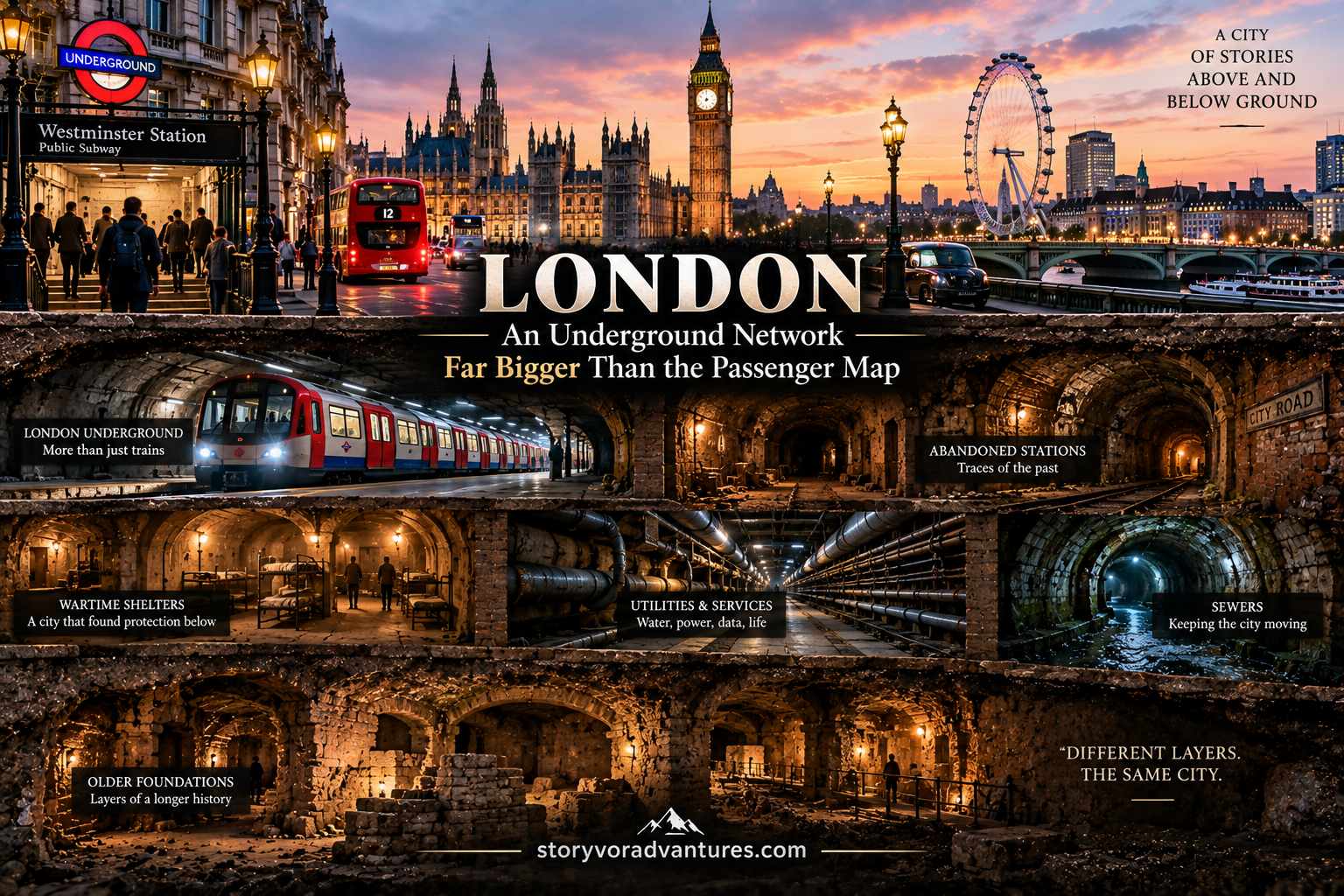
- For most people, underground London means the Tube.
- But the familiar passenger network is only one part of the infrastructure beneath the British capital.
- London’s underground environment includes railway tunnels, utility infrastructure, sewers, service spaces, shelters and structures created for different purposes at different moments in the city’s development.
- The London Underground itself also contains traces of change. Stations have closed, platforms have fallen out of regular passenger use and routes have been reorganized as transportation needs evolved.
- During periods of war, underground spaces also acquired another importance. Some were used or adapted to protect people and support essential operations while danger existed above ground.
- London therefore demonstrates how the purpose of underground space can change. A tunnel can begin as transportation infrastructure, become strategically important during an emergency and later survive as a historical remnant.
- Above ground, London continually modernizes.
- Below ground, pieces of earlier versions of the city can remain surprisingly close.
🇬🇧 5. Edinburgh — When a Growing City Builds Over Its Own Streets

- Edinburgh offers another remarkable example of how urban development can leave older spaces beneath newer ones.
- Around the historic Old Town, changing street levels, bridges and construction created enclosed spaces beneath parts of the city. One well-known example is the area associated with Mary King’s Close, where portions of historic streets and buildings eventually became covered by later development.
- The interesting part is not simply that “a street exists underground.” It is understanding how something that was once part of ordinary urban life can become hidden when the city around it changes.
- Imagine a place where people once walked between homes and businesses. Generations later, the city has been altered so extensively that portions of that earlier environment appear to belong underground.
- Urban landscapes can therefore be deceptive.
- A street is not permanent simply because it looks permanent today. Cities constantly modify their own geography.
🇺🇸 6. New York City — The Invisible Systems Supporting Life Above
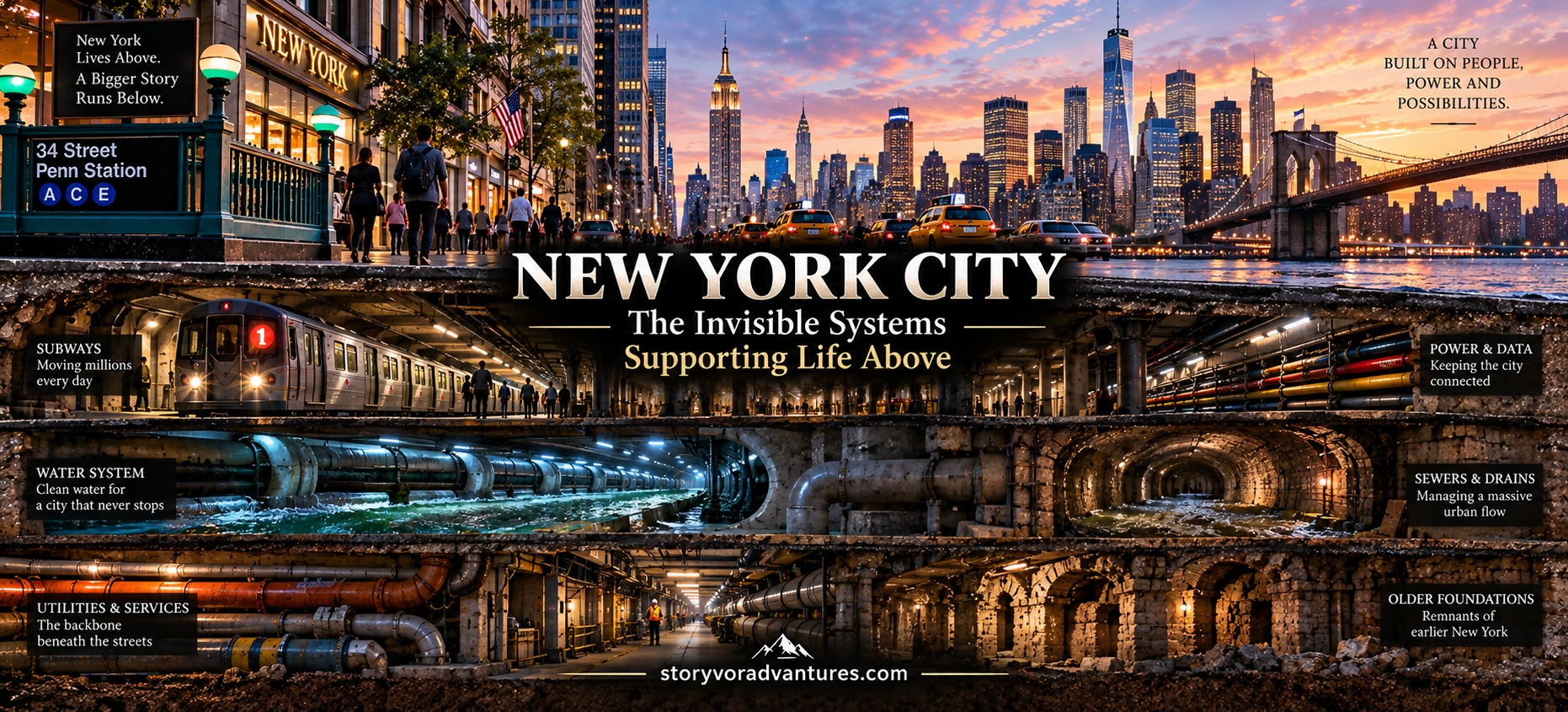
- New York demonstrates another side of the underground city: scale.
- Millions of residents and visitors move through a dense urban environment that depends on enormous systems they rarely notice. Subway tunnels are the obvious example, but below the streets are also water infrastructure, sewers, electrical and telecommunications systems, building basements and other service networks.
- The important story here is not that New York has a mysterious second Manhattan hidden underground. It does not.
- The fascinating reality is that a city of this density could not function efficiently if every essential network had to occupy valuable surface space.
- Modern cities increasingly separate functions vertically. People and vehicles dominate much of the visible surface, buildings rise into the sky, while transportation and utilities can occupy layers below.
- When you look at Manhattan’s skyline, therefore, you are seeing only half of the engineering story.
- Some of the infrastructure that allows those towers to operate is beneath the person looking up at them.
🇯🇵 7. Tokyo — The Underground City Designed for Everyday Life
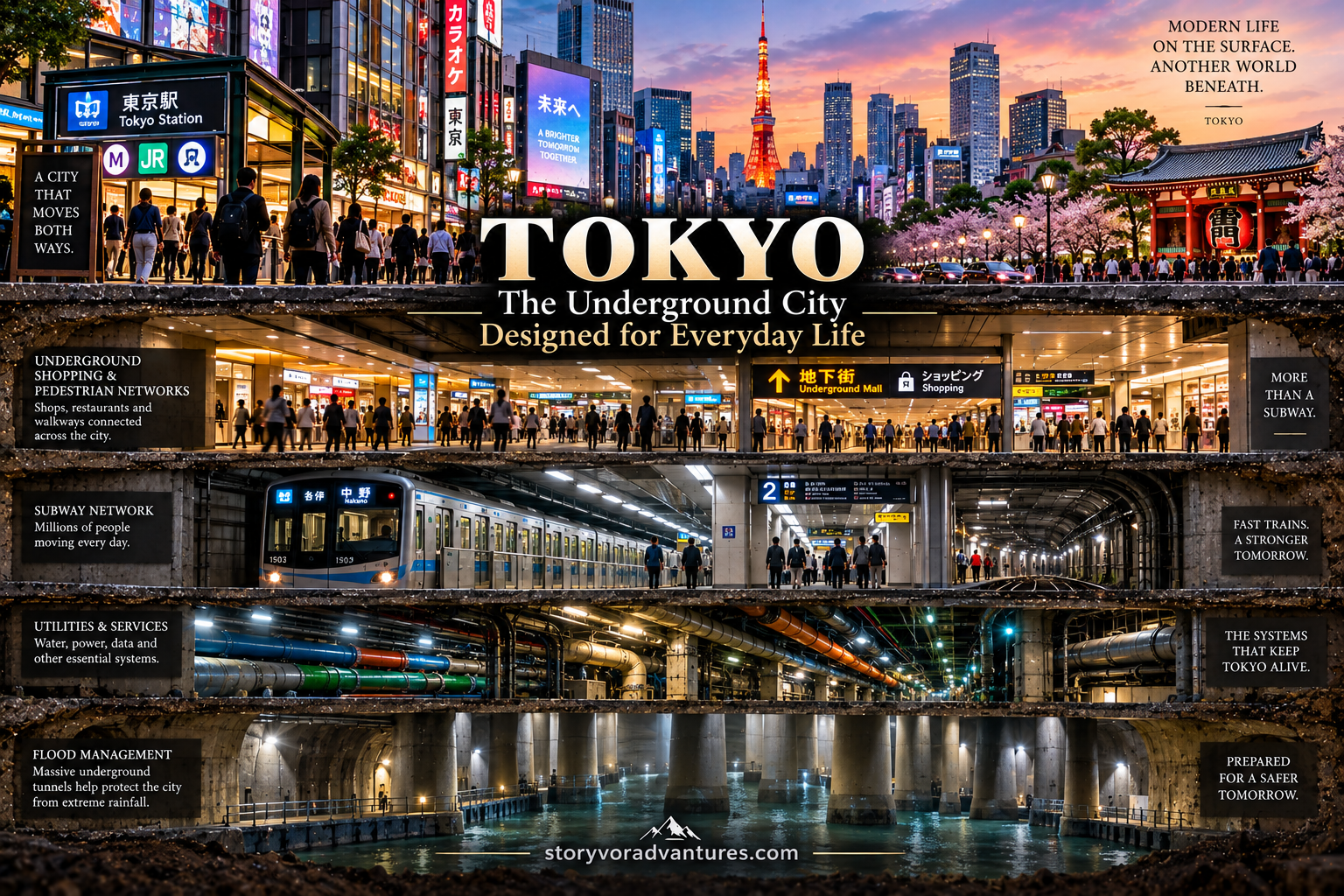
- Tokyo takes underground urban space in another direction.
- Around major railway stations, underground areas can function as extensions of the city rather than merely tunnels connecting one platform to another. Pedestrian passages can connect stations with shops, department stores, offices and surrounding buildings.
- A person may travel considerable distances through these connected spaces while spending surprisingly little time outside.
- There is also a less visible layer of engineering beneath the Tokyo metropolitan area. Greater Tokyo has major underground flood-management infrastructure designed to help manage extreme rainfall and reduce flood risk. Huge tunnels and chambers can temporarily redirect and store water that might otherwise threaten populated areas.
- This represents a major evolution in the idea of an underground city.
- Ancient underground engineering often helped supply cities with water. Modern underground engineering may be required to protect cities from too much of it.
- Different century. Different problem.
- Same solution: use the space beneath the city.
🇨🇦 8. Montreal — What Happens When Winter Pushes Part of City Life Indoors?

- Montreal shows that underground and enclosed networks do not always develop because of ancient history or secrecy.
- Sometimes climate helps make them useful.
- The city’s famous interconnected pedestrian network links transit stations, shopping areas, offices, hotels and other destinations across a large part of downtown. Portions are underground, while other connections are enclosed rather than literally beneath the surface.
- This distinction matters because it is often casually described as an “underground city,” creating the impression of an entirely separate metropolis below Montreal.
- The reality is more practical—and arguably more interesting.
- It is a connected system that allows people to move between important urban destinations while reducing exposure to difficult weather and busy surface streets.
- Rather than hiding the past, Montreal’s network demonstrates how cities can use multiple levels to make modern urban life more convenient.
🇦🇺 9. Sydney — Modern Streets Above a Much Older Human Landscape

- When discussing what lies beneath cities, archaeology should not begin only with famous European civilizations.
- Modern cities around the world occupy landscapes with human histories far older than their current skylines.
- Sydney, for example, developed on Country that had been lived in and cared for by Aboriginal peoples for thousands of years before British colonisation. Archaeological evidence discovered during construction and research can therefore reveal histories that existed long before today’s roads, towers and railway systems.
- This changes how we should think about the phrase “underground city.”
- Not everything beneath a modern street belongs to a forgotten city in the dramatic cinematic sense. Sometimes what lies below is subtler: tools, foundations, deposits, landscape evidence or other archaeological material capable of changing our understanding of who lived there and how the place was used.
- The ground beneath cities is therefore not merely empty space waiting for engineers.
- It can also be an archive.
🇲🇽 10. Mexico City — A Modern Metropolis Built Over an Older Capital
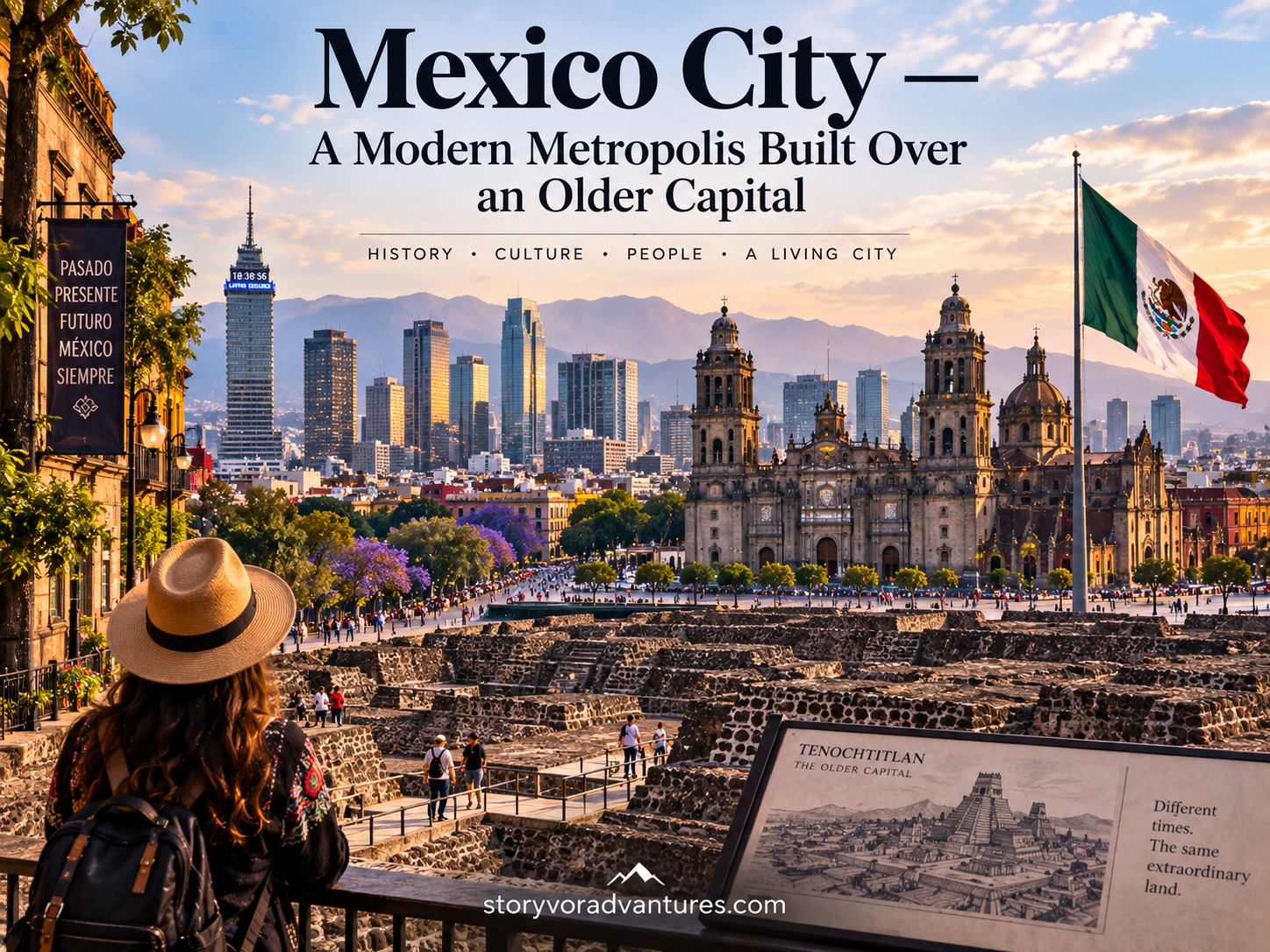
- Few cities demonstrate urban layering as dramatically as Mexico City.
- Before the Spanish colonial city developed, the Aztec capital of Tenochtitlan stood in the same broader area, built on islands within Lake Texcoco. Following conquest, colonial construction transformed the urban landscape, and later centuries added still more layers.
- Today, archaeological remains can exist remarkably close to modern streets and buildings. The Templo Mayor site near Mexico City’s historic centre makes this relationship especially visible: a major modern metropolis and the remains of an earlier capital occupy almost the same urban space.
- But Mexico City adds another fascinating complication.
- Much of the modern metropolis occupies former lakebed terrain. The soft ground and extensive groundwater extraction have contributed to serious land subsidence in parts of the city.
- Here, underground history and underground geology interact.
- The past beneath the streets is not only archaeological. The physical ground itself continues to influence the future of the city above.
🚇 The Subway Is Only the Beginning
- When people imagine underground cities, subway systems usually come to mind first because they are the underground spaces most urban residents regularly enter.
- But beneath a large city, many networks can overlap.
- Transportation tunnels may pass near sewers. Water pipes cross electrical infrastructure. Building foundations extend downward between older structures. Archaeological remains may lie beneath both. New engineering projects must somehow find space among systems installed decades—or centuries—earlier.
- This makes underground construction extraordinarily complicated.
- Engineers are not always digging through empty earth.
- They may be entering an already crowded landscape that simply happens to be invisible from the surface.
💧 Some of the Most Important Things Beneath a City Are Completely Ordinary
- Ancient chambers and abandoned tunnels receive attention because they look mysterious.
- A sewer rarely appears on a travel bucket list.
- Yet ordinary infrastructure may be far more important to everyday survival than spectacular ruins.
- Clean-water pipes, storm drains, sewage systems, electrical cables, telecommunications networks and transport tunnels allow enormous numbers of people to occupy relatively small urban areas.
- Remove those invisible systems and the impressive skyline above them quickly becomes much less useful.
- This creates an interesting paradox of modern cities.
- The systems we depend on most are often the systems designed to remain unseen.
🏗️ What Happens When Construction Workers Discover History?
- Building in an old city can produce a conflict between two different needs.
- The city needs to move forward. It may require a new railway, apartment building, road, sewer or commercial development.
- But excavation can reveal archaeological material that has survived precisely because nobody disturbed it for centuries.
- When important remains are discovered, archaeologists, engineers, developers and public authorities may need to determine how work should continue. Depending on local laws and the importance of a discovery, remains might be documented, excavated, preserved in place or incorporated into a project.
- This is one reason major infrastructure projects in historically rich cities can become complicated.
- Every metre downward has the possibility of becoming a metre backward in time.
🚪 Are There Really Secret Tunnels Under Cities?
- Yes—but the word “secret” needs to be treated carefully.
- Cities genuinely contain restricted tunnels, abandoned infrastructure, military-related spaces, service corridors and areas closed to the public. However, the internet often transforms an ordinary inaccessible tunnel into something much more dramatic.
- A locked door does not automatically hide a government mystery.
- Sometimes it hides electrical equipment.
- An abandoned railway tunnel does not necessarily contain a secret society.
- Sometimes the railway simply stopped using it.
- The real underground world is fascinating enough without inventing stories about it. In fact, understanding why a tunnel was actually constructed often reveals more about a city’s history than the legend attached to it.
🧱 Why Don’t Cities Simply Remove Everything Old?
- Removing underground structures can be expensive, dangerous and unnecessary.
- An old tunnel might lie beneath active buildings. Archaeological remains may have cultural importance. Large excavations can interfere with utilities, traffic and foundations. In other situations, sealing an obsolete structure may be easier than completely removing it.
- As a result, cities accumulate infrastructure.
- A new generation builds around what the previous generation left behind.
- Over hundreds of years, this creates an underground record of changing technology and changing priorities—water systems, transport routes, foundations, shelters and ruins all occupying different pieces of the same earth.
- Cities do not only expand outward and upward.
- They accumulate downward.
🤖 The Future Underground City May Be Very Different
- The next chapter beneath our streets may not look anything like the past.
- As urban populations grow and surface land becomes more valuable, cities continue exploring ways to use underground space for transport, utilities, pedestrian movement, flood protection and other infrastructure.
- At the same time, modern mapping and sensing technologies allow engineers to understand underground environments more accurately before construction begins. Digital models can increasingly represent pipes, tunnels, geological conditions and existing structures that people above ground never see.
- Future cities may therefore become even more vertically organized.
- The skyline will still attract the photographs.
- But some of the engineering that makes those skylines possible may increasingly disappear beneath our feet.
🌆 The Next Time You Walk Through a City, Look Down
- Imagine standing on an ordinary pavement.
- Above you may be offices, apartments and towers.
- Beside you are buses, bicycles, cafés and thousands of other people.
- But beneath you there could be a subway train carrying hundreds of passengers. Below that may be a sewer or water pipe. Nearby could be foundations belonging to a demolished building. Deeper still, depending on the city, there may be archaeological remains or geological layers that existed long before the first street was built.
- Suddenly the city stops looking flat.
- It becomes a three-dimensional timeline.
- The surface shows what the city is today.
- The ground beneath it preserves pieces of what the city needed, what it abandoned and sometimes what existed before the modern city had a name.
❤️ Final Thoughts — Every City Has More Than One Story

- We often understand cities by looking upward.
- We photograph skyscrapers. We admire monuments. We follow streets and watch skylines.
- But cities also have depth.
- Paris has old quarry networks beneath parts of its elegant streets. Rome contains layers of earlier urban life. Istanbul preserves monumental water infrastructure underground. London hides generations of transportation and service systems. Tokyo uses enormous underground engineering to support and protect modern life. Mexico City sits within a landscape where archaeology, geology and a modern megacity continuously interact.
- None of this means that every city hides a mysterious civilization beneath it.
- The reality is better than the myth.
- Under our feet is evidence of how human beings repeatedly solve problems, rebuild after change and adapt the same limited pieces of land for completely different generations.
- Perhaps the next time you walk through an old city, the most interesting direction to look will not be toward the skyline.
- It will be down.
❓ Frequently Asked Questions
Are there complete cities underneath modern cities?
In some places there are extensive underground complexes, historic streets, archaeological layers or connected infrastructure, but descriptions such as “an entire secret city” are often exaggerated. Underground environments differ enormously from one city to another.
Why does Rome have so much archaeology beneath modern buildings?
Rome has experienced thousands of years of continuous development. Buildings were demolished, reused, buried or incorporated into later construction while street and ground levels changed over time. This produced multiple archaeological layers beneath parts of the modern city.
Can tourists explore underground Paris?
A regulated portion of the Paris Catacombs is open to visitors. Much of the wider underground quarry network is not legally accessible to the general public and can be dangerous.
Are abandoned subway stations real?
Yes. Large transport networks can contain stations, platforms or sections that are no longer used for normal passenger service because routes and operational needs change over time.
Will future cities build more underground?
Underground construction is already important for transportation, utilities, pedestrian connections and flood management. In dense cities where surface land is limited, underground space is likely to remain an important part of infrastructure planning.
⚠️ Important Note
This article is intended for educational and general-interest purposes. Underground infrastructure, archaeological areas, tunnels and abandoned structures may be restricted, unstable or dangerous. Never enter closed tunnels, construction sites, abandoned infrastructure or restricted underground areas without legal authorization and appropriate professional guidance.
© 2026 storyvoradvantures